Resistance Training as Anti-Aging Medicine: The Science-Backed Fountain of Youth
Is resistance training the anti-aging pill? We break down cutting-edge research showing RT's impact on skin health, metabolic function, bone density, and cellular rejuvenation.
EXERCISEAGING
DR T S DIDWAL MD
4/27/202616 min read
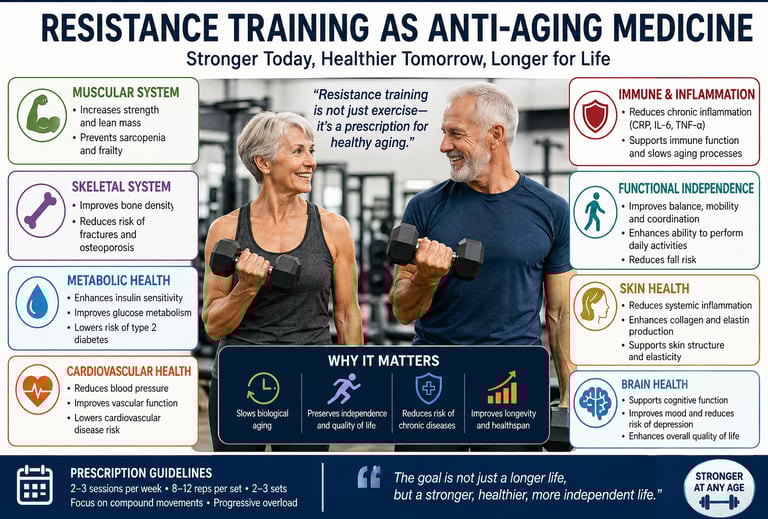
Resistance training is emerging as a cornerstone intervention in longevity science—not just for building muscle, but for preserving independence, reducing chronic inflammation, and improving metabolic and cellular health with aging.
Scientific evidence shows that regular strength training improves muscle mass, bone density, metabolic health, and systemic inflammation—key drivers of age-related decline.
At the cellular level, resistance exercise enhances antioxidant defenses (e.g., superoxide dismutase), reduces chronic inflammation (“inflammaging”), and stimulates beneficial muscle-derived signaling molecules called myokines. These adaptations help protect against chronic diseases such as type 2 diabetes, cardiovascular disease, and sarcopenia.
Beyond internal health, resistance training also improves physical function, balance, and independence, reducing fall risk and disability in older adults. Emerging research suggests it may even support skin structure by improving collagen-related pathways through systemic anti-inflammatory effects.
Key takeaway: Performing resistance training 2–3 times per week using progressive overload and functional movements can significantly improve both lifespan and healthspan, making it a cornerstone intervention in modern preventive and longevity medicine.
Clinician’s Perspective
Position resistance training as first-line therapy:
For aging patients, resistance training should be framed alongside pharmacotherapy as a core intervention for preventing sarcopenia, insulin resistance, and functional decline (Mcleod et al., 2019).Target “inflammaging” as a therapeutic endpoint:
Chronic low-grade inflammation underlies most age-related diseases. Resistance training reduces markers such as CRP, IL-6, and TNF-α through myokine-mediated pathways, offering a systemic anti-inflammatory effect (Nejatian Hoseinpour et al., 2025).Prescribe for metabolic disease prevention and reversal:
Regular resistance exercise improves insulin sensitivity, glucose uptake, and body composition, making it highly effective in prediabetes and type 2 diabetes management.Prioritize functional outcomes over aesthetics:
Focus on improvements in Activities of Daily Living (ADLs), fall prevention, gait stability, and independence rather than muscle hypertrophy alone (Kendall et al., 2025).Emphasize early initiation but reinforce late benefits:
While earlier adoption yields greater long-term benefits, clinically meaningful improvements occur even when initiated after age 60–70.Leverage short-term gains to improve adherence:
Inform patients that measurable improvements in strength and function can occur within 8–12 weeks, enhancing motivation and long-term compliance (Akkuş Uçar et al., 2025).Incorporate functional, multi-joint movements:
Exercises such as squats, hinges, pushes, pulls, and carries provide superior transfer to real-world function and neuromuscular coordination.Screen and individualize programs:
Assess cardiovascular risk, joint health, frailty status, and comorbidities before initiating. Tailor intensity (typically 60–80% 1RM) and progression accordingly.Highlight multi-system benefits:
Resistance training simultaneously improves musculoskeletal, metabolic, cardiovascular, and even integumentary health, including emerging evidence for skin structure improvements (Nishikori et al., 2023).Reframe exercise as medicine:
Communicate clearly: resistance training is not optional fitness—it is a dose-dependent, evidence-based intervention for healthy aging and longevity.
Aging is often framed as an unavoidable, one-way decline—wrinkling skin, weakening muscles, rising blood sugar, and a gradual loss of independence. But modern physiology tells a more nuanced story: while chronological aging is inevitable, biological aging is highly modifiable. Among all lifestyle interventions studied to date, resistance training has emerged as one of the most powerful tools to slow, and in some cases partially reverse, key drivers of age-related decline. Far from being just a fitness strategy, it functions as a multi-system therapeutic intervention influencing muscle, metabolism, inflammation, and even cellular defense mechanisms (Mcleod et al., 2019; Mi et al., 2023).
At the molecular level, resistance exercise activates skeletal muscle as an endocrine organ, releasing myokines that exert systemic anti-inflammatory effects and counter the chronic low-grade inflammation known as “inflammaging” (Nejatian Hoseinpour et al., 2025). Simultaneously, it enhances endogenous antioxidant systems—such as superoxide dismutase—helping neutralize oxidative stress, a central mechanism underlying cellular aging and chronic disease (Cordeiro et al., 2025). These adaptations are not theoretical; they translate into measurable clinical outcomes, including improved insulin sensitivity, reduced cardiovascular risk, and preservation of lean body mass—key determinants of longevity and healthspan.
Beyond internal physiology, resistance training directly impacts functional independence—the ability to perform everyday activities like climbing stairs, rising from a chair, or preventing a fall. Studies consistently show that even short-term programs (8–12 weeks) significantly improve strength, mobility, and quality of life in older adults (Kendall et al., 2025; Akkuş Uçar et al., 2025). Emerging evidence further suggests benefits extending to skin health, with improved dermal structure linked to reduced systemic inflammation (Nishikori et al., 2023).
In this context, resistance training is not merely exercise—it is increasingly recognized as a cornerstone intervention in preventive and longevity medicine.
The Antioxidant Revolution: Fighting Free Radicals From Within
One of the most exciting discoveries in anti-aging research involves how resistance training affects our body's natural defense systems. A groundbreaking systematic review and meta-analysis examined randomized controlled trials to understand how resistance exercise impacts endogenous antioxidants in older individuals (Cordeiro et al., 2025).
Here's what makes this research remarkable: our bodies naturally produce antioxidants—molecules that neutralize harmful free radicals responsible for oxidative stress and cellular damage. However, as we age, this natural antioxidant production typically declines, leaving us vulnerable to accelerated aging and disease.
Key findings from the Cordeiro study:
Resistance training significantly increased levels of superoxide dismutase (SOD), a crucial antioxidant enzyme that protects cells from oxidative damage
Training programs lasting 8-16 weeks showed measurable improvements in antioxidant capacity
The benefits occurred regardless of training intensity, suggesting that consistency matters more than how heavy you lift
Both men and women experienced similar antioxidant benefits
What does this mean for you? When you engage in regular resistance exercise, you're essentially activating your body's internal defense system. Think of it as upgrading your biological software to run more efficiently. The oxidative stress that typically accelerates aging, contributes to chronic disease, and damages DNA gets significantly reduced when your antioxidant systems are functioning optimally.
The practical implication is profound: you don't need expensive supplements or exotic superfoods to boost your antioxidant levels. A well-designed resistance training program naturally stimulates your body to produce these protective compounds.
Preserving Physical Function: The Independence Factor
Here's a sobering reality: loss of physical function is one of the most significant threats to independence in older adults. The ability to climb stairs, carry groceries, get up from a chair, or recover from a stumble—these everyday movements determine whether you maintain autonomy or require assistance.
Recent research specifically examined how resistance training preserves physical function in older community-dwelling adults (Kendall et al., 2025). This wasn't a study of elite athletes or super-fit seniors; these were regular people living in their communities, facing the typical challenges of aging.
Key takeaways from the Kendall research:
Resistance exercise significantly improved lower body strength, which directly impacts mobility and fall prevention
Upper body strength improvements translated to better ability to perform daily tasks like reaching overhead or carrying objects
Balance and coordination improved, reducing fall risk—a leading cause of injury and loss of independence in older adults
Functional capacity improvements occurred across various age groups, from young-old (65-74) to old-old (75+) participants
What's particularly encouraging about these findings is that the improvements weren't marginal—they were clinically significant. Participants gained enough strength and function to meaningfully impact their daily lives. The difference between being able to get up from a low chair unassisted versus needing help, or confidently navigating stairs versus avoiding them, fundamentally affects quality of life.
The research emphasizes that physical function preservation should be viewed as preventive medicine. Waiting until you've lost significant strength and mobility makes recovery more difficult. Starting resistance training while you're still functioning well helps you maintain that function for decades longer.
Functional Training: Supporting Independence and Quality of Life
Building on the theme of independence, recent work explored how functional training—a specific approach to resistance exercise that mimics real-world movements—supports both independence and quality of life in aging populations (Brogno, 2025).
Traditional weight training often isolates individual muscles, but functional resistance training focuses on compound movements that train multiple muscle groups simultaneously, just as they work together in daily life. Think squats (sitting and standing), rows (pulling), presses (pushing), and carries (transporting objects).
Critical insights from Brogno's research:
Functional resistance training improved activities of daily living (ADLs) more effectively than isolated exercises
Multi-joint movements trained the neuromuscular system more comprehensively, improving coordination and balance
Training programs that incorporated real-world movement patterns showed better transfer to actual daily tasks
Psychological benefits emerged alongside physical improvements, with participants reporting greater confidence in their physical capabilities
The psychological component deserves special attention. Aging often brings a fear of movement—a concern about getting hurt or being unable to perform tasks. When older adults regain strength and confidence through functional training, this fear diminishes. They become willing to try new activities, remain more socially engaged, and maintain a more active lifestyle overall.
This creates a positive feedback loop: resistance training builds physical capacity, which increases confidence, which leads to more physical activity, which further improves function. The opposite spiral—declining function leading to fear, leading to inactivity, leading to further decline—is the trajectory we want to avoid.
The Skin Connection: Beauty From the Inside Out
Now for something that might surprise you: resistance training doesn't just strengthen your muscles—it can actually rejuvenate your skin. Fascinating research published in Scientific Reports demonstrated how resistance exercise affects skin aging at the molecular level (Nishikori et al., 2023).
We typically think of skin aging as purely cosmetic, but skin health is actually an important marker of overall physiological aging. The same processes that cause wrinkles, thinning, and loss of elasticity reflect broader systemic aging mechanisms.
Groundbreaking findings from the Nishikori study:
16 weeks of resistance training reduced circulating inflammatory factors that contribute to skin degradation
The dermal extracellular matrix—the structural foundation that gives skin its firmness and elasticity—showed enhanced composition after training
Collagen and elastin production pathways were upregulated, essentially reversing some aspects of skin aging
These effects occurred through systemic mechanisms, meaning the skin benefited even though it wasn't directly exercised
The mechanism is elegant: resistance exercise reduces systemic inflammation (which we'll discuss more shortly), and this reduced inflammatory environment allows skin cells to function more optimally. The extracellular matrices in the dermis—essentially the scaffolding that supports skin structure—can repair and rebuild when inflammatory stress decreases.
This research suggests that the "glow" people often report after regular exercise isn't just increased circulation—it's actual structural improvements in skin composition. You're literally building better skin from the inside out.
Research Trends: What the Science Says
To understand where anti-aging and resistance training research is heading, a comprehensive bibliometric analysis using CiteSpace and VOSviewer mapped research hotspots and emerging trends (Mi et al., 2023).
What this analysis revealed:
Research on resistance training and aging has grown exponentially over the past two decades
Key research clusters focus on sarcopenia (age-related muscle loss), metabolic health, cognitive function, and chronic disease prevention
Emerging trends include molecular mechanisms of muscle adaptation, the role of resistance exercise in longevity pathways, and personalized training approaches
International collaboration has increased, with strong research networks spanning North America, Europe, and Asia
This bird's-eye view of the research landscape tells us several important things. First, resistance training as anti-aging medicine is no longer a fringe concept—it's a major focus of gerontological research worldwide. Second, the mechanisms underlying these benefits are becoming increasingly well understood at molecular and cellular levels. Third, future research will likely provide more personalized recommendations based on individual genetic profiles, health status, and aging trajectories.
For those of us interested in practical applications, this growing research base means recommendations will become increasingly refined and evidence-based. We're moving beyond "exercise is good for you" to understanding exactly how different training parameters affect specific aging processes.
Primary Countermeasure to Chronic Disease
Perhaps the most comprehensive framework for understanding resistance training as anti-aging medicine positions resistance exercise as a "primary countermeasure" to age-related chronic disease (Mcleod et al., 2019).
This isn't hyperbole. The research examined how resistance training affects the major chronic diseases that define modern aging: cardiovascular disease, type 2 diabetes, sarcopenia, osteoporosis, cognitive decline, and cancer.
Major findings from the Mcleod review:
Resistance training improved insulin sensitivity and glucose metabolism, directly addressing type 2 diabetes risk
Cardiovascular adaptations included improved blood pressure, lipid profiles, and vascular function
Bone mineral density increased, countering osteoporosis—particularly important for postmenopausal women
Muscle mass preservation and strength gains directly combat sarcopenia, maintaining metabolic rate and functional capacity
Emerging evidence suggests benefits for cognitive function and reduced cancer risk
What makes resistance exercise uniquely valuable is its multi-system impact. A single intervention—lifting weights 2-3 times per week—simultaneously addresses multiple disease pathways. Compare this to medications, which typically target one specific condition and often come with side effects requiring additional medications.
The review emphasizes that resistance training should be considered first-line therapy, not a complementary or alternative approach. For many age-related conditions, the evidence for resistance exercise is as strong or stronger than pharmacological interventions.
Short-Term Training, Long-Term Benefits
One common objection to starting an exercise program later in life is the perception that it takes months or years to see benefits. Research challenges this assumption, demonstrating that even short-term resistance training produces measurable improvements in functional and physiological markers (Akkuş Uçar et al., 2025).
The study focused on older women—a population particularly vulnerable to age-related strength loss and functional decline—and implemented a structured 8-week resistance training program.
Key outcomes from this short-term intervention:
Significant improvements in biomechanical markers including gait, balance, and movement efficiency
Enhanced cardiovascular function measured through aerobic capacity tests
Muscular strength gains averaging 15-25% across major muscle groups
Improved metabolic markers including fasting glucose and lipid profiles
Perhaps most importantly, participants reported subjective improvements in quality of life, daily task performance, and confidence in their physical abilities—all within just two months.
This research is encouraging because it demonstrates that you don't need to commit to years of training before experiencing meaningful benefits. Within weeks, your body begins adapting, your function improves, and the positive effects cascade across multiple systems. This quick feedback can be motivating and helps establish exercise as a sustainable habit.
Inflammation: The Silent Ager
If there's one biological process that underlies most age-related decline, it's chronic inflammation—often called "inflammaging." This low-grade, persistent inflammatory state damages tissues, impairs function, and accelerates disease progression.
A systematic review and meta-analysis specifically examined how resistance training influences inflammatory markers, body composition, and functional capacity in healthy older adults (Nejatian Hoseinpour et al., 2025).
Critical findings from this comprehensive analysis:
Resistance training significantly reduced C-reactive protein (CRP), a key marker of systemic inflammation
Interleukin-6 (IL-6) and tumor necrosis factor-alpha (TNF-α)—pro-inflammatory cytokines—decreased with regular training
Body composition improvements included increased lean mass and decreased fat mass, particularly visceral fat that produces inflammatory compounds
Functional capacity measures showed strong correlations with reduced inflammation—as inflammation decreased, function improved
The relationship between inflammation and aging cannot be overstated. Chronic inflammation contributes to cardiovascular disease, diabetes, Alzheimer's disease, arthritis, and cancer. It impairs wound healing, reduces immune function, and accelerates cellular aging.
What's remarkable is that resistance exercise addresses inflammation through multiple pathways: by reducing visceral fat (which secretes inflammatory molecules), by improving metabolic health (poor metabolism drives inflammation), and through direct anti-inflammatory signaling from contracting muscles.
Your muscles, when regularly trained, essentially function as an endocrine organ, secreting anti-inflammatory compounds called myokines. This is why resistance training has systemic effects far beyond the muscles being worked.
To Summarize : Effects of Resistance Training on Aging
Muscular System:
Increases strength and lean muscle mass → helps prevent sarcopeniaSkeletal System:
Improves bone mineral density → reduces risk of fractures and osteoporosisMetabolic System:
Enhances insulin sensitivity → lowers risk of type 2 diabetesCardiovascular System:
Reduces blood pressure and improves vascular function → decreases cardiovascular disease riskImmune System:
Lowers chronic inflammation (CRP, IL-6, TNF-α) → slows biological aging processesFunctional Capacity:
Improves balance, coordination, and mobility → preserves independence and daily functionSkin / Integumentary System:
Enhances extracellular matrix integrity and reduces inflammation → supports skin structure and elasticity
Based on the collective research, here's what an effective anti-aging resistance training program looks like:
Frequency: 2-3 sessions per week, with at least one day of rest between sessions targeting the same muscle groups.
Exercise Selection: Focus on compound, functional movements that train multiple muscle groups: squats, deadlifts or hip hinges, chest and shoulder presses, rows, and core exercises.
Intensity: Moderate to high intensity—weights should be challenging enough that the last 2-3 repetitions of each set require significant effort. Research suggests 60-80% of one-repetition maximum (1RM) is optimal for most adults.
Volume: 2-3 sets of 8-12 repetitions per exercise provides the best balance of strength, muscle growth, and metabolic benefits.
Progression: Gradually increase weight, repetitions, or sets every 2-4 weeks as your body adapts. Progressive overload is essential for continued benefits.
Safety Considerations: Work with a qualified fitness professional initially to learn proper form. Start conservatively and progress gradually. Listen to your body and distinguish between productive discomfort and pain signaling injury.
Frequently Asked Questions
Is resistance training anti-aging?
Yes. Resistance training is one of the most effective evidence-based strategies to slow aging by improving muscle mass, bone density, metabolic health, and reducing chronic inflammation. Studies show that training 2–3 times per week enhances strength, preserves physical function, and lowers the risk of age-related diseases such as diabetes, osteoporosis, and cardiovascular disease.
Is it safe to start resistance training if I've never done it before, even in my 60s or 70s?
Absolutely. The research consistently shows that older adults, even those with no previous training experience, can safely begin resistance exercise programs when properly supervised and progressively designed. In fact, older adults often show relative strength gains comparable to younger individuals. The key is starting conservatively with appropriate weights and focusing on proper form before adding intensity.
How long before I notice improvements?
Based on the research, particularly studies examining short-term interventions, you can expect to notice subjective improvements in daily function and energy within 3-4 weeks. Measurable strength gains typically appear within 6-8 weeks, while systemic changes like improved inflammatory markers and antioxidant capacity develop over 8-16 weeks of consistent training.
Can resistance training really help my skin look younger?
Research demonstrates that resistance training improves skin structure by reducing inflammation and enhancing the dermal extracellular matrix. While it won't eliminate wrinkles overnight, regular training creates an internal environment that supports better skin health and may slow visible signs of aging. Think of it as complementary to topical skincare, working from the inside out.
Do I need to go to a gym, or can I do this at home?
While gyms offer advantages like professional equipment and expert guidance, effective resistance training can absolutely be done at home. Resistance bands, dumbbells, kettlebells, or even bodyweight exercises can provide sufficient stimulus for anti-aging benefits. The key is progressive overload—consistently challenging your muscles to adapt.
What if I have arthritis or joint pain?
Resistance training is actually therapeutic for many forms of arthritis when properly designed. Stronger muscles better support and protect joints, potentially reducing pain. Water-based resistance exercise, machine-based training that controls movement paths, or working with a physical therapist can help you train safely despite joint issues.
Will resistance training make me bulky?
This is a common concern, especially among women, but it's largely unfounded. Building substantial muscle mass requires specific training protocols, nutrition strategies, and often years of dedicated effort. The resistance training protocols shown to produce anti-aging benefits will make you stronger and improve your body composition without dramatic size increases.
How does resistance training compare to aerobic exercise for anti-aging?
Both are valuable, and ideally, your exercise program includes both. However, resistance training offers unique benefits that aerobic exercise doesn't provide, particularly for preserving muscle mass, bone density, and strength—all critical for maintaining independence. The research suggests resistance exercise should be considered the foundation of an anti-aging exercise program, with aerobic activity as an important complement.
Clinical Pearls:
1. Primary Modulator of Systemic Inflammation (The Myokine Effect):
Pearl: RT should be prescribed as a primary intervention to combat "inflammaging."
Mechanism: Contracting muscle releases anti-inflammatory myokines that directly reduce pro-inflammatory markers (e.g., CRP, IL-6), acting as a powerful systemic anti-aging therapy.
2. Cellular Defense via Consistency Over Intensity:
Pearl: Emphasize consistency (2-3x/week) over maximal effort, especially for novices.
Mechanism: RT significantly upregulates endogenous antioxidant enzymes (like SOD) regardless of high training intensity, ensuring cellular protection against oxidative stress from the start (Cordeiro et al., 2025).
3. Proactive Preservation of ADL Function:
Pearl: Counsel patients to start RT early to preserve Activities of Daily Living (ADLs), viewing it as preventative medicine against functional decline.
Application: Prioritize functional, multi-joint movements (squats, carries) to maintain neuromuscular system health, mobility, and autonomy (Kendall et al., 2025).
4. Direct Structural Benefit to Dermal Health:
Pearl: Utilize the unexpected aesthetic benefit: RT enhances skin structure from the inside out.
Mechanism: Systemic inflammation reduction from RT positively impacts the dermal extracellular matrix, boosting collagen and elastin production pathways (Nishikori et al., 2023).
5. Short-Term Gains Build Critical Self-Efficacy:
Pearl: Highlight that measurable functional improvements occur in as little as 8-12 weeks to maintain adherence.
Impact: These quick gains enhance the patient's self-efficacy and confidence, reversing the negative psychological feedback loop of fear, inactivity and decline (Akkuş Uçar et al., 2025).
Author’s Note
As a clinician, I have long observed a disconnect between what medicine treats and what truly drives aging. We prescribe medications for diabetes, hypertension, osteoporosis, and frailty—often addressing each condition in isolation—yet the underlying biology is deeply interconnected. Loss of muscle mass, chronic inflammation, insulin resistance, and declining physical function are not separate problems; they are different expressions of the same aging process.
What continues to stand out—both in the clinic and in the scientific literature—is how consistently resistance training targets these root mechanisms. It is one of the few interventions that simultaneously improves metabolic health, preserves musculoskeletal integrity, enhances functional independence, and modulates inflammatory pathways. In many ways, it aligns more closely with the biology of aging than most pharmacological approaches.
This article is not meant to suggest that resistance training replaces medical therapy, but rather that it deserves equal priority in clinical conversations. Too often, exercise is presented as a general recommendation—important, but secondary. The evidence no longer supports that hierarchy. When appropriately prescribed and individualized, resistance training functions as a structured, measurable, and progressive therapeutic tool.
Equally important is the realization that it is never too late to begin. Some of the most meaningful improvements I have seen—in strength, mobility, and confidence—have occurred in individuals who started well into later life. These changes are not merely physical; they restore autonomy and reshape how patients experience aging itself.
If there is one message to carry forward, it is this: healthy aging is not passive—it is trainable
Disclaimer: This article is for informational purposes only and does not constitute medical advice. Individual circumstances vary, and treatment decisions should always be made in consultation with qualified healthcare professionals.
Related Articles
How Muscle Strength Correlates with Mortality Risk: Evidence from 7 Major Studies
Why Strength Training Reduces Inflammation and May Prevent Most Chronic Diseases
The Science of Healthy Brain Aging: Microglia, Metabolism & Cognitive Fitness | DR T S DIDWAL
The Aging Muscle Paradox: How Senescent Cells Cause Insulin Resistance and The Strategies to Reverse It | DR T S DIDWAL
VO2 Max & Longevity: The Ultimate Guide to Living Longer | DR T S DIDWAL
Blue Zones Secrets: The 4 Pillars of Longevity for a Longer, Healthier Lifepost | DR T S DIDWAL
References
Akkuş Uçar, M., Yılmaz, C., Soylu, H. H., Sarıakçalı, B., Budak, C., Kavuran, K., Durmuşoğlu, M. V., & Ceylan, L. (2025). Short-term resistance training enhances functional and physiological markers in older women: Implications for biomechanical and health interventions in aging. Frontiers in Public Health, 13, 1630525. https://doi.org/10.3389/fpubh.2025.1630525
Brogno, B. (2025). Aging with strength: Functional training to support independence and quality of life. INQUIRY: The Journal of Health Care Organization, Provision, and Financing, 62. https://doi.org/10.1177/00469580251348133
Cordeiro, L. S., Linhares, D. G., Castro, J. B. P., Oliveira Barros Dos Santos, A., Lima Dos Santos, L., César Pereira Salustiano Mallen da Silva, G., & Gomes de Souza Vale, R. (2025). Impacts of resistance training on endogenous antioxidants in older individuals: A systematic review and meta-analysis of randomized controlled trials. Journal of Physical Activity & Health, 22(4), 407–417. https://doi.org/10.1123/jpah.2024-0281
Kendall, H., Kipp, L. E., & Mettler, J. A. (2025). Resistance training preserves physical function in older community-dwelling adults. Translational Journal of the ACSM, 10(3), e000312. https://doi.org/10.1249/TJX.0000000000000312
Mcleod, J. C., Stokes, T., & Phillips, S. M. (2019). Resistance exercise training as a primary countermeasure to age-related chronic disease. Frontiers in Physiology, 10, 645. https://doi.org/10.3389/fphys.2019.00645
Mi, J., Zhang, L., Sun, W., Wang, Z., Yang, P., Zhang, J., & Zhang, Y. (2023). Research hotspots and new trends in the impact of resistance training on aging, bibliometric and visual analysis based on CiteSpace and VOSviewer. Frontiers in Public Health, 11, 1133972. https://doi.org/10.3389/fpubh.2023.1133972
Nejatian Hoseinpour, A., Bassami, M., Ahmadizad, S., Donath, L., Setayesh, S., Mirzaei, M., & Mohammad Rahimi, G. R. (2025). The influence of resistance training on inflammatory markers, body composition and functional capacity in healthy older adults: A systematic review and meta-analysis. Archives of Gerontology and Geriatrics, 130, 105731. https://doi.org/10.1016/j.archger.2024.105731
Nishikori, S., Yasuda, J., Murata, K., Takegaki, J., Harada, Y., Shirai, Y., & Fujita, S. (2023). Resistance training rejuvenates aging skin by reducing circulating inflammatory factors and enhancing dermal extracellular matrices. Scientific Reports, 13(1), 10214. https://doi.org/10.1038/s41598-023-37207-9