Obesity Isn’t Just Fat: How Muscle Quality Controls Fat Loss and Metabolism
Most weight loss fails because it ignores muscle quality. Learn how improving muscle function boosts metabolism, fat loss, and long-term health.
OBESITYEXERCISE
Dr. T.S. Didwal, M.D.(Internal Medicine)
6/24/202617 min read
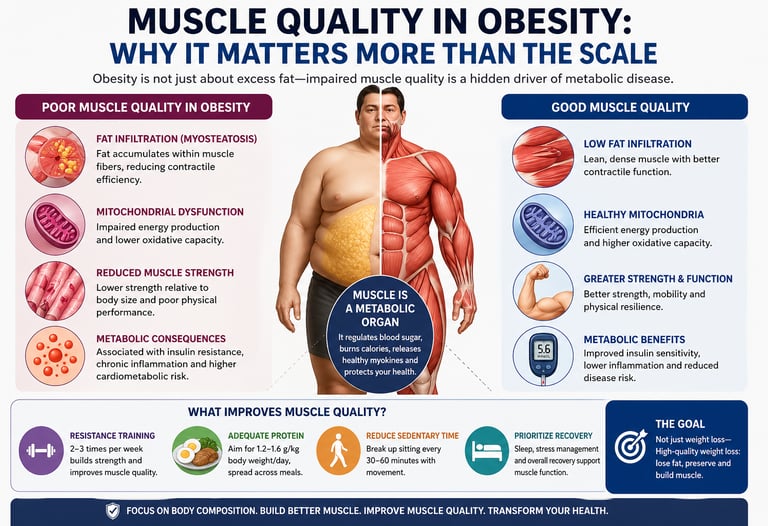
Obesity is not just a problem of excess fat—it is a disorder of impaired muscle quality.
Muscle quality refers to how well skeletal muscle functions, including its strength, metabolic activity, and resistance to fat infiltration. In obesity, reduced muscle quality (often due to Myosteatosis and mitochondrial dysfunction) leads to insulin resistance, lower energy expenditure, and increased cardiometabolic risk—even when muscle mass appears normal.
Improving muscle quality through resistance training, adequate protein intake, and reduced sedentary behaviour enhances glucose metabolism, supports sustainable fat loss, and improves long-term metabolic health. This is why modern obesity care is shifting from weight loss alone to muscle-centric metabolic health.
What is muscle quality in obesity?
Muscle quality in obesity is the functional health of skeletal muscle, including its strength, metabolic efficiency, and fat infiltration. Poor muscle quality is strongly linked to insulin resistance, inflammation, reduced fat burning, and a higher risk of chronic disease.
Why muscle quality matters more than weight in obesity:
Muscle is the primary site of glucose disposal, influencing insulin sensitivity
Poor muscle quality reduces metabolic rate and fat oxidation
Myosteatosis impairs muscle function even when mass is preserved
Weight loss without muscle preservation can worsen metabolic health
Resistance training + protein intake are first-line interventions
Muscle quality predicts long-term weight regain and functional decline
Clinician’s Perspective: Muscle Quality in Obesity
Shift from weight-centric to tissue-centric assessment:
Obesity should no longer be viewed purely as excess adiposity. Clinicians should recognise it as a disorder of impaired muscle–fat interaction, where reduced muscle quality (strength, mitochondrial function, fat infiltration) drives metabolic risk independent of BMI.Assess function, not just mass:
Normal or even elevated muscle mass in obesity can mask poor muscle quality. Incorporating simple tools such as handgrip strength, sit-to-stand tests, or gait speed can provide meaningful insight into functional muscle health beyond body composition metrics.Recognise myosteatosis as a metabolic risk marker:
Intramuscular fat accumulation (myosteatosis) is increasingly linked to insulin resistance, chronic inflammation, and reduced glucose disposal capacity, even in patients without severe obesity. This represents a key therapeutic target.Reframe weight loss goals toward “quality loss”:
Traditional caloric restriction often leads to disproportionate lean mass loss, further impairing muscle quality. Clinicians should emphasise fat loss while preserving or improving muscle through structured interventions.Prioritise resistance training as first-line therapy:
Resistance exercise is not optional—it is central to restoring muscle quality, improving neuromuscular efficiency, and enhancing mitochondrial function. It should be prescribed alongside, not after, dietary strategies.Optimise protein intake clinically:
Adequate protein (typically ~1.2–1.6 g/kg/day in weight management contexts) supports muscle protein synthesis and functional recovery, particularly during caloric deficit or pharmacotherapy.Integrate pharmacotherapy with muscle-preserving strategies:
With increasing use of anti-obesity agents (e.g., GLP-1 receptor agonists), clinicians must proactively address lean mass loss risk, ensuring concurrent exercise and nutritional support.Adopt a lifespan approach:
Poor muscle quality begins early and accelerates with ageing. Early intervention can prevent progression toward Sarcopenic Obesity, a high-risk phenotype associated with frailty and metabolic disease.
Clinical Bottom Line:
In obesity management, improving **muscle quality—not just reducing fat—is a primary therapeutic objective with direct implications for metabolic health, function, and long-term outcomes.
You can lose weight, see a lower number on the scale—and still become metabolically worse. That paradox sits at the heart of modern obesity science, and it points to a critical but often ignored factor: not just how much muscle you have, but how well that muscle functions.
Traditionally, obesity has been defined by excess fat mass. But emerging research is reframing it as a disorder of body composition and tissue quality, where impaired skeletal muscle plays a central role. Muscle is not merely a structural tissue—it is the body’s largest metabolic organ, responsible for the majority of insulin-mediated glucose uptake and a key regulator of energy balance (Hegazi & Halpern, 2025). When muscle quality declines—through fat infiltration (myosteatosis), mitochondrial dysfunction, and reduced contractile efficiency—its metabolic performance deteriorates, even if total muscle mass appears preserved.
This concept of poor muscle quality in obesity is gaining increasing attention. Individuals with obesity often exhibit reduced muscle strength relative to body size, impaired oxidative capacity, and altered muscle architecture—changes that are strongly linked to insulin resistance and cardiometabolic risk (Inostroza-Mondaca et al., 2025). In practical terms, this means two people with the same weight—or even the same muscle mass—can have vastly different metabolic health depending on the functional state of their muscle tissue.
The implications are profound. Weight loss strategies that ignore muscle quality may inadvertently worsen metabolic health by reducing lean tissue or failing to restore its function. In contrast, interventions that improve muscle quality—through resistance training, adequate protein intake, and metabolic conditioning—can enhance insulin sensitivity, increase energy expenditure, and fundamentally shift the trajectory of obesity (Barber et al., 2025; Harper et al., 2025).
The future of obesity management is no longer just about losing fat. It is about restoring muscle, to not just to a larger size, but a higher quality.
1. The Scale Lies: Why Body Composition Tells the Real Story
Let's begin with what might be the most important concept in this entire discussion: weight and health are not the same thing.
Hegazi and Halpern (2025), writing in Reviews in Endocrine and Metabolic Disorders, make this case with striking clarity. Their analysis highlights that clinical approaches to obesity have been disproportionately focused on fat mass — largely because fat is visible and measurable and because BMI (body mass index) has dominated obesity classification for decades. But BMI, they argue, tells us almost nothing about how much muscle a person has, how functional that muscle is, or what role that muscle plays in metabolic health.
Muscle mass, they note, performs vital metabolic functions that have nothing to do with aesthetics. Skeletal muscle is the body's primary site for glucose disposal — meaning it plays a central role in blood sugar regulation. It produces signalling molecules (myokines) that communicate with organs throughout the body, reducing inflammation and supporting immune function. It is a reservoir for amino acids that the body draws on during illness, injury, or physiological stress.
When a person lives with obesity, this fat-to-muscle relationship is frequently dysregulated in ways that standardised measurements like BMI cannot capture. A person can be classified as "overweight" while carrying very little metabolically active muscle, or conversely, they can carry higher body weight with a muscle mass distribution that is genuinely protective. Reducing body composition to a single number, the authors argue, risks missing the full picture — and potentially leading patients and clinicians toward the wrong interventions.
The takeaway for you: Don't just ask "how much do I weigh?" Ask "how much muscle do I have, and how healthy is it?"
2. Muscle Problems Begin in Childhood — And That Should Alarm Us
Perhaps the most urgent finding in this body of research concerns young people. Inostroza-Mondaca and colleagues (2025), publishing a landmark systematic review with meta-analysis in Scientific Reports, examined muscle strength, muscle morphology (structure), and oxidative capacity across normal-weight youth compared to their overweight and obese peers.
Their findings are sobering. Across multiple studies and diverse populations of children and adolescents, youth classified as overweight or obese consistently demonstrated reduced relative muscle strength — meaning their muscle strength was lower when adjusted for body size — as well as differences in muscle architecture and impaired oxidative capacity (the ability of muscle cells to use oxygen efficiently for energy).
This is not merely a physical performance issue. Reduced oxidative capacity in muscle is associated with insulin resistance, a hallmark precursor to type 2 diabetes. Impaired muscle strength in young people is linked to reduced physical activity engagement, lower cardiorespiratory fitness, and worse metabolic outcomes later in life. What happens in the muscles of a 12-year-old matters for what happens to the cardiovascular system of a 40-year-old.
The meta-analysis also raises important questions about the direction of causality. Does obesity cause the muscle deficits, or do muscle deficits — perhaps driven by sedentary behaviour and poor nutrition in early childhood — contribute to the development of obesity? The answer is likely both, creating a reinforcing cycle that, if left unaddressed, compounds over decades.
What this research makes clear is that muscle health interventions need to begin early. Addressing body composition in paediatric and adolescent populations — through structured physical activity, adequate dietary protein, and reduced sedentary time — is not a luxury. It is a public health imperative.
The takeaway for you: If you are a parent, school professional, or paediatrician, muscle health in children deserves as much attention as weight and BMI tracking.
3. What "High-Quality" Weight Loss Actually Means
We've all been told that weight loss is simple: eat less, move more, lose weight. But Harper, Dent, and McPherson (2025), writing in the prestigious journal Diabetes, challenge us to think more carefully about what kind of weight loss actually benefits health.
Their paper introduces and develops the concept of "high-quality weight loss" — a framework centred not just on reducing total body mass, but on preserving or building skeletal muscle while specifically targeting fat reduction. The distinction is crucial, and here's why.
When people lose weight through caloric restriction alone — particularly through very low-calorie diets without adequate protein or resistance exercise — they often lose a significant proportion of lean muscle mass alongside fat. This is sometimes described as "losing weight" but it is more accurately described as losing body composition indiscriminately. The metabolic consequences can be severe: reduced basal metabolic rate (meaning fewer calories burned at rest), greater risk of weight regain, worsened insulin sensitivity in the long term, and reduced physical function.
In contrast, weight loss strategies that prioritise skeletal muscle preservation or accretion — combining adequate dietary protein intake, structured resistance training, and appropriate caloric deficit — produce a fundamentally different metabolic outcome. Individuals lose more fat proportionally, maintain or improve insulin sensitivity, preserve physical function, and experience better long-term weight maintenance.
This has direct implications for how obesity should be clinically managed, especially in an era where pharmacological interventions like GLP-1 receptor agonists are increasingly prescribed. These medications can drive rapid weight loss, but unless combined with muscle-preserving nutrition and exercise strategies, that weight loss may include unacceptably high rates of muscle loss — a scenario with serious long-term consequences.
The takeaway for you: Not all weight loss is equal. A smaller number on the scale means very little if it comes at the cost of your muscle mass. Focus on fat loss and muscle preservation simultaneously.
4. Muscle as Medicine: A Strategic Asset for Obesity Management
Building on the concept of high-quality weight loss, Barber and colleagues (2025), publishing in Metabolites, present perhaps the most comprehensive framework to date for understanding skeletal muscle as a strategic lever in obesity management. Their paper, Optimised Skeletal Muscle Mass as a Key Strategy for Obesity Management, argues that maintaining and building muscle mass should be considered a cornerstone of every evidence-based obesity treatment plan — not an afterthought or supplementary concern.
Their argument rests on several interconnected mechanisms. First, skeletal muscle is the largest insulin-sensitive tissue in the human body. Greater muscle mass translates directly to greater capacity for glucose uptake and disposal, reducing circulating blood glucose and lowering the metabolic burden associated with insulin resistance. In practical terms, more muscle means a more responsive, efficient metabolic system.
Second, muscle tissue is metabolically expensive to maintain. Gram for gram, muscle burns more energy at rest than fat tissue. This means that individuals with higher proportions of lean muscle mass have a higher basal metabolic rate — their bodies burn more calories even when sedentary. This creates a meaningful metabolic advantage over time and makes long-term weight maintenance significantly easier.
Third, the authors emphasise the role of myokines — cytokine-like signalling proteins released by contracting muscle — in systemic metabolic regulation. Exercise-stimulated myokines such as irisin, IL-6, and BDNF exert anti-inflammatory effects, stimulate fat oxidation, support neurological health, and improve pancreatic beta-cell function. The act of contracting muscle, in other words, sends health-promoting signals throughout the entire body.
Barber et al. advocate for a nutritional strategy centred on optimised protein intake — particularly essential amino acids and leucine-rich protein sources — combined with resistance training and, where appropriate, targeted nutritional supplementation. They also highlight the importance of avoiding excessively restrictive dieting, which accelerates muscle catabolism.
The takeaway for you: Building and preserving muscle is not about vanity. It is one of the most powerful metabolic interventions available — and it's accessible to almost everyone.
5. The Future of Muscle Health: Where Science Is Heading Next
Looking ahead, Prado and colleagues (2026), writing an advance online publication in Clinical Nutrition, present a sweeping research agenda for the future of muscle health from a clinical nutrition perspective. Their collaboration, drawing on expertise across multiple specialties and institutions, identifies not only what we know but what we urgently need to learn.
Several priorities emerge from their work. First, there is a pressing need for standardised, accessible tools to assess muscle quantity and quality in clinical settings. Current gold-standard methods like DXA (dual-energy X-ray absorptiometry) and CT imaging are not available at most primary care points of contact. Developing validated, low-cost assessment tools — including bioelectrical impedance analysis improvements, ultrasound muscle imaging, and functional strength tests — is essential to bringing muscle health assessment into routine care.
Second, the authors emphasise the need for personalised, precision approaches to muscle health interventions. Not everyone responds identically to protein supplementation or resistance training. Genetic variation, hormonal status, age, baseline muscle quality, gut microbiome composition, and concurrent medications all influence individual responses. Future research must disentangle these variables to produce truly personalised recommendations.
Third, Prado et al. call for greater integration between clinical nutrition, exercise science, endocrinology, geriatrics, and oncology — recognising that muscle health is not a siloed concern but a cross-cutting determinant of health across all major chronic disease contexts.
The takeaway for you: Muscle health science is advancing rapidly. The recommendations you receive from healthcare providers about muscle and nutrition are likely to become significantly more personalised and precise in the years ahead. This is an exciting time to be proactive about your own muscle health journey.
Practical Applications: What You Can Do Starting Today
The research is clear, but research alone doesn't change lives — action does. Here are evidence-aligned practical steps grounded in the studies reviewed above.
Prioritise dietary protein at every meal. Aim for a protein-rich food source at breakfast, lunch, and dinner. Adults should target approximately 1.2–1.6 grams of protein per kilogram of body weight per day, particularly if managing overweight or engaging in an active weight loss phase. High-quality sources include eggs, Greek yoghurt, legumes, fish, lean poultry, tofu, and dairy.
Add resistance training to your weekly routine. Strength-based exercise — using weights, resistance bands, bodyweight movements, or gym equipment — is the most potent stimulus for muscle synthesis and preservation. Aim for at least two to three sessions per week targeting major muscle groups. Even modest resistance training produces meaningful metabolic benefits.
Reduce prolonged sitting. Prolonged sedentary behaviour suppresses muscle metabolic activity even in individuals who exercise regularly. Break up sitting time every 30–60 minutes with short bouts of standing, walking, or movement.
Support children's physical activity. Given what Inostroza-Mondaca et al. (2025) found in young people, building muscle-strengthening habits early — through sport, active play, gym class, and family movement — is a genuine investment in lifelong metabolic health.
Reframe weight loss goals. Rather than setting purely scale-based targets, consider tracking strength improvements, waist-to-height ratio, functional fitness markers (how many push-ups or squats you can perform), or energy levels. These measures reflect body composition quality more meaningfully than weight alone.
Work with your healthcare team. If you are managing obesity with pharmaceutical interventions, ask your clinician specifically about strategies to preserve muscle mass during weight loss. The evidence base for combined pharmacological and lifestyle approaches is growing, and muscle protection should be an explicit part of your plan.
Frequently Asked Questions (FAQs)
Does muscle quality matter more than weight in obesity?
Yes. Muscle quality directly determines insulin sensitivity, metabolic rate, and fat loss efficiency. Poor muscle function can lead to metabolic disease even at lower body weights.
Can you have normal muscle mass but poor muscle quality?
Yes. Conditions like Myosteatosis reduce muscle function despite normal size, leading to impaired metabolism and increased health risks.
How can muscle quality be improved?
Resistance training (2–3 times/week)
Protein intake (~1.2–1.6 g/kg/day)
Reducing sedentary time
Combining lifestyle changes with medical therapy when needed
Why do many weight loss programs fail long-term?
Because they focus on weight reduction without preserving muscle quality, leading to metabolic slowdown and increased risk of weight regain.
Can I have poor muscle health even if I'm not overweight?
Yes, absolutely. The condition often referred to as "normal-weight obesity" or "sarcopenic obesity" describes individuals who may appear to be a healthy weight by BMI but have a high proportion of body fat and low muscle mass. This combination carries significant metabolic risks, including insulin resistance and cardiovascular disease. Body composition matters more than body weight alone (Hegazi & Halpern, 2025).
How much protein do I actually need if I'm trying to lose weight and preserve muscle?
Most evidence suggests that protein needs during active weight loss are higher than standard dietary guidelines — typically in the range of 1.2 to 1.6 grams per kilogram of body weight per day, with some research supporting even higher intakes in older adults or those doing intensive exercise. Spreading protein evenly across meals, rather than concentrating it at dinner, appears to support muscle protein synthesis more effectively (Barber et al., 2025; Harper et al., 2025).
Are GLP-1 medications (like Ozempic or Wegovy) bad for muscle health?
GLP-1 receptor agonists can produce rapid and significant weight loss, but early evidence suggests they may lead to disproportionate lean mass loss alongside fat loss if not combined with adequate protein intake and resistance exercise. This is an active area of research. If you are taking these medications, proactively discussing muscle-protective nutrition and exercise strategies with your healthcare provider is highly advisable (Harper et al., 2025).
Is it too late to build muscle if I'm older or already have obesity?
No — it is not too late. While muscle-building responses may be somewhat attenuated with age, resistance training and adequate protein intake produce meaningful gains in muscle mass and strength across all age groups, including older adults and individuals with obesity. The benefits of muscle-focused interventions are not age-limited. Starting at any point is beneficial (Barber et al., 2025; Prado et al., 2026).
My child is overweight — should I be worried about their muscles too?
Yes, and this is an important and often overlooked dimension of paediatric health. Research shows that children and adolescents with overweight or obesity tend to have lower relative muscle strength and impaired muscle oxidative capacity compared to normal-weight peers. These deficits are associated with worse metabolic outcomes over time. Prioritising enjoyable physical activity — particularly activities involving muscle-strengthening movements — and ensuring adequate protein intake are practical, evidence-backed priorities for young people (Inostroza-Mondaca et al., 2025).
What is the best type of exercise for muscle health?
Resistance training (also called strength or weight training) is the most direct and effective stimulus for muscle growth and preservation. This includes free weights, machines, resistance bands, and bodyweight exercises like squats, lunges, and push-ups. Combining resistance training with regular aerobic activity (walking, cycling, swimming) provides the most comprehensive metabolic benefit. The key is consistency over time — moderate, regular effort outperforms sporadic intense effort every time (Barber et al., 2025).
How will my doctor assess my muscle health?
Currently, muscle health assessment in routine clinical practice is limited by access to equipment. DEXA scanning and CT imaging are gold standards but not universally available. Hand grip strength testing, gait speed assessment, and calf circumference are practical, low-cost proxies used in research and some clinical settings. Bioelectrical impedance analysis (BIA) scales are widely available and provide a reasonable estimate of lean mass. The field is actively working on more accessible clinical tools (Prado et al., 2026).
Clinical pearls
1. The "Metabolic Sink" Principle
Scientific Perspective: Skeletal muscle accounts for approximately 70–80% of insulin-mediated glucose uptake. By increasing muscle mass, you increase the surface area of GLUT4 transporters, directly improving glycemic control and reducing the workload on the pancreas.
hink of your muscles as a "sugar sponge." The more muscle you have, the more "room" your body has to store the carbohydrates you eat. Instead of sugar floating in your blood and causing damage, your muscles soak it up to use as fuel.
2. Quality Over Quantity in Weight Loss
Scientific Perspective: Rapid weight loss without resistance training can result in up to 25–40% of that weight coming from lean body mass. This induces "adaptive thermogenesis," where the basal metabolic rate (BMR) drops disproportionately, fueling the "yo-yo" effect of weight regain.
If you lose 10 pounds by starving yourself, 3 of those pounds might be the muscle that helps you burn fat. You end up a "smaller but slower" version of yourself. To keep the weight off for good, you have to "protect the engine" (your muscle) while you "burn the extra fuel" (the fat).
3. The "Anabolic Window" of Aging
Scientific Perspective: Aging is associated with "anabolic resistance," where the body becomes less efficient at turning dietary protein into muscle tissue. To overcome this, older adults require a higher leucine threshold (~2.5–3g of leucine per meal) to trigger Muscle Protein Synthesis (MPS).
As we get older, our muscles become a bit "hard of hearing" when it comes to protein. To get them to listen and grow, you have to speak louder. This means eating a larger, high-quality serving of protein (like a chicken breast or a cup of Greek yogurt) at every meal rather than just snacking throughout the day.
4. Muscle as an Endocrine Organ (Myokines)
Scientific Perspective: Muscle is not just for movement; it is an active endocrine organ. During contraction, it secretes myokines (e.g., Irisin, IL-6) that exert anti-inflammatory effects, improve brain health (via BDNF), and encourage "browning" of white adipose tissue.
Every time you lift weights or squeeze your muscles, you are releasing a "natural pharmacy" into your bloodstream. These internal medicines help fight inflammation, boost your mood, and even help your fat cells burn more energy.
5. The "Relative Strength" Metric for Youth
Scientific Perspective: In pediatric obesity, absolute strength may appear normal, but relative strength (strength-to-mass ratio) is often severely impaired. This deficit predicts future cardiovascular risk and insulin resistance more accurately than BMI alone.
It doesn’t matter how "strong" a child seems; what matters is how well they can move their own body. If a child struggles to lift their own weight or play actively, it’s a sign their muscles aren't keeping up with their growth. Focusing on "play-based strength" (climbing, jumping) is better than focusing on the scale.
6. The Protein-Pacing Strategy
Scientific Perspective: Muscle protein synthesis is a transient process that peaks and returns to baseline. To maximise 24-hour muscle accrual, protein should be distributed evenly (e.g., 30g+ per meal) rather than skewed (e.g., 10g at breakfast, 80g at dinner).
Your body can’t "store" protein for later like it stores fat. If you eat all your protein at dinner, your muscles miss out on the rest of the day. To keep your muscles strong, spread your protein out—make sure breakfast and lunch have just as much "muscle-building power" as your evening meal.
Author’s Note
As a clinician working at the intersection of metabolic disease, nutrition, and functional health, I have increasingly found that the traditional, weight-centric model of obesity fails to capture what truly determines patient outcomes. Over the years, it has become clear—both from emerging scientific literature and from clinical practice—that muscle quality is not a secondary variable, but a central driver of metabolic health.
Many patients I see have successfully lost weight, yet continue to struggle with fatigue, poor glycaemic control, or rapid weight regain. When we look deeper, the issue is often not residual fat alone, but compromised muscle function—characterised by reduced strength, impaired mitochondrial efficiency, and, in many cases, underlying myosteatosis. These insights have reshaped how I approach obesity management: not simply as a process of reducing body weight, but as a strategy to restore metabolic resilience through muscle.
This article was written to bridge a critical gap between evolving science and real-world application. The goal is to move beyond oversimplified advice and instead offer a more biologically grounded, clinically relevant perspective—one that empowers both patients and healthcare professionals to rethink priorities.
Clinical Insight
From a clinical perspective, obesity should be reframed as a condition of muscle–fat dysfunction rather than excess fat alone. Patients with poor muscle quality often present with insulin resistance, reduced physical capacity, and a higher risk of progression toward Sarcopenic Obesity.
Assessment should prioritise functional measures (strength, mobility) alongside body composition, and treatment strategies must integrate resistance training, adequate protein intake, and careful use of pharmacotherapy to preserve lean mass.
This article is intended for educational purposes only and does not constitute medical advice. Always consult a qualified healthcare provider before beginning a new exercise or nutrition program, especially if you have an existing medical condition.
Related Articles
Body Roundness Index vs. BMI: Which Better Predicts Diabetes and Heart Disease
Midlife Weight Loss: Can Just 5-10% Really Add Years to Your Life?
GLP-1 Muscle Loss: You’re Losing Weight—But Are You Losing Strength Too?
Can Healthy Mitochondria Protect Against Sarcopenia and Age-Related Decline? | DR T S DIDWAL
Stopping GLP-1: Will the Weight Come Back? | DR T S DIDWAL
Sarcopenic Obesity: How to Lose Fat Safely Without Losing Muscle | DR T S DIDWAL
How to Prevent and Reverse Muscle Wasting in Chronic Disease (2025 Guide) | DR T S DIDWAL
References
Barber, T. M., Kabisch, S., Pfeiffer, A. F. H., & Weickert, M. O. (2025). Optimised skeletal muscle mass as a key strategy for obesity management. Metabolites, 15(2), 85. https://doi.org/10.3390/metabo15020085
Harper, M. E., Dent, R. R. M., & McPherson, R. (2025). High-quality weight loss in obesity: Importance of skeletal muscle. Diabetes, 74(12), 2191–2198. https://doi.org/10.2337/dbi25-0003
Hegazi, R., & Halpern, B. (2025). Looking beyond fat in obesity: The frequently overlooked importance of muscle mass. Reviews in Endocrine and Metabolic Disorders, 26, 719–721. https://doi.org/10.1007/s11154-025-09986-1
Inostroza-Mondaca, M., Valdés, O., Ramirez-Campillo, R., et al. (2025). Muscle strength, muscle morphology, and oxidative capacity in normal weight versus overweight and obese youth: A systematic review with meta-analysis. Scientific Reports, 15, 36108. https://doi.org/10.1038/s41598-025-24024-5
Prado, C. M., Gonzalez, M. C., Cruz-Jentoft, A. J., Heymsfield, S. B., Daly, R. M., Landi, F., & collaborators. (2026). Shaping the future of muscle health: A clinical nutrition perspective and research agenda. Clinical Nutrition. Advance online publication. https://doi.org/10.1016/j.clnu.2026.106652