Mediterranean Diet Benefits (2026): The Science-Backed Way to Live Longer, Protect Your Heart & Brain
Discover how the Mediterranean diet lowers heart risk by 30%, improves brain health, and supports longevity. Evidence-based 2026 guide + meal plan.
NUTRITION
Dr. T.S. Didwal, M.D.(Internal Medicine)
5/6/202613 min read
The Mediterranean diet is a scientifically validated dietary pattern associated with lower cardiovascular risk, reduced mortality, improved metabolic health, and better brain function. It emphasises plant-based foods, olive oil, fish, and whole grains, with minimal ultra-processed foods.
Key Health Benefits
↓ Cardiovascular disease risk (~30%)
↓ All-cause mortality (~15–20%)
↓ Risk of cognitive decline and dementia
↑ Insulin sensitivity and metabolic flexibility
↓ Chronic inflammation (“inflammaging”)
These benefits arise from a multi-pathway effect involving:
Anti-inflammatory polyphenols (olive oil, fruits)
Omega-3 fatty acids (fish)
Dietary fibre and gut microbiome modulation (legumes, whole grains)
What to Eat (Core Components)
Daily:
Vegetables, fruits, legumes, whole grains
Extra virgin olive oil (primary fat)
Nuts, seeds, herbs, water
Weekly:
Fish (≥2 servings), poultry, eggs, yoghurt
Limit:
Red meat, processed foods, added sugars
Why It Works (Scientific Mechanisms)
The Mediterranean diet acts as a “metabolic therapy” by:
Reducing systemic inflammation (↓ IL-6, TNF-α)
Improving lipid profile (↑ HDL, ↓ LDL oxidation)
Enhancing insulin sensitivity
Supporting gut–brain axis and microbiome diversity
Protecting neurons via antioxidant and vascular pathways
Brain Health & Aging
Associated with lower dementia risk and slower cognitive decline
Supports neuronal integrity and hippocampal function
Nutrients like omega-3s, polyphenols, and folate play key roles
Evidence includes cohort studies, RCTs, and >5,000 publications on diet–brain interactions.
Mediterranean Diet + Exercise = Maximum Benefit
Combining the diet with moderate physical activity (≈150 min/week) leads to:
Greater reductions in blood pressure and glucose
Improved body composition
Enhanced cardiovascular outcomes
How to Start (Evidence-Based Steps)
Replace butter with olive oil
Add 1–2 extra servings of vegetables daily
Eat fish twice weekly
Include legumes 3–4× per week
Switch to whole grains
Snack on nuts and fruit instead of processed foods
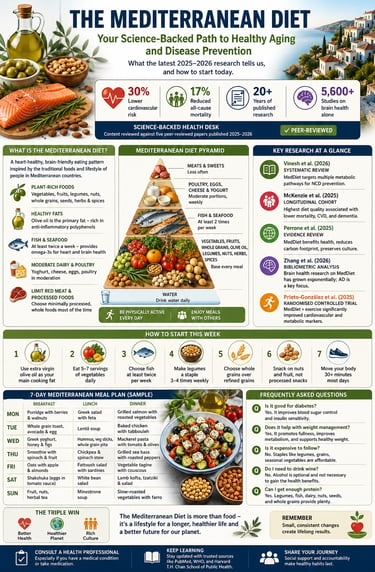
From cardiovascular protection to brain health — what the latest 2025–2026 research tells us, and how to start today.
The Mediterranean diet (MedDiet): A flexible, plant-forward eating pattern (veggies, fruits, whole grains, legumes, nuts, olive oil as main fat, fish/seafood 2x/week, moderate dairy/poultry, minimal red meat/processed foods). Not restrictive — focuses on abundance and flavor.
Health Benefits (backed by recent studies):
Metabolic/Healthy Aging: Multi-target effects on inflammation, insulin sensitivity, lipids, gut health, and cellular aging (Vinesh et al. 2026 review).
Mortality/CVD/Dementia: Higher adherence linked to lower all-cause mortality, CVD events, and dementia risk in a large women's cohort (McKenzie et al. 2025). Dose-response: better diet = better outcomes.
Brain Health: Strong research growth; supports via anti-inflammation, omega-3s, polyphenols, gut-brain axis (Zhang et al. 2026 bibliometric).
Synergy with Exercise: Combo outperforms either alone for cardiometabolic markers (Prieto-González et al. 2025 RCT).
Broader Wins: 30–40% lower carbon footprint; cultural/sustainable model (Perrone et al. 2025).
How to Start: Swap fats to EVOO, add veggies/legumes/fish/nuts, choose whole grains, move daily. Use the provided meal ideas flexibly.
What makes this dietary pattern unique — and what has attracted so much scientific attention — is that it is not characterised by what it excludes, but by what it includes. Richness, variety, colour, and flavour are fundamental to the Mediterranean table. Key components include
Extra Virgin Olive Oil
The cornerstone fat — rich in oleocanthal and polyphenols with potent anti-inflammatory effects.
Fatty Fish
Salmon, sardines, and mackerel deliver omega-3s that protect heart rhythm and brain function.
Legumes
Lentils, chickpeas, and beans provide fibre, plant protein, and resistant starch for gut health.
Colourful Vegetables
At least 3–4 servings daily. These supply antioxidants, phytonutrients, and micronutrients.
Whole Grains
Farro, barley, whole wheat, and oats for sustained energy and cardiovascular protection
Fresh Fruit
Seasonal and varied — providing vitamin C, flavonoids, and natural prebiotics.
The Mediterranean Diet Pyramid at a Glance
Daily: The Foundation
Vegetables & Fruits: High in fiber and antioxidants to reduce inflammation.
Whole Grains: Such as oats, brown rice, and whole-wheat bread for sustained energy.
Healthy Fats: Primarily extra-virgin olive oil as the main source of added fat.
Plant Proteins: Legumes (beans, lentils, chickpeas) and raw, unsalted nuts.
Aromatics: Herbs and spices to flavor food while reducing the need for salt.
Hydration: Water as the primary beverage.
Weekly: Lean Proteins & Dairy
Fish & Seafood: At least 2 times per week (rich in Omega-3 fatty acids).
Poultry & Eggs: Eaten in moderate portions (roughly 2–4 times per week).
Dairy: Fermented options like Greek yogurt and moderate amounts of cheese for gut health and calcium.
Monthly/Limit: Occasional Consumption
Red Meat: Kept to a minimum, primarily for flavor or special occasions.
Sweets: Desserts are rare and usually fruit-based.
Processed Foods: Highly refined oils, sausages, and pre-packaged meals are strictly limited to maintain heart health.
A Metabolic Strategy for Healthy Aging
In a landmark 2026 review published in The Journal of Nutritional Physiology, Vinesh et al. examined the Mediterranean diet as a comprehensive metabolic strategy for preventing non-communicable diseases (NCDs) — the group of conditions including cardiovascular disease, type 2 diabetes, certain cancers, and chronic respiratory disease that together account for the majority of global deaths.
The authors highlight how the synergistic combination of nutrients in the MedDiet — monounsaturated fats, dietary fibre, polyphenols, and omega-3 fatty acids — works through multiple metabolic pathways simultaneously. Unlike a single-nutrient supplement approach, the diet targets inflammation, oxidative stress, blood glucose regulation, lipid profiles, and gut microbiome health all at once.
Key insight from Vinesh et al. (2026): The Mediterranean diet acts as a multi-target metabolic intervention, simultaneously improving insulin sensitivity, reducing systemic inflammation, and optimising lipid metabolism — effects that no single drug or supplement can replicate.
For aging individuals, this is particularly meaningful. As we age, our metabolic flexibility — the body's ability to switch efficiently between fuel sources — naturally declines. The MedDiet appears to counteract several hallmarks of metabolic aging, including increased visceral adiposity (deep abdominal fat), impaired glucose tolerance, elevated chronic inflammation (sometimes called "inflammaging"), and declining mitochondrial function.
The evidence points to olive oil's oleocanthal content as a natural COX-inhibitor, legumes as key drivers of improved gut microbiota diversity, and the polyphenols in berries and red grapes as activators of sirtuins — proteins linked to cellular longevity. Together, these create a biochemical environment that genuinely supports healthy aging at the cellular level.
Australian Longitudinal Study on Women’s Health (ALSWH)
The McKenzie et al. (2025) study provides a powerful long-term perspective on how dietary patterns influence the trajectory of aging.
Here is a more detailed breakdown of the study's findings and implications:
1. The Population and Methodology
The Cohort: The study utilized data from a large-scale, multi-decade tracking of Australian women. This allowed researchers to see the cumulative effects of diet over 20+ years rather than just a short-term snapshot.
The Metric: Researchers used a Diet Quality Index (DQI) specifically modeled after Mediterranean principles (high plant intake, healthy fats, low processed sugars).
2. Key Finding: The "Protective Threshold"
The study found a dose-response relationship between diet and health outcomes. Women in the highest third of diet quality experienced:
Lower All-Cause Mortality: A significantly higher probability of reaching advanced age compared to those with low DQI scores.
Cardiovascular Resilience: A marked reduction in the incidence of stroke and ischemic heart disease, likely due to the anti-inflammatory nature of the diet.
3. The Cognitive Connection (Dementia Prevention)
One of the most significant aspects of the McKenzie study was the link to Cognitive Health:
Delayed Onset: Higher adherence to Mediterranean-style eating was associated with a lower risk of developing dementia and age-related cognitive decline.
Neuroprotection: The study suggests that the high intake of polyphenols (from fruits/veg) and monounsaturated fats (from olive oil) protects the brain's vascular system, preventing "silent" micro-strokes that contribute to cognitive loss.
4. Impact on "Healthspan" vs. "Lifespan"
The research emphasized that the MedDiet didn't just help women live longer; it helped them live better.
Functional Independence: Those with high DQI scores maintained better physical mobility and reported higher "quality of life" scores in their later years.
Comorbidity Reduction: The diet helped suppress the development of multiple chronic conditions simultaneously (e.g., managing blood pressure while also maintaining insulin sensitivity).
5. Clinical Takeaway
For healthcare providers, the McKenzie et al. study serves as "gold-standard" evidence that mid-life dietary habits are the primary predictors of late-life brain health. It reinforces the idea that it is never too late to start, but the cumulative benefits of the Mediterranean Diet are most profound when maintained as a long-term lifestyle.
A Model of Sustainability: Health, Environment, and Culture
Perrone et al. (2025) analysis in the International Journal of Environmental Research and Public Health positioned the Mediterranean diet as far more than a health intervention. Their work frames it as a model of sustainability — one that simultaneously addresses personal health, environmental stewardship, and the preservation of cultural heritage.
From an environmental standpoint, the Mediterranean diet has a substantially lower carbon footprint than typical Western diets. By centring plant foods, legumes, fish, and olive oil rather than red meat and ultra-processed products, adherents consume roughly 30 to 40 per cent fewer greenhouse gas emissions per kilogram of food. The plant-forward nature of the diet also demands less land and water than meat-heavy alternatives.
From a cultural perspective, the Mediterranean diet was inscribed on UNESCO's Intangible Cultural Heritage of Humanity list in 2013, not simply as a collection of foods, but as a "set of skills, knowledge, rituals, symbols and traditions" related to cultivation, harvesting, fishing, conservation, processing, cooking, and sharing. The communal eating practices embedded in Mediterranean culture — sharing meals, taking time to eat slowly, valuing seasonal and local produce — may themselves contribute to wellbeing independently of the food content.
Choosing a Mediterranean-style diet is simultaneously an act of self-care, environmental responsibility, and cultural participation. It is, as Perrone et al. describe, "a gift to future generations as much as to ourselves."
For patients concerned about both personal health and the health of the planet, this triple benefit is genuinely motivating. The diet is not a sacrifice — it is an upgrade in the quality and meaning of how we eat.
The Mediterranean Diet and Brain Health: Two Decades of Evidence
Brain health has emerged as one of the most active research frontiers in Mediterranean diet science. A comprehensive bibliometric analysis published in Frontiers in Nutrition by Zhang et al.(2026) mapped the entire trajectory of Mediterranean diet and brain health research from 2005 to 2025, analysing over 5,600 publications to identify hotspots, trends, and emerging directions.
Their findings reveal exponential growth in this research field, with a particularly intense focus on three areas: Alzheimer's disease and dementia prevention, cognitive decline in older adults, and depression and mental health outcomes. The most cited research clusters around the mechanisms by which the diet may protect neural tissue — specifically through reducing neuroinflammation, improving cerebrovascular function, supporting healthy gut-brain axis signalling, and preserving hippocampal volume (the brain region most vulnerable to early Alzheimer's pathology).
Omega-3 fatty acids from fish, particularly EPA and DHA, have demonstrated direct neuroprotective effects by maintaining neuronal membrane fluidity and reducing amyloid plaque aggregation — one of the hallmarks of Alzheimer's disease. Polyphenols from extra virgin olive oil, berries, and green leafy vegetables cross the blood-brain barrier and activate antioxidant pathways that protect neurons from oxidative damage. Folate from legumes and dark greens supports homocysteine metabolism — elevated homocysteine being an established risk factor for cognitive decline.
In plain language: Every olive, every sardine, every bowl of lentil soup that replaces a processed food option is a small investment in the health of your brain — and the evidence from more than two decades of research suggests these investments compound over time, much like financial savings.
The bibliometric analysis by Zhang et al. also identifies emerging research interest in the interaction between the Mediterranean diet and the gut microbiome in relation to brain health — a rapidly evolving field sometimes called the "gut-brain axis." The diverse fibre content of the MedDiet supports a rich and varied microbiome, which in turn influences neurotransmitter production, immune regulation, and even mood.
Combining Mediterranean Diet with Exercise: A Powerful Duo
While diet quality alone yields substantial health benefits, a randomised controlled trial published in Frontiers in Nutrition by Prieto-González et al. (2025) demonstrates that pairing the Mediterranean diet with structured physical exercise produces markedly greater improvements in cardiometabolic health than either intervention alone.
The study recruited physically inactive adults and randomised them into four groups: Mediterranean diet alone, structured exercise alone, combination of both, and a control group. After the intervention period, the combined group showed the most significant improvements across a range of key markers including blood pressure, resting heart rate, waist circumference, body fat percentage, HDL cholesterol (the "good" cholesterol), and fasting blood glucose.
The synergy between diet and exercise makes biological sense. Exercise increases insulin sensitivity and creates demand for the high-quality nutrients that the Mediterranean diet provides. The anti-inflammatory effect of regular physical activity is amplified by the anti-inflammatory dietary pattern. Both independently, and powerfully together, down-regulate inflammatory cytokines such as IL-6 and TNF-alpha, which drive cardiovascular disease, type 2 diabetes, and cognitive decline.
The good news from this trial is that the structured exercise component was not extreme — it consisted of moderate-intensity activities accessible to previously inactive adults. The Mediterranean diet component did not require expensive ingredients or gourmet cooking skills. Together, they represent a genuinely achievable and evidence-based lifestyle prescription.
Key Research Findings (2025–2026)
Multisystem Metabolic Protection (Vinesh et al., 2026)
Finding: The Mediterranean Diet serves as a powerful preventative tool for Non-Communicable Diseases (NCDs) by targeting multiple metabolic pathways simultaneously.
Evidence: Systematic Review.
Long-term Longevity and Brain Health (McKenzie et al., 2025)
Finding: In a long-term study of Australian women, those with the highest Diet Quality Index (DQI) scores saw a significant reduction in mortality, cardiovascular disease (CVD), and dementia.
Evidence: Longitudinal Cohort Study.
The "Triple Win": Health, Environment, and Culture (Perrone et al., 2025)
Finding: Beyond personal health, the MedDiet is identified as a sustainable choice that reduces carbon footprints and preserves cultural heritage.
Evidence: Evidence Review.
Exponential Growth in Alzheimer’s Research (Zhang et al., 2026)
Finding: Literature from the last 20 years shows an explosion in research connecting the MedDiet to brain health, with a specific and growing focus on preventing Alzheimer’s Disease (AD).
Evidence: Bibliometric Analysis.
Synergy with Exercise (Prieto-González et al., 2025)
Finding: In adults who were previously sedentary, combining the Mediterranean Diet with regular exercise led to significant improvements in both heart health and metabolic markers.
Evidence: Randomised Controlled Trial (RCT).
Clinical Summary
These studies collectively reinforce that the Mediterranean Diet is no longer just a "dietary choice" but a multimodal intervention. It provides a "Triple Win" by improving individual longevity, protecting cognitive function into old age, and supporting environmental sustainability.
Practical Applications: How to Start This Week
You do not need to overhaul your entire life overnight. Research consistently shows that gradual, sustainable changes in dietary patterns produce better long-term adherence than dramatic, all-or-nothing approaches. Here is a practical roadmap based on the evidence reviewed.
Step-by-Step Transition Plan
Replace your cooking fat with extra virgin olive oil. Swap butter, margarine, and vegetable oils for cold-pressed extra virgin olive oil. Use it for sautéing, roasting, salad dressing, and even on bread. This single change begins delivering polyphenol and oleocanthal benefits immediately.
Add one extra vegetable serving daily. Aim for a variety of colours throughout the week. Roasted red peppers, steamed broccoli, wilted spinach, sliced cucumber — simplicity and variety are both valued. Work towards 5–7 servings daily.
Replace red meat with fish twice a week. Choose fatty fish such as salmon, mackerel, sardines, or trout. These provide omega-3s that protect both your heart and your brain. Canned versions count — they are affordable and convenient.
Make legumes a staple, not an afterthought. Lentil soups, chickpea salads, hummus, and bean stews should appear on your table 3–4 times weekly. These are among the most nutrient-dense foods on earth — high in protein, fibre, folate, and iron.
Swap refined grains for whole grains Choose whole wheat bread, brown rice, oats, farro, or barley in place of white rice, white bread, and refined pasta. The fibre content alone delivers meaningful cardiovascular and metabolic benefits.
Snack on nuts and fruit instead of processed snacks. A small handful of walnuts (richest in plant-based omega-3s), almonds, or pistachios, along with seasonal fruit, replaces ultra-processed snacks with genuinely nourishing alternatives.
Move your body — any movement counts. Based on the Prieto-González et al. (2025) RCT evidence, pairing your dietary changes with even 30 minutes of moderate activity five days a week amplifies results significantly. Walking, swimming, cycling — the mode matters less than consistency
.
Sample 7-Day Mediterranean Meal Sketch
Use this as inspiration, not a strict prescription. The Mediterranean philosophy values flexibility, seasonality, and enjoyment.
Monday
Porridge with berries & walnuts
Greek salad with feta
Grilled salmon + roasted veg
Tuesday
Whole grain toast, avocado, egg
Lentil soup
Baked chicken + tabbouleh
Wednesday
Greek yoghurt, honey, figs
Hummus, veg sticks, whole grain pita
Mackerel pasta, tomato, olives
Thursday
Smoothie with spinach & fruit
Chickpea & spinach stew
Grilled sea bass, roasted peppers
Friday
Oats with apple & almonds
Fattoush salad with sardines
Vegetable tagine + couscous
Saturday
Shakshuka (eggs in tomato sauce)
White bean salad
Lamb kofta + tzatziki + salad
Sunday
Fruit, nuts, herbal tea
Minestrone soup
Slow-roasted vegetables + farro
Key Takeaways from the Evidence
The Mediterranean diet works through multiple biological pathways at once
It reduces risks of cardiovascular disease, dementia, and all-cause mortality
Its environmental footprint is 30–40% lower than typical Western diets
Adding structured exercise dramatically amplifies its benefits
Gradual, enjoyable changes outperform radical, unsustainable overhauls
Brain health benefits appear to accumulate over time with consistent adherence
Mediterranean Diet: Frequently Asked Questions
1. Is the Mediterranean diet suitable for people with type 2 diabetes?
Yes. The Mediterranean diet improves insulin sensitivity, glycaemic control, and weight regulation. Its high fibre content (legumes, whole grains) and healthy fats (olive oil, nuts) help reduce postprandial glucose spikes and chronic inflammation—key drivers of type 2 diabetes.
2. How quickly can health benefits be seen?
Some benefits, such as improved blood glucose and lipid profile, may appear within weeks. However, major outcomes like reduced cardiovascular risk, mortality, and cognitive decline develop over months to years with consistent adherence.
3. Can the Mediterranean diet be followed on a budget?
Yes. Affordable staples like lentils, beans, seasonal vegetables, whole grains, and locally available oils make it cost-effective. Expensive items (e.g., imported fish or nuts) can be replaced with regional alternatives without losing benefits.
4. Does the Mediterranean diet support weight loss?
Yes—primarily through sustainable fat loss rather than rapid dieting. It promotes satiety, reduces ultra-processed food intake, and improves metabolic efficiency, making long-term weight management more achievable.
5. Is olive oil safe for cooking at high temperatures?
Extra virgin olive oil is relatively stable for cooking due to its monounsaturated fat content and antioxidant polyphenols. It is suitable for sautéing and moderate-heat cooking, though very high-temperature frying should be limited.
6. What if I do not eat fish—can I still benefit?
Yes. While fish provides omega-3 fatty acids, similar benefits can be partially obtained from nuts (especially walnuts), seeds (flax, chia), and plant-based foods. The overall dietary pattern remains protective even with modifications.
7. Is there strong evidence that the Mediterranean diet protects brain health?
Yes, but with nuance. Observational studies show strong associations with lower dementia risk, while mechanistic and emerging interventional data support neuroprotective effects. However, not all findings establish direct causation.
The Mediterranean diet is supported by cohort studies, systematic reviews, and randomized trials, making it one of the most evidence-backed dietary patterns for cardiometabolic and cognitive health—especially when combined with regular physical activity.
.
Building Lasting Habit Change
Evidence from behavioural science and nutritional psychology suggests that lasting dietary change is most likely when it is: gradual (not overnight overhauls), identity-based (thinking of yourself as someone who "eats well" rather than someone who is "on a diet"), socially embedded (eating with others, cooking with family), and enjoyment-driven (choosing foods you genuinely like within the pattern). The Mediterranean diet, by design, aligns with all four of these principles. It is a way of life, not a rulebook.
Disclaimer: This article is for informational purposes only and does not constitute medical advice. Individual circumstances vary, and treatment decisions should always be made in consultation with qualified healthcare professionals.
Related Articles
How Dietary Fats Reprogram Your Metabolism and Your Heart Risk: New Science Explained
Which Fats Are Best for Heart Health? What Modern Cardiometabolic Science Reveals
Can Plant-Based Polyphenols Lower Biological Age? | DR T S DIDWAL
References
Vinesh, D. S., Altaf, R. R. S., Mohan, A., Palani, N., Mendonce, K. C., Selvan, S., Rajadesingu, S., & et al. (2026). The Mediterranean diet as a metabolic strategy for healthy aging and non-communicable disease prevention. The Journal of Nutritional Physiology, 5, 100015. https://doi.org/10.1016/j.jnutp.2026.100015
McKenzie, B., Cavenagh, D., Collins, C., & et al. (2025). Diet quality indices, all-cause mortality, cardiovascular disease, and dementia — outcomes from the Australian longitudinal study on women's health. The Journal of Nutrition, 155(5), 1508–1519. https://doi.org/10.1016/j.tjnut.2025.03.003
Perrone, P., Landriani, L., Patalano, R., Meccariello, R., & D'Angelo, S. (2025). The Mediterranean diet as a model of sustainability: Evidence-based insights into health, environment, and culture. International Journal of Environmental Research and Public Health, 22(11), 1658. https://doi.org/10.3390/ijerph22111658
Zhang, B., Hu, S., & Li, H. (2026). Research progress and hotspots of the impact of Mediterranean diet on brain health from 2005 to 2025: A bibliometric and visualization analysis. Frontiers in Nutrition, 13, 1796774. https://doi.org/10.3389/fnut.2026.1796774
Prieto-González, P., Yagin, F. H., Alghannam, A. F., & Canli, U. (2025). Effects of a Mediterranean diet and structured exercise intervention on selected anthropometric, cardiovascular, and metabolic variables in physically inactive adults: A randomized controlled trial. Frontiers in Nutrition, 12, 1695412. https://doi.org/10.3389/fnut.2025.1695412