How Dietary Fats Reprogram Your Metabolism—and Your Heart Risk (New Science Explained)
Learn how dietary fat types affect cholesterol, inflammation, and cardiovascular disease risk—and how simple fat swaps can protect your heart.
NUTRITIONMETABOLISM
Dr. T.S. Didwal, M.D.(Internal Medicine)
7/4/202610 min read
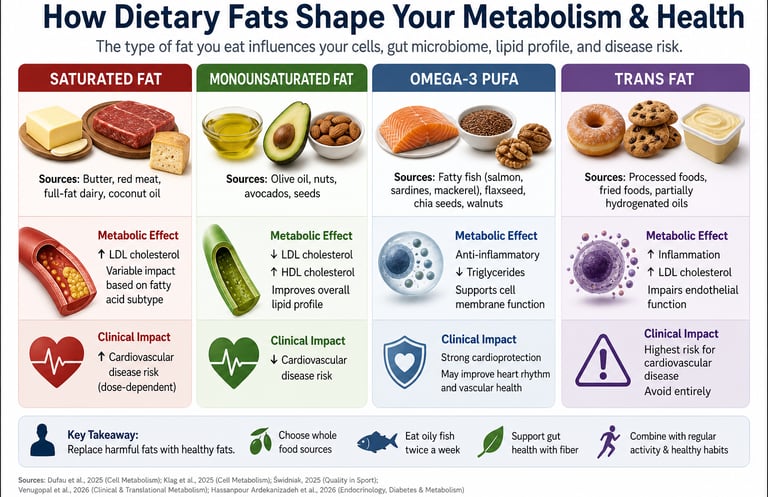
Dietary fats influence metabolism based on their type, not just quantity. Unsaturated fats (omega-3s, monounsaturated fats) improve lipid profiles and reduce cardiovascular risk, while excess saturated and trans fats disrupt gut microbiome signaling, impair insulin sensitivity, and increase inflammation. Replacing saturated fats with unsaturated fats is one of the most evidence-based strategies for metabolic health.
Recent 2025–2026 research reveals that dietary fats do much more than provide calories — they actively reprogram metabolism at the cellular, microbial, and systemic levels, directly influencing cholesterol, inflammation, insulin sensitivity, and cardiovascular disease risk.
Key New Scientific Insights:
Nuclear Hormone-Sensitive Lipase (nHSL): A groundbreaking 2025 Cell Metabolism study (Dufau et al.) discovered that a nuclear form of hormone-sensitive lipase acts as a molecular switch inside fat cells, regulating gene expression, fat storage, and adipose tissue metabolism.
Gut Microbiome Disruption: High-fat diets, particularly rich in saturated fats, break down a critical lipid-signaling network between beneficial gut bacteria and host tissues (Klag et al., 2025). This disruption impairs insulin sensitivity, promotes inflammation, and alters fat metabolism.
Fat Type Matters Most: Comprehensive reviews confirm that replacing saturated and trans fats with monounsaturated fats (olive oil, avocados, nuts) and omega-3 polyunsaturated fats (fatty fish, walnuts) significantly improves lipid profiles, lowers triglycerides, and reduces cardiovascular risk (Hassanpour Ardekanizadeh et al., 2026).
Early Risk in Young Adults: Poor dietary fat quality combined with a sedentary lifestyle is contributing to premature coronary artery disease (PCAD) even in young Indian adults (Venugopal et al., 2026).
If you've spent years believing that "low-fat" is automatically "heart-healthy," new research suggests the story is far more nuanced. The type of fat on your plate — not simply the total grams — is what determines whether your cells stay metabolically resilient or drift toward inflammation, insulin resistance, and cardiovascular disease.
A wave of research published between 2025 and 2026 has reshaped how physicians and nutrition scientists think about dietary fat. Investigators have identified a molecular switch inside fat cells that controls how they store and release energy, uncovered a lipid "communication network" between gut bacteria and the rest of the body, and confirmed — through large population studies — that swapping saturated and trans fats for unsaturated ones measurably lowers cardiovascular risk.
1. The Big Idea: Fat as a Metabolic Signal
For decades, dietary fat was treated primarily as a calorie source and a presumed driver of weight gain. Emerging cellular and population research complicates that picture considerably. Fat molecules appear to act as signals that interact with gene expression inside fat cells, with communication pathways in the gut, and with long-term markers of cardiovascular health (Dufau et al., 2025; Klag et al., 2025).
In practice, this means two people eating the same number of fat calories can end up with very different metabolic outcomes depending on the type of fat they choose. Saturated and trans fats tend to push lipid profiles and inflammatory markers in an unfavorable direction, while monounsaturated and omega-3 polyunsaturated fats tend to do the opposite (Hassanpour Ardekanizadeh et al., 2026).
Key takeaway: Think of fat less like a fuel gauge and more like a set of instructions your body reads and acts on.
2. Inside the Fat Cell: A Newly Discovered Molecular Switch
The Discovery
Hormone-sensitive lipase (HSL) has been understood for years as an enzyme that helps release stored fat for energy, particularly during exercise or fasting. A 2025 study in Cell Metabolism, conducted by an international team, identified a distinct nuclear form of this enzyme — informally described as nuclear hormone-sensitive lipase — that behaves very differently from its cytoplasmic counterpart (Dufau et al., 2025).
Rather than just breaking down fat molecules, this nuclear form appears to influence gene expression inside fat cells, effectively acting as a control switch for how those cells grow, store energy, and respond to hormonal cues.
Why It Matters
This finding helps explain a long-standing clinical puzzle: why two people can eat similar diets and exercise similarly, yet accumulate body fat very differently. According to this research, some of that variation may trace back to how well-regulated this nuclear switch is inside a person's fat cells (Dufau et al., 2025).
For clinicians, this reframes weight management conversations. "Calories in versus calories out" remains relevant, but it is clearly not the whole equation — cellular regulation matters too.
Clinical takeaway: While this discovery doesn't yet change day-to-day treatment, it strengthens the rationale for lifestyle strategies — good sleep, resistance training, and unsaturated fat intake — that support healthy adipose tissue function while future drug targets are explored.
3. The Gut Microbiome's Role in Processing Dietary Fat
A Broken Line of Communication
A second major 2025 study, also published in Cell Metabolism, examined how high-fat diets affect the relationship between gut bacteria and the rest of the body (Klag et al., 2025). Beneficial, commensal bacteria appear to participate in a lipid-based signaling network — essentially producing metabolites that help regulate insulin sensitivity and inflammation throughout the body.
When dietary fat intake climbs too high, particularly from saturated sources, this signaling network is disrupted. The effect isn't simply "fewer good bacteria" — the researchers describe a more specific breakdown in the chemical communication between microbes and host tissue, which in turn impairs insulin sensitivity and promotes low-grade inflammation (Klag et al., 2025).
Why Some People Tolerate High-Fat Diets Better Than Others
This mechanism may help explain why some individuals on calorie-dense diets develop metabolic disease quickly while others seem more resistant. Part of the difference may come down to how resilient — or vulnerable — an individual's gut microbiome is to fat-driven disruption.
Dietary fiber, fermented foods, and a diverse, plant-forward diet appear to support the microbial partners responsible for maintaining this lipid signaling network (Klag et al., 2025).
Clinical takeaway: Gut health isn't a separate wellness trend from cardiometabolic health — it's mechanistically connected. Feeding your microbiome well is a direct investment in insulin sensitivity and inflammation control.
4. Fat Types Compared: Clinical Impact at a Glance
Fat Type Common Sources Effect on Lipids Cardiovascular Impact Saturated Fat Butter, red meat, full-fat dairy, coconut oil Raises LDL cholesterol (varies by fatty acid subtype) Higher CVD risk, dose-dependent Monounsaturated Fat (MUFA) Olive oil, avocados, nuts Lowers LDL, raises HDL Reduced CVD risk Omega-3 Polyunsaturated Fat Salmon, sardines, walnuts, flaxseed Anti-inflammatory, lowers triglycerides Strong cardioprotective effect Trans Fat Processed and fried foods, partially hydrogenated oils Raises LDL, promotes inflammation Highest CVD risk; avoid entirely
A comprehensive 2025 review in Quality in Sport adds important nuance here: not all saturated fats behave identically (Świdniak, 2025). Stearic acid, found in foods like dark chocolate, appears comparatively neutral because the body readily converts it to oleic acid — a monounsaturated fat. Palmitic acid, common in butter and palm oil, has a much stronger LDL-raising effect. In other words, "saturated fat" is not one uniform category — source and specific fatty acid composition matter.
5. Premature Heart Disease: Why Young Adults Are at Risk
It's tempting to assume heart disease is a problem for later decades of life. A 2026 study in Clinical & Translational Metabolism challenges that assumption directly, examining young Indian adults diagnosed with premature coronary artery disease (PCAD) — defined as coronary disease occurring before age 45 in men and 55 in women (Venugopal et al., 2026).
The study found that diets high in saturated fat, paired with sedentary behavior, smoking, and low intake of fruits and vegetables, were strongly linked to unfavorable lipid profiles — elevated LDL cholesterol, high triglycerides, and low HDL cholesterol — even in this younger population (Venugopal et al., 2026). These lipid patterns are known precursors to arterial plaque formation.
The researchers note that premature coronary disease appears at disproportionately high rates in Indian populations compared with many Western cohorts, even after adjusting for standard risk factors (Venugopal et al., 2026).
Clinical takeaway: Arterial damage can begin accumulating silently in the third decade of life. Waiting until your 40s or 50s to think about cholesterol may mean addressing plaque that has already formed.
6. The Population Evidence: Fatty Acids and Cardiovascular Outcomes
A large 2026 study published in Endocrinology, Diabetes & Metabolism connects the cellular and microbial mechanisms above to real-world outcomes at the population level (Hassanpour Ardekanizadeh et al., 2026). Its key findings:
Higher intake of saturated and trans fatty acids correlated with elevated total cholesterol, LDL cholesterol, and composite cardiovascular risk scores.
Higher omega-3 polyunsaturated fat intake was inversely associated with triglyceride levels and cardiovascular risk.
Even modest replacement of saturated fat calories with unsaturated fat produced measurable improvements in lipid profiles — supporting "fat swapping" as a realistic, achievable strategy rather than an all-or-nothing overhaul (Hassanpour Ardekanizadeh et al., 2026).
Taken together with the cellular and microbiome research above, this represents converging evidence from three different levels of biology — molecular, microbial, and population-wide — all pointing to the same conclusion: fat type is the primary lever for cardiometabolic risk, not fat quantity alone.
7. Practical Application: A Fat-Swapping Framework
Step 1: Replace, Don't Just Restrict
Swap butter and ghee for extra virgin olive oil or avocado oil in cooking. Choose whole-food fat sources — olives, avocados, nuts — over heavily processed oils.
Step 2: Eat Oily Fish Twice a Week
Salmon, sardines, mackerel, and herring are rich in EPA and DHA omega-3s. Vegetarians and vegans can consider algae-based omega-3 supplements as an alternative source.
Step 3: Feed Your Gut Microbiome
Legumes, whole grains, vegetables, and fermented foods (yogurt, kefir, kimchi, tempeh) support the microbial lipid-signaling network described by Klag et al. (2025).
Step 4: Read Labels Carefully
Watch for "partially hydrogenated oils" on ingredient lists — a marker of industrial trans fat. Aim to keep saturated fat under roughly 10% of total daily calories, consistent with major cardiovascular guidelines.
Step 5: Get Screened Early
Given the premature coronary artery disease findings above, consider a full lipid panel in your 20s or 30s — especially with a family history of heart disease or a long-term high-saturated-fat diet.
Step 6: Don't Go Fat-Free — Swap Smart
Total fat intake in the range of 25–35% of daily calories, with an emphasis on unsaturated sources, is generally preferable to very low-fat diets that are compensated for with refined carbohydrates.
Step 7: Practice Moderation, Even With "Good" Fats
All fat is calorie-dense at roughly 9 kcal per gram. Even healthy fats, consumed to excess, may stress the same gut-signaling pathways discussed above (Klag et al., 2025).
Types of Dietary Fat: Metabolic and Clinical Impact
Saturated Fat
Main sources: Butter, red meat, full-fat dairy
Metabolic effect: Increases LDL cholesterol; effects vary by fatty acid subtype
Clinical impact: Associated with higher cardiovascular disease risk (dose-dependent)
Monounsaturated Fat (MUFA)
Main sources: Olive oil, nuts, avocados
Metabolic effect: Improves lipid profile (↓ LDL, ↑ HDL)
Clinical impact: Linked to reduced cardiovascular disease risk
Omega-3 Polyunsaturated Fat (PUFA)
Main sources: Fatty fish (salmon, sardines), flaxseed, walnuts
Metabolic effect: Anti-inflammatory; lowers triglycerides
Clinical impact: Strong cardioprotective effects; supports heart rhythm and vascular health
Trans Fat
Main sources: Processed foods, partially hydrogenated oils
Metabolic effect: Increases inflammation and LDL cholesterol
Clinical impact: Highest risk for cardiovascular disease; should be avoided entirely
8. Common Myths and Mistakes
Myth: All saturated fat is equally harmful. Reality: Fatty acid subtype matters. Stearic acid behaves differently than palmitic acid in terms of cardiovascular impact (Świdniak, 2025).
Myth: Plant-based fat is automatically healthier than animal fat. Reality: Coconut oil is plant-derived but high in saturated fat, while oily fish — an animal source — is one of the richest sources of cardioprotective omega-3s.
Myth: Going low-fat is the safest path to heart health. Reality: Diets very low in fat are often compensated for with refined carbohydrates, which can raise triglycerides and worsen lipid profiles.
Myth: Heart disease risk from diet doesn't start until midlife. Reality: The PCAD research shows measurable lipid damage accumulating in adults under 45 (Venugopal et al., 2026).
9. Frequently Asked Questions
Is saturated fat always bad for heart health? Not universally. Effects vary by specific fatty acid, but overall, replacing saturated fat with unsaturated fat is well-supported by current evidence (Świdniak, 2025).
How does dietary fat affect gut health? High dietary fat intake, particularly saturated fat, disrupts a lipid-based communication network between gut bacteria and the body's cells, which can impair insulin sensitivity and increase inflammation (Klag et al., 2025).
Can young adults really develop heart disease from diet? Yes. Research shows a clear link between dietary fat quality, lifestyle factors, and adverse lipid profiles in adults under 45 with premature coronary artery disease (Venugopal et al., 2026).
What are the best fats for heart health? Omega-3 polyunsaturated fats (oily fish, flaxseed, walnuts) and monounsaturated fats (olive oil, avocados, almonds) are consistently linked to improved cardiovascular markers (Hassanpour Ardekanizadeh et al., 2026).
Does the nuclear HSL discovery change treatment today? Not directly yet. It's a mechanistic discovery that may eventually inform obesity and metabolic disease therapies, but current implications are mainly for understanding — not treating — fat cell behavior (Dufau et al., 2025).
How much dietary fat should I eat per day? Most guidelines suggest 25–35% of total calories from fat, with saturated fat kept under about 10%. Fat quality matters more than total quantity for most people.
Are plant fats always healthier than animal fats? No — the specific fatty acid profile matters more than whether the source is plant or animal.
What's the single most practical change I can make? Swap one saturated fat source (butter, fatty red meat) for one unsaturated source (olive oil, nuts, fatty fish) a few times per week.
Should I get my cholesterol checked if I'm under 30? If you have a family history of heart disease or a long-standing high-saturated-fat diet, a baseline lipid panel is reasonable to discuss with your doctor.
Does fiber intake really affect cholesterol and heart risk? Yes — dietary fiber supports the gut bacteria involved in lipid signaling, which is connected to insulin sensitivity and inflammation control (Klag et al., 2025).
10. Conclusion and Action Steps
The science increasingly supports a simple but important shift in thinking: dietary fat behaves like biological information, not just fuel. It talks to your genes through cellular switches, to your metabolism through gut bacteria, and to your arteries through your lipid profile.
Three action steps to start this week:
Replace one saturated fat source with an unsaturated one in your next three meals.
Add one serving of fatty fish or a plant-based omega-3 source to your week.
If you're over 20 and haven't had a lipid panel, ask your doctor about one.
This article is for informational purposes only and does not replace personalized medical advice. Individuals with diabetes, dyslipidemia, or existing cardiovascular disease should consult a healthcare provider before making significant dietary changes.
Related Articles
Which Fats Are Best for Heart Health? What Modern Cardiometabolic Science Reveals
Can Plant-Based Polyphenols Lower Biological Age? | DR T S DIDWAL
Time-Restricted Eating: Metabolic Advantage or Just Fewer Calories? | DR T S DIDWAL
References
Dufau, J., Recazens, E., Bottin, L., Bergoglio, C., Mairal, A., Chaoui, K., Marques, M.-A., Jimenez, V., García, M., Wang, T., Laurell, H., Iacovoni, J. S., Flores-Flores, R., Denechaud, P.-D., Acheikh Ibn Oumar, K., Amri, E.-Z., Postic, C., Concordet, J.-P., Gourdy, P., Mejhert, N., Rydén, M., Burlet-Schiltz, O., Bosch, F., Wolfrum, C., Mouisel, E., Tavernier, G., & Langin, D. (2025). Nuclear hormone-sensitive lipase regulates adipose tissue mass and adipocyte metabolism. Cell Metabolism, 37(11), 2250. https://doi.org/10.1016/j.cmet.2025.09.014
Hassanpour Ardekanizadeh, N., Mobarakeh, K. A., Nami, S., et al. (2026). Association between dietary fatty acid intake with cardiovascular disease risk and serum lipid levels. Endocrinology, Diabetes & Metabolism, 9(1), e70148. https://doi.org/10.1002/edm2.70148
Klag, K., Ott, D., Tippetts, T. S., Nicolson, R. J., Tatum, S. M., Bauer, K. M., Stephen-Victor, E., Weis, A. M., Bell, R., Weagley, J., Maschek, J. A., Vu, D. L., Heaver, S., Ley, R., O'Connell, R., Holland, W. L., Summers, S. A., Stephens, W. Z., & Round, J. L. (2025). Dietary fat disrupts a commensal-host lipid network that promotes metabolic health. Cell Metabolism. Advance online publication. https://doi.org/10.1016/j.cmet.2025.10.007
Świdniak, A. (2025). The dietary fats: A comprehensive study about the influence of different types of fats on general health and developing diseases. Quality in Sport, 40. https://doi.org/10.12775/qs.2025.40.58799
Venugopal, H. G., Reddy, M., L, S., et al. (2026). Association of dietary and lifestyle factors with lipid profile in young Indian adults with premature coronary artery disease. Clinical & Translational Metabolism, 24, 9. https://doi.org/10.1007/s12018-026-09330-4