Lactate Threshold Explained: Boost Stamina, Burn Fat & Train Smarter
Learn how to boost stamina and performance using lactate threshold training. Includes LT1 vs LT2, VO₂max insights, and practical workout strategies.
EXERCISE
Dr. T.S. Didwal, M.D.(Internal Medicine)
4/21/202614 min read
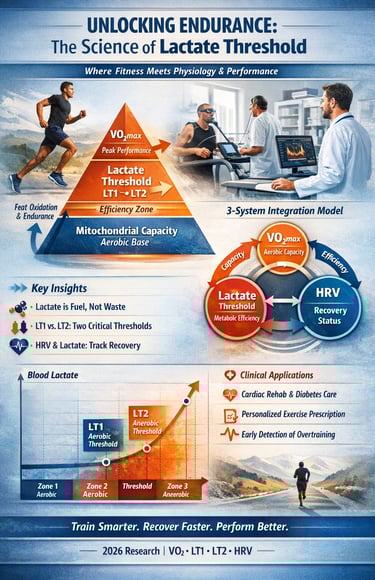
What is lactate threshold, and why is it important?
Lactate threshold is the exercise intensity at which lactate begins to accumulate in the blood faster than it can be cleared. It is one of the most accurate predictors of endurance performance because it determines how long you can sustain a given pace without fatigue.
There are two key thresholds:
LT1 (aerobic threshold): the point where lactate first rises above baseline, supporting long-duration, low-intensity exercise
LT2 (anaerobic threshold): the highest intensity you can sustain before rapid fatigue occurs
Improving lactate threshold allows individuals to exercise at higher intensities for longer periods, enhancing endurance, metabolic efficiency, and recovery. Unlike VO₂max, which reflects maximum capacity, lactate threshold reflects how efficiently that capacity is used in real-world performance.
It is widely used in sports performance, cardiac rehabilitation, and metabolic health, helping clinicians and coaches prescribe safe, personalised training intensities.
Key Insight
Lactate is not your enemy. It is an energy shuttle, a signalling molecule, and a metabolic fuel — and your threshold for handling it can be systematically improved with targeted training. Research in Folia Medica (Mandadzhiev, 2025) emphasises that lactate plays a complex, multifaceted role in exercise physiology far beyond its old reputation as a simple metabolic waste product.4
For recreational athletes and patients in cardiac or pulmonary rehabilitation programmes alike, lactate threshold serves as a precision tool for exercise prescription — helping clinicians and coaches set intensities that are both safe and effective.
Clinician’s Perspective: Lactate Threshold in Practice
Precision Exercise Prescription
Lactate threshold (LT), particularly LT1, provides a safe, individualised anchor for exercise intensity in patients with cardiovascular, pulmonary, and metabolic disease. Training below LT1 minimises excessive sympathetic stress while maximising aerobic adaptation—critical in cardiac rehabilitation and chronic disease management (Iuliano et al., 2026).Bridging Performance and Medicine
LT offers a clinically meaningful metric that sits between VO₂peak (capacity) and functional tolerance. Unlike VO₂max, which may be difficult to measure in frail patients, LT can be estimated using submaximal protocols, making it more feasible in routine clinical settings.Metabolic Health Indicator
Improvements in lactate clearance reflect enhanced mitochondrial function, insulin sensitivity, and metabolic flexibility. This is particularly relevant in patients with obesity, metabolic syndrome, and type 2 diabetes, where impaired oxidative metabolism is a core defect (Huang et al., 2025).Early Detection of Overtraining or Clinical Deterioration
A leftward shift in lactate response (higher lactate at lower workloads) may indicate:Overreaching in athletes
deconditioning or disease progression in patients
This makes serial lactate assessment a potential monitoring biomarker.
Integration with Autonomic Markers (HRV)
Combining LT with heart rate variability (HRV) allows clinicians to assess both physiological capacity and recovery status. Reduced HRV alongside declining threshold performance may signal inadequate recovery or increased cardiovascular strain (Lu et al., 2026).Sex-Specific and Individualised Care
Evidence supports sex-based differences in lactate dynamics and threshold expression, necessitating personalised interpretation rather than reliance on generalized cut-offs (Fischer et al., 2025).Non-Invasive Future Directions
Emerging tools—including HRV-guided estimation and simplified treadmill protocols—are making LT assessment more accessible beyond specialised labs, expanding its role in primary care and preventive cardiology.
Clinical Takeaway
Lactate threshold is not just a performance metric—it is a practical, scalable, and physiologically robust tool for guiding safe exercise, monitoring adaptation, and improving long-term cardiometabolic outcomes.
Your legs feel strong. Your breathing is controlled. The pace seems sustainable—until suddenly, it isn’t. Within minutes, fatigue surges, your muscles burn, and what felt manageable becomes overwhelming. This tipping point is not random. It reflects a precise physiological boundary known as the lactate threshold—one of the most powerful, yet underappreciated, determinants of endurance performance.
For decades, lactate was misunderstood as merely a metabolic “waste product,” blamed for fatigue and muscle soreness. Modern exercise physiology has overturned that narrative. Lactate is now recognised as a key metabolic intermediary, serving as both a fuel source and a signalling molecule that coordinates energy production across tissues (Mandadzhiev, 2025). Rather than causing fatigue, it is the imbalance between lactate production and clearance—often accompanied by hydrogen ion accumulation—that limits performance at higher intensities.
This shift in understanding has transformed how scientists and clinicians view endurance capacity. Research shows that lactate threshold predicts performance more reliably than maximal oxygen uptake (VO₂max) alone, particularly in sustained efforts such as distance running and cycling (Heuberger et al., 2018). In practical terms, it defines how hard you can go—and for how long—before your physiology forces you to slow down.
Even more compelling, emerging evidence suggests that lactate dynamics are not just about performance, but also about recovery, metabolic health, and training adaptation. Faster lactate clearance reflects improved mitochondrial function and greater metabolic flexibility, key markers of both athletic fitness and cardiometabolic health (Huang et al., 2025).
In short, understanding your lactate threshold is not just for elite athletes. It is a clinically relevant, scientifically grounded tool that can help anyone—from patients in rehabilitation to competitive performers—train smarter, recover better, and unlock a new level of physiological efficiency.
2–4 mmol/L — common blood lactate level at LT2 (anaerobic threshold)
~60% of VO₂max at which LT1 typically occurs in trained athletes
~80% of VO₂max at which LT2 typically occurs in elite endurance athletes
3 primary threshold concepts with distinct repeatability profiles (Heuberger et al., 2018)1
LT1 vs LT2: Two Thresholds, Two Entirely Different Training Zones
One of the most important — and most frequently misunderstood — aspects of lactate physiology is that there are actually two distinct thresholds, not one.
Lactate Threshold 1 (LT1) — The Aerobic Threshold
LT1 marks the intensity at which blood lactate first rises meaningfully above baseline. Below this point, your body operates almost entirely aerobically. This is the sweet spot for long, slow distance (LSD) training, fat oxidation, and building your aerobic base. LT1 training is gentle enough for daily repetition and forms the foundation of most polarised training models.
Lactate Threshold 2 (LT2) — The Anaerobic or "Race" Threshold
LT2 — often called the anaerobic threshold (AT) or maximal lactate steady state (MLSS) — is the highest intensity at which lactate production and clearance remain balanced. Beyond this point, lactate accumulates rapidly and performance becomes unsustainable. For competitive athletes, LT2 pace closely approximates half-marathon race pace and is the primary target for interval and tempo training.
A landmark study by Heuberger et al. (2018) in PLoS ONE assessed the repeatability of multiple lactate threshold concepts in endurance athletes. Their findings revealed that while lactate threshold markers are broadly reproducible, individual variability exists — reinforcing the need for personalised threshold testing rather than relying on population averages.1
How Is Lactate Threshold Measured? Old Methods, New Solutions
Traditionally, lactate threshold testing required a lab, a treadmill, and multiple blood draws — making it accessible only to elite athletes or well-funded research institutions. That picture is changing rapidly.
The Gold Standard: Incremental Exercise Testing
In a graded exercise test (GXT), participants exercise at progressively increasing intensities while small blood samples (usually from a fingertip or earlobe) are taken at each stage to measure lactate concentration. The resulting lactate-intensity curve allows identification of LT1 and LT2 with precision.
The Modified Åstrand Test: A New Accessible Protocol
Iuliano et al. (2026), publishing in the British Medical Bulletin, validated new regression equations for estimating both VO₂peak and lactate threshold from a modified Åstrand maximal incremental treadmill test — a protocol originally designed to be simpler and more accessible than laboratory-grade testing.2 This development is significant for recreational athletes and clinical populations who may lack access to metabolic carts and arterial blood gas analysis.
What This Means for You
You no longer need a high-end sports science laboratory to get meaningful lactate threshold data. Validated treadmill protocols with simple equipment can now provide clinically useful VO₂peak and LT estimates — making personalised exercise prescription more accessible than ever.
VO₂ & Prediction
VO₂peak, Lactate Threshold, and the Fitness Equation
VO₂max (maximum oxygen uptake) and lactate threshold are the two pillars of endurance performance. While VO₂max determines the ceiling of your aerobic engine, lactate threshold determines how efficiently you can operate near that ceiling.
An athlete with a moderate VO₂max but a high LT2 (as a percentage of VO₂max) will consistently outperform an athlete with a higher VO₂max but a lower LT2 — particularly in longer-duration events where pacing and metabolic sustainability are critical.
"Estimating VO₂peak alongside lactate threshold from a single, accessible incremental test opens a practical pathway for exercise prescription in recreational and clinical populations."
— Informed by Iuliano et al. (2026), British Medical Bulletin2
The equations validated by Iuliano et al. (2026) offer a non-invasive bridge between field testing and laboratory precision — particularly valuable in clinical settings such as cardiac rehabilitation, where exercise tolerance assessment is essential but invasive testing is contraindicated.
Sex, VO₂max, and the Cost of Movement: What Changes Your Threshold?
A natural and important question in personalised exercise physiology is: does lactate threshold work the same way for everyone? A 2025 study by Fischer et al. in European Journal of Applied Physiology tackled this question head-on in the context of cycling performance.
Their modelling study in young athletes revealed that sex, maximal oxygen uptake, and the "cost of cycling" (the energy expended per unit of mechanical work) all significantly influence where the lactate threshold falls relative to absolute power output. Key findings included:
Sex Differences
Female athletes showed meaningful differences in threshold power output compared to male athletes when controlling for body mass — highlighting the importance of sex-specific reference ranges in sports performance testing.
Cost of Cycling
Cycling economy (efficiency) was a key modulator of threshold. More efficient cyclists could sustain higher absolute power outputs at their lactate threshold — an argument for technique training alongside physiological conditioning.
These findings underscore a simple but profound principle: lactate threshold is not a fixed biological trait. It is the product of multiple interacting variables — many of which are amenable to training-induced change.
Lactate, Recovery, and Fatigue: The Athlete's Hidden Dashboard
Most athletes think of lactate only as something to be avoided — a marker of going too hard. The reality, as synthesised by Huang et al. (2025) in a comprehensive review in Frontiers in Physiology, is far more sophisticated.
Post-exercise lactate clearance — how quickly your body removes accumulated lactate after intense effort — is itself a powerful indicator of recovery capacity and aerobic fitness. Athletes with greater mitochondrial density and more efficient lactate shuttle systems clear lactate faster, recover more quickly between efforts, and can train at higher volumes without accumulating fatigue.
Lactate as a Fatigue Monitor
The review highlights how serial lactate monitoring during training blocks can serve as a non-invasive fatigue monitoring tool. A right-shift of the lactate curve (requiring higher intensity to produce the same lactate response) suggests improved fitness; a left-shift may indicate accumulated fatigue, overreaching, or insufficient recovery.
Practical takeaway: Tracking resting and submaximal lactate over a training cycle can help coaches and athletes detect early signs of overtraining — before performance decline becomes apparent.
The Lactate Shuttle Hypothesis
Modern understanding positions lactate not just as a metabolic byproduct but as an active energy substrate shuttled between muscle fibres, organs, and even the brain. The liver, heart, and oxidative muscle fibres all consume lactate as fuel — meaning efficient lactate metabolism is as much about clearance capacity as it is about production rate.
Non-Invasive Methods
Heart Rate Variability: The Non-Invasive Threshold Frontier
One of the most exciting recent developments in lactate threshold assessment comes from Lu et al. (2026), published in the International Journal of Sports Medicine.6 Their study investigated whether heart rate variability (HRV) — the beat-to-beat variation in heart rate controlled by the autonomic nervous system — could accurately predict lactate threshold heart rate and speed in runners.
The findings were encouraging: specific HRV indices demonstrated meaningful correlations with both threshold heart rate and running speed at the lactate threshold, suggesting that consumer-grade HRV devices (including many smartwatches) may eventually offer practical, blood-free threshold estimation in field settings.
Important Caveat
HRV-based threshold estimation is promising but not yet a validated replacement for incremental testing with blood lactate sampling. It should currently be viewed as a complementary tracking tool rather than a primary diagnostic method. Consult a sports scientist or exercise physiologist before making major training changes based on HRV data alone.
Practical Applications
Lactate Threshold Training Zones — Simplified
Build Aerobic Base / Fat Burning
Zone: Zone 1
Intensity: Below LT1 (~60–65% HRmax)
Physiological Goal:
Increase mitochondrial density
Enhance fat oxidation
Improve long-duration endurance capacity
Tempo / Threshold Development
Zone: Zone 2
Intensity: Between LT1 and LT2 (~75–85% HRmax)
Physiological Goal:
Raise lactate threshold (LT2)
Improve lactate clearance and utilisation
Enhance sustainable pace and efficiency
Race-Specific / VO₂max Training
Zone: Zone 3
Intensity: Above LT2 (>85% HRmax)
Physiological Goal:
Expand aerobic ceiling (VO₂max)
Increase tolerance to high lactate levels
Simulate race intensity and performance stress
Key Takeaway
Each zone targets a distinct physiological system—aerobic base, metabolic efficiency, and maximal capacity—and an effective training program strategically integrates all three.
Step-by-Step: Applying Lactate Threshold in Your Training
Get Your Threshold Tested
Seek a validated incremental treadmill or cycle test with blood lactate sampling. If a full lab test is unavailable, the modified Åstrand-based protocols validated by Iuliano et al. (2026) offer a practical alternative.
Identify Your LT1 and LT2 Heart Rates
Work with a sports scientist or exercise physiologist to translate your lactate-intensity data into heart rate and pace zones. These are your personalised training anchors.
Adopt a Polarised or Pyramidal Structure
Spend approximately 75–80% of training volume below LT1 (Zone 1) and 10–20% at or above LT2 (Zone 3). Limit time in the "grey zone" between thresholds for optimal adaptation.
Monitor Lactate Clearance During Recovery Weeks
If access to lactate testing is available, periodic submaximal lactate checks during recovery weeks can detect overreaching before it becomes overtraining — as supported by Huang et al. (2025).
Account for Sex and Individual Differences
Use sex-specific reference ranges for threshold interpretation — particularly in cycling. Fischer et al. (2025) demonstrate that population-averaged thresholds may underestimate or overestimate true thresholds in individual athletes.
Supplement with HRV Monitoring
Use HRV as a day-to-day readiness guide. Sustained depression of HRV metrics, particularly in the context of high training load, may signal the need for recovery, complementing the formal lactate testing picture (Lu et al., 2026).
Frequently Asked Questions
1 Is lactate bad for my muscles?
No, lactate is not the villain it was once portrayed as. It is an important energy substrate and signalling molecule. The burning sensation during intense exercise is primarily caused by hydrogen ion accumulation (acidosis), not lactate itself. Modern research (Mandadzhiev, 2025) confirms lactate plays a positive role in exercise metabolism.
2 Can I improve my lactate threshold?
Absolutely. The lactate threshold responds well to both endurance-based (Zone 1–2) training, which increases mitochondrial density and lactate clearance, and threshold-specific interval work (tempo runs, sweet spot cycling). Consistent, periodised training over 8–12 weeks typically produces measurable threshold improvements.
3 How often should I get my threshold tested?
For serious athletes, testing every 8–12 weeks during a training block helps track adaptations and recalibrate training zones. For recreational athletes, one to two annual tests plus regular self-monitoring (using pace, heart rate, and perceived exertion) is usually sufficient and practical.
4 Is lactate threshold the same as "anaerobic threshold"?
Not exactly. "Anaerobic threshold" typically corresponds to LT2 — the maximal lactate steady state — while "lactate threshold" can refer to either LT1 or LT2 depending on context. Heuberger et al. (2018) highlight that different threshold concepts have different repeatability profiles and physiological meanings — so specifying which threshold you're discussing matters.
5 Does sex affect my lactate threshold?
Yes. Fischer et al. (2025) demonstrated that sex is a significant modulator of lactate threshold in young cyclists — independent of VO₂max. Female athletes often show different threshold-to-VO₂max ratios and should use sex-appropriate reference standards rather than male-derived norms.
6 Can I estimate my threshold without a blood test?
Emerging research suggests yes. Both the modified Åstrand treadmill protocol (Iuliano et al., 2026) and HRV-based estimation (Lu et al., 2026) offer non-invasive approximations of threshold. These methods are not perfect replacements for blood lactate testing but offer valuable, accessible alternatives for those without lab access.
7 What does lactate threshold mean for weight loss or general health?
Training below LT1 optimises fat oxidation, making it ideal for body composition goals. For general health, understanding your threshold helps set exercise intensities that are both safe and effective — particularly relevant in cardiac or metabolic rehabilitation where overexertion must be carefully avoided. Exercise prescription anchored to LT1 ensures safety without sacrificing metabolic benefit.
Clinical Pearls
1. The "Metabolic Fuel" Shift
Scientific Perspective: Lactate is not a metabolic dead-end; it is a vital carbohydrate source. Through the Lactate Shuttle, it is transported to the heart, brain, and non-exercising muscles to be oxidized as fuel, especially when glucose is scarce.
Stop thinking of lactate as "acid" that burns your muscles. Think of it as a recycled fuel. Your body is actually very clever—it takes the leftovers from high-intensity work and turns them into "premium gas" for your heart and brain to keep you moving longer.
2. LT1: The True Foundation of Health
Scientific Perspective: LT1 (the first rise in lactate) represents the upper limit of the Zone 1/Aerobic Base. Training at or slightly below this intensity maximizes mitochondrial biogenesis and fat oxidation rates (Fatmax), which are critical for metabolic flexibility and cardiovascular longevity.
To go fast, you must first spend a lot of time going slow. Training at a "conversational pace" (where you can talk in full sentences) builds the cellular machinery that allows you to burn fat more efficiently and protects your heart from overstress.
3. Precision Over "No Pain, No Gain"
Scientific Perspective: Fixed-intensity prescriptions (e.g., % of Heart Rate Max) often fail due to individual variability. Anchoring training to LT2 (Anaerobic Threshold) ensures a specific metabolic stressor is applied, preventing "grey zone" training where the athlete is too fast for recovery but too slow for optimal adaptation.
Working out until you collapse isn't always "better." By finding your specific "threshold," we can give you a precise dose of exercise. It’s like a prescription medication: too little does nothing, but too much causes side effects (like burnout or injury).
4. Sex-Specific Threshold Dynamics
Scientific Perspective: As highlighted by Fischer et al. (2025), sex is a primary modulator of LT. Female athletes often exhibit different lactate clearance rates and threshold-to-VO₂max ratios compared to males, necessitating sex-specific reference ranges rather than scaled-down male models.
Men and women don’t always "burn fuel" the same way during exercise. If you are a woman following a training plan designed for men, your "threshold" might be set incorrectly. Personalised testing is the only way to ensure your heart rate zones actually match your unique biology.
5. Recovery as a Diagnostic Tool
Scientific Perspective: The rate of post-exercise lactate clearance is a powerful marker of autonomic recovery and mitochondrial health. A "left-shift" in the lactate curve (higher lactate at lower speeds) during a training block is a leading indicator of functional overreaching or systemic fatigue.
How quickly you "bounce back" after a hard effort tells us more about your fitness than the effort itself. If your usual easy run starts feeling harder and your heart rate is higher than normal, your body’s internal dashboard is flashing a yellow light. It’s time to rest before you break.
Author’s Note
This article was written with a deliberate goal: to bridge the gap between high-performance exercise physiology and real-world clinical practice. Lactate threshold is often discussed in elite sports contexts, yet its relevance extends far beyond competitive athletes—to patients with cardiometabolic disease, individuals beginning fitness journeys, and clinicians seeking precise, evidence-based exercise prescription tools.
The science presented here is grounded in recent peer-reviewed literature (2025–2026) and reflects a major paradigm shift in how we understand lactate. Influenced by foundational work from researchers such as George A. Brooks, modern physiology recognises lactate not as a waste product, but as a central player in energy metabolism, recovery, and adaptation.
While every effort has been made to ensure scientific accuracy and clinical relevance, exercise response remains highly individualised. Factors such as age, sex, training status, comorbidities, and medications can significantly influence lactate dynamics and threshold interpretation. Therefore, the concepts discussed should be applied within the context of personalised assessment and professional guidance.
For clinicians, this article aims to provide a practical framework to integrate lactate threshold into patient care. For athletes and coaches, it offers a data-driven approach to optimise training intensity and recovery. For general readers, it serves as an invitation to understand your body’s physiology more deeply—and to train with intention rather than intuition alone.
As exercise science continues to evolve, the integration of wearable technology, non-invasive monitoring, and metabolic insights will likely make tools like lactate threshold even more accessible. The future of fitness and medicine is not just about working harder—but about working smarter, guided by physiology.
Medical Disclaimer: This article is intended for educational and informational purposes only. It does not constitute medical advice and should not be used as a substitute for consultation with a qualified healthcare professional. Always discuss exercise programmes and cardiac risk assessment with your doctor, particularly if you have existing cardiovascular disease or significant risk factors.
Related Articles
HIIT for Longevity: Improving Healthspan Markers – But Does It Extend Lifespan?
The Physiology of HIIT: Mitochondria, Oxygen & Energy Systems
VO₂ Max vs Lactate Threshold Explained: What Truly Determines Your Fitness
HIIT vs Moderate Cardio: Which Improves Cardiovascular Fitness Faster
References
1 Heuberger, J. A. A. C., Gal, P., Stuurman, F. E., de Muinck Keizer, W. A. S., Mejia Miranda, Y., & Cohen, A. F. (2018). Repeatability and predictive value of lactate threshold concepts in endurance sports. PLoS ONE, 13(11), e0206846. https://doi.org/10.1371/journal.pone.0206846
2 Iuliano, E., Zambelli, S., Mazzilli, M., Maffulli, N., Padulo, J., & Picerno, P. (2026). Estimation of V̇O2peak and lactate threshold in recreationally active persons through new equations for a modified Åstrand's maximal incremental treadmill test. British Medical Bulletin, 157(1), ldag006. https://doi.org/10.1093/bmb/ldag006
3 Fischer, J., Hävecker, F., Ji, S., et al. (2025). Modeling lactate threshold in cycling — influence of sex, maximal oxygen uptake, and cost of cycling in young athletes. European Journal of Applied Physiology, 125, 2145–2158. https://doi.org/10.1007/s00421-025-05744-y
4 Mandadzhiev, N. (2025). The contemporary role of lactate in exercise physiology and exercise prescription — A review of the literature. Folia Medica, 67(1). https://doi.org/10.3897/folmed.67.e144693
5, 7 Huang, T., Liang, Z., Wang, K., Miao, X., & Zheng, L. (2025). Novel insights into athlete physical recovery concerning lactate metabolism, lactate clearance and fatigue monitoring: A comprehensive review. Frontiers in Physiology, 16, 1459717. https://doi.org/10.3389/fphys.2025.1459717
6 Lu, C., Lu, S., Wu, Y., Xing, Q., Pan, B., & Shen, Y. (2026). Estimation of runners' lactate threshold heart rate and speed by heart rate variability. International Journal of Sports Medicine, 47(4), 304–314. https://doi.org/10.1055/a-2721-9979