Irisin: The Powerful Exercise Hormone That Burns Fat, Protects the Heart, and May Slow Aging
Explore the cutting-edge science behind irisin, the exercise-induced hormone linked to fat loss, metabolic health, cardiovascular protection, cognitive function, and healthy aging.
EXERCISEOBESITY
Dr. T.S. Didwal, M.D.(Internal Medicine)
5/21/202615 min read
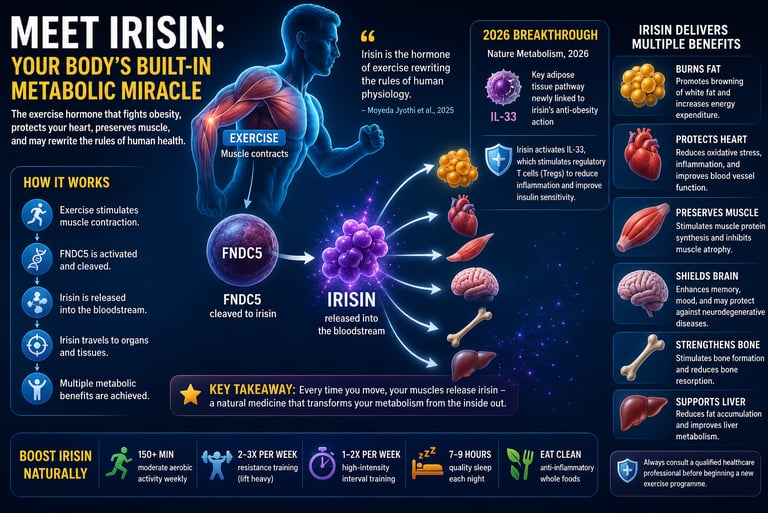
Irisin: The Exercise Hormone that fights obesity, protects your heart, preserves muscle, and may rewrite the rules of human health
The modern epidemic of obesity, type 2 diabetes, cardiovascular disease, and accelerated ageing has long been blamed on one simple problem: people move too little. But emerging metabolic science suggests the deeper issue may be biochemical. When muscles remain inactive, the body loses access to a powerful internal signalling system designed to regulate inflammation, energy balance, fat metabolism, and cellular resilience. At the centre of this system is irisin — a remarkable exercise-induced hormone that scientists now believe may help explain why physical activity protects nearly every organ in the human body (Mohammed et al., 2025).
First identified in 2012, irisin is released from skeletal muscle during exercise after the activation of FNDC5, a membrane protein involved in metabolic signalling. Early research linked irisin to the “browning” of white fat, transforming energy-storing fat into calorie-burning beige fat. But newer evidence reveals something far more profound. A landmark 2026 study published in Nature Metabolism demonstrated that irisin can reduce obesity-related inflammation by activating the IL-33 regulatory T-cell pathway, directly improving insulin sensitivity and metabolic health (Wang et al., 2026).
In other words, every brisk walk, resistance workout, or cycling session may trigger a molecular cascade capable of reshaping metabolism, protecting the heart, preserving muscle, and potentially slowing biological ageing itself.
Key Takeaways
1. Irisin Is the “Exercise Hormone” That Transforms Metabolism
Irisin is a myokine released from skeletal muscle during exercise that helps regulate fat burning, insulin sensitivity, inflammation, and energy metabolism through the FNDC5 pathway.
2. Exercise Activates Irisin to Fight Obesity and Insulin Resistance
New 2026 research published in Nature Metabolism shows that irisin improves metabolic health by activating IL-33 and regulatory T cells, reducing chronic inflammation inside fat tissue.
3. Irisin Helps Convert White Fat Into Calorie-Burning Beige Fat
One of irisin’s most important functions is stimulating the “browning” of white adipose tissue, increasing thermogenesis and energy expenditure — a key mechanism in weight regulation.
4. Irisin Protects the Heart and Blood Vessels
Studies suggest irisin reduces oxidative stress, improves endothelial function, lowers inflammatory cytokines, and may help protect against cardiovascular disease and metabolic syndrome.
5. Irisin Supports Muscle Preservation During Aging
Irisin stimulates muscle protein synthesis, activates satellite cells, and may help combat sarcopenia and sarcopenic obesity — two major drivers of frailty and metabolic decline in older adults.
6. High-Intensity Exercise and Resistance Training Boost Irisin the Most
Research indicates that HIIT, strength training, and regular aerobic exercise are among the most effective ways to naturally increase circulating irisin levels and improve metabolic resilience.
7. Irisin May Become a Future Therapy for Diabetes, Obesity, and Aging
Scientists are investigating recombinant irisin therapies as potential treatments for obesity, insulin resistance, osteoporosis, neurodegeneration, and cardiovascular disease — although exercise remains the safest proven irisin booster today.
What Exactly Is Irisin?
Irisin is a myokine — a signalling protein secreted primarily by skeletal muscle during physical activity. It is cleaved from a precursor protein called FNDC5 (fibronectin type III domain-containing protein 5) and released into the bloodstream, where it acts as a biochemical messenger, coordinating responses across multiple organs simultaneously. First identified in 2012, irisin initially attracted attention for its role in converting energy-storing white fat into calorie-burning beige fat — a process scientists call "browning" of adipose tissue.
But what the latest research reveals goes far beyond simple fat burning. As Mohammed et al. (2025) summarise in their comprehensive narrative review published in Naunyn-Schmiedeberg's Archives of Pharmacology, irisin plays a multidimensional role in exercise-induced muscle and metabolic health, acting on the liver, bone, brain, and heart in addition to adipose tissue. In the words of Moyeda Jyothi et al. (2025), writing in the International Journal of Pharmaceutical Sciences, irisin is "the hormone of exercise rewriting the rules of human physiology" — and that is not mere hyperbole.
Exercise Muscle contracts→ FNDC5 cleaved to irisin → Bloodstream distribution → Multiple organs respond → Metabolic benefits achieved
Irisin vs. Obesity and Insulin Resistance: The 2026 Breakthrough
Perhaps the most significant irisin discovery published so far this year comes from a landmark study in Nature Metabolism (Wang et al., 2026). The research team — drawing from institutions including Harvard Medical School and Brigham and Women's Hospital — uncovered a previously unknown pathway by which irisin combats obesity and insulin resistance. Their findings demonstrate that irisin acts on adipose tissue (body fat) by triggering the release of interleukin-33 (IL-33), an immune signalling molecule that in turn activates a specialised population of immune cells called regulatory T cells (Tregs).
Why does this matter? Regulatory T cells are powerful anti-inflammatory agents. In obesity, chronic low-grade inflammation in fat tissue is a key driver of insulin resistance — the condition where the body's cells stop responding properly to insulin, eventually leading to type 2 diabetes. By mobilising Tregs through the irisin–IL-33 axis, exercise effectively sends a biological peacekeeping force into inflamed fat tissue, calming the inflammation and restoring insulin sensitivity.
Patient-Friendly Takeaway: Every time you go for a brisk walk or lift weights, your muscles release irisin into your blood. This hormone travels to your body fat, signals your immune system to reduce inflammation, and helps your cells use insulin properly again. In short, exercise literally heals your metabolism at the molecular level.
This mechanistic clarity is a game-changer. It moves irisin from an interesting biomarker into a bona fide therapeutic target. Researchers are now exploring whether synthetic or recombinant irisin analogues could one day be administered to patients who are unable to exercise — such as those with severe mobility limitations or chronic fatigue disorders — to replicate these metabolic benefits pharmacologically.
The Heart Connection: Irisin as a Cardiometabolic Guardian
The cardiovascular implications of irisin are equally compelling. Khalil et al. (2025), writing in the Beni-Suef University Journal of Basic and Applied Sciences, provide an exhaustive analysis of irisin's role in metabolic and cardiovascular disorders. Their review documents evidence that irisin exerts cardioprotective effects through several overlapping mechanisms.
First, irisin reduces oxidative stress in cardiac tissue — essentially neutralising the harmful free radicals that accumulate during metabolic disease and can damage heart muscle cells. Second, it suppresses pro-inflammatory cytokines — the chemical messengers that drive atherosclerosis (arterial plaque formation). Third, irisin appears to improve endothelial function: the health of the inner lining of blood vessels, which is critical for blood pressure regulation and arterial flexibility.
The review also highlights irisin's relationship with adipokines — hormones secreted by fat tissue, including the well-known adiponectin. In people with obesity, adiponectin levels typically fall while inflammatory adipokines rise. Irisin appears to partially counteract this imbalance, tilting the adipokine profile in a cardioprotective direction. Khalil et al. (2025) conclude that irisin holds "significant therapeutic potential" in cardiovascular disease, metabolic syndrome, and type 2 diabetes, though they appropriately note that large-scale human clinical trials are still needed to translate these mechanistic insights into treatment protocols.
"Irisin holds significant therapeutic potential across cardiovascular disease, metabolic syndrome, and type 2 diabetes — the defining chronic conditions of our time."
Muscle, Fat, and the Sarcopenia Puzzle
One of irisin's most clinically urgent applications involves sarcopenic obesity — a condition characterised by the simultaneous presence of excess body fat and severe loss of muscle mass. This combination is increasingly common in ageing populations and carries risks far greater than either condition alone, including dramatically elevated risks of falls, fractures, metabolic dysfunction, and premature mortality.
Kim et al. (2026), in a landmark cross-sectional and longitudinal study published in the Journal of Cachexia, Sarcopenia and Muscle, directly examined associations between irisin, adiponectin, obesity, sarcopenia, and sarcopenic obesity in a large cohort. Their findings establish that irisin and adiponectin are closely interrelated biomarkers whose combined behaviour tracks meaningfully with the development and progression of these conditions. Importantly, longitudinal analysis — tracking the same individuals over time — adds causal weight to what was previously only correlational evidence.
The biological rationale is sound: irisin not only acts on fat tissue but also directly influences muscle protein synthesis pathways, promotes satellite cell activation (the stem cells that repair and grow muscle fibres), and inhibits muscle atrophy signalling. Mohammed et al. (2025) extensively review the molecular mechanisms by which irisin protects against exercise-induced muscle damage while simultaneously promoting muscle hypertrophy — growth — in response to resistance training.
How Irisin Communicates With the Whole Body
The Brain Connection
Irisin receptors have been identified in the hippocampus — the brain region central to learning and memory. Animal studies and emerging human data suggest that irisin may mediate at least some of the well-documented cognitive benefits of aerobic exercise, including improved memory, reduced depression symptoms, and protection against neurodegenerative diseases. This "muscle-brain crosstalk" positions irisin as a potential future target in Alzheimer's disease research. Moyeda et al. (2025) note that irisin crosses the blood-brain barrier and activates BDNF (brain-derived neurotrophic factor), the protein often called "miracle-gro for the brain."
The Bone Connection
Bone and muscle share an intimate biological dialogue, and irisin sits at the heart of it. It stimulates osteoblasts (the cells that build new bone) while inhibiting osteoclasts (cells that break bone down), improving bone mineral density. This anti-osteoporotic action, coupled with its anti-sarcopenic effect on muscle, positions irisin as a dual protector against the two major causes of age-related fractures.
The Liver Connection
Non-alcoholic fatty liver disease (NAFLD) affects an estimated one in four adults worldwide. Mohammed et al. (2025) document evidence that irisin reduces hepatic lipid accumulation and improves liver enzyme profiles in animal models of fatty liver disease, likely through its effects on lipid metabolism and insulin sensitivity. Human studies are ongoing.
The Whole-Body Picture: Irisin is not a single-target molecule. It functions as a master coordinator of exercise-induced adaptation — simultaneously improving your fat tissue's inflammatory status, your heart's resilience, your brain's plasticity, your bones' density, and your muscles' mass. No pharmaceutical drug currently achieves this simultaneously.
What Lowers Irisin Levels — And What You Can Do About It
Understanding what suppresses irisin production is just as important as knowing what elevates it. Sedentary behaviour is the most potent irisin suppressant — even a few days of bed rest significantly reduce circulating irisin levels. Obesity itself creates a paradox: despite having more fat tissue (which expresses some FNDC5), obese individuals often have lower functional irisin activity due to receptor desensitisation and chronic inflammation blunting downstream signalling.
Ageing is another major factor. As we age, the expression of FNDC5 — irisin's precursor — naturally declines in muscle tissue, contributing to the frailty and metabolic deterioration characteristic of older age. Khalil et al. (2025) highlight that this age-related irisin deficiency may partially explain why older adults are disproportionately susceptible to metabolic syndrome, cardiovascular disease, and sarcopenia. Poor sleep, chronic psychological stress, and a diet high in ultra-processed foods have also been associated with blunted irisin responses.
The good news? Exercise is the single most powerful irisin amplifier identified to date. Both aerobic exercise (running, cycling, swimming) and resistance training (weight training) significantly elevate circulating irisin — with high-intensity interval training appearing particularly effective, as documented by Mohammed et al. (2025). The dose-response is real: more structured physical activity generally produces greater and more sustained irisin elevation.
Therapeutic Horizons: Is an Irisin Drug Coming?
The therapeutic potential of irisin is enormous, and the pharmaceutical industry has taken notice. Several research groups are investigating recombinant irisin peptides — laboratory-manufactured versions of the hormone — that could be administered by injection to replicate exercise benefits in clinical populations unable to exercise adequately. Khalil et al. (2025) outline the current state of this research pipeline, noting promising pre-clinical results in models of type 2 diabetes, heart failure, osteoporosis, and neurodegenerative disease.
However, significant challenges remain before irisin therapies reach the clinic. These include optimising delivery methods (irisin is a protein and is rapidly degraded when taken orally), ensuring tissue-specific targeting to avoid off-target effects, establishing safe dosing ranges, and conducting the large-scale randomised controlled trials that regulatory bodies require. Moyeda Jyothi et al. (2025) caution that while the scientific promise is real, the translation from bench to bedside will take time.
In the meantime, exercise remains the safest, most accessible, and best-validated irisin-boosting strategy available to every human being on the planet — at no cost, with side effects that include improved mood, better sleep, and longer life.
Faqs
1. What is irisin and where does it come from?
Irisin is an exercise-induced hormone known as a myokine, meaning it is released primarily by skeletal muscle during physical activity. It is produced when a precursor protein called FNDC5 is cleaved and released into the bloodstream during muscle contraction. Once circulating, irisin acts as a biochemical messenger, influencing fat tissue, the heart, brain, liver, and bones. Scientists first identified irisin in 2012 after discovering its role in converting white fat into calorie-burning beige fat — a process linked to improved metabolism and energy expenditure.
2. How does irisin help with weight loss and insulin resistance?
Irisin helps improve metabolic health through several mechanisms. It stimulates the browning of white adipose tissue, increasing thermogenesis and calorie burning. It also reduces chronic inflammation inside fat tissue, which is a major driver of insulin resistance and type 2 diabetes. A 2026 study published in Nature Metabolism showed that irisin activates the IL-33 regulatory T-cell pathway, helping restore insulin sensitivity and improve glucose metabolism. In simple terms, irisin helps the body use energy more efficiently while calming harmful metabolic inflammation.
3. What type of exercise boosts irisin levels the most?
Research suggests that both aerobic exercise and resistance training increase irisin levels, but high-intensity interval training (HIIT) and progressive strength training appear especially effective. Activities such as sprint intervals, brisk uphill walking, cycling, resistance exercises, and circuit training can stimulate substantial irisin release. Consistency matters most — regular exercise performed several times weekly produces more sustained metabolic benefits than occasional intense workouts.
4. Can irisin protect the heart?
Yes. Emerging evidence suggests irisin may have important cardioprotective effects. Studies indicate that irisin can reduce oxidative stress, suppress inflammatory cytokines, improve endothelial function, and support blood vessel health. These effects may help reduce the risk of atherosclerosis, hypertension, metabolic syndrome, and cardiovascular disease. Researchers are now investigating whether irisin could eventually become a therapeutic target in cardiometabolic medicine.
5. What is sarcopenic obesity, and how does irisin help?
Sarcopenic obesity is a condition in which a person has both excess body fat and significant loss of muscle mass. It commonly occurs with ageing and greatly increases the risk of frailty, falls, insulin resistance, disability, and premature mortality. Irisin may help by simultaneously supporting muscle preservation and improving fat metabolism. Studies suggest it stimulates muscle protein synthesis, activates muscle repair cells called satellite cells, and reduces inflammatory signalling associated with muscle wasting.
6. Can irisin improve brain health?
Possibly. Researchers have discovered that irisin can cross the blood-brain barrier and may stimulate the production of brain-derived neurotrophic factor (BDNF), a protein involved in memory, learning, and neuroplasticity. Animal studies and emerging human research suggest irisin could contribute to exercise-related improvements in mood, cognition, and protection against neurodegenerative diseases such as Alzheimer's disease. This area of research is rapidly expanding.
7. Will there be an irisin drug or supplement I can take?
Scientists are actively studying recombinant irisin therapies and synthetic irisin analogues as potential future treatments for obesity, type 2 diabetes, osteoporosis, cardiovascular disease, and muscle loss. However, no approved irisin drug or proven irisin supplement currently exists. Significant challenges remain, including safe delivery methods, dose standardization, and large human clinical trials. For now, regular physical activity remains the safest and most effective way to naturally increase irisin levels.
Clinical pearls
1. The Adipose-Immune Axis (The Irisin–IL-33–Treg Pathway)
Scientific Perspective: Irisin functions as an upstream immunomodulator within adipose tissue. It induces the local expression of interleukin-33 (IL-33), which directly recruits and activates anti-inflammatory regulatory T cells (Tregs). This pathway actively suppresses the chronic, macrophage-driven low-grade inflammation in white adipose tissue that underpins visceral adiposity and peripheral insulin resistance.
Think of body fat in obesity like a small, chronic fire causing constant inflammation. When you exercise, irisin acts as a biological fire truck. It signals your immune system to send in specialized "peacekeeping" cells that put out the inflammatory fire, allowing your body's cells to process insulin properly again.
2. Biomarker Synergy in Sarcopenic Obesity
Scientific Perspective: Serum irisin levels exhibit a strong, pathologically relevant interplay with adiponectin. In patients presenting with sarcopenic obesity (simultaneous skeletal muscle atrophy and excess adiposity), monitoring the dual decline of irisin and adiponectin serves as a highly accurate tracker for disease progression, tracking both loss of muscle protein synthesis and worsening metabolic dysfunction.
Losing muscle while gaining fat as we age is a double whammy for health. Irisin (from muscle) and adiponectin (from healthy fat) work as a team. Tracking these markers lets us see exactly how well your muscles are communicating with your fat stores, helping us protect you from frailty and weak bones.
3. Presurgical & Mobility-Limited Preconditioning
Scientific Perspective: Circulating irisin levels drop sharply within days of acute immobilization or bed rest, precipitating rapid muscle atrophy and an immediate decline in baseline FNDC5 expression. For patients facing scheduled immobility (e.g., orthopaedic surgery), preoperative physical optimization acts as a metabolic buffer, preserving baseline myokine signaling to accelerate post-surgical muscle recovery.
Your body stops making this protective hormone after just a few days of total bed rest. If you have a surgery coming up that will keep you off your feet, building up your "irisin savings account" through exercise beforehand will help protect your muscles from wasting away while you recover.
4. Maximizing Myokine Yield via Intensity Manipulation
Scientific Perspective: While steady-state aerobic exercise stimulates baseline irisin release, high-intensity interval training (HIIT) and heavy progressive resistance training elicit a significantly greater transient spike in circulating irisin. The mechanical stress of muscle contraction and subsequent satellite cell activation are directly proportional to the magnitude of the myokine response.
Any movement is good, but intensity matters if you want the maximum dose of this metabolic miracle. Mixing short bursts of intense effort (like interval training) or lifting challenging weights squeezes far more irisin out of your muscles than a leisurely walk alone.
5. Multi-System Cross-Talk via the Blood-Brain Barrier
Scientific Perspective: Irisin readily crosses the blood-brain barrier to bridge peripheral physical activity with central cognitive preservation. Once in the central nervous system, it stimulates the expression of brain-derived neurotrophic factor (BDNF) within the hippocampus, promoting neuroplasticity, protecting against neurodegenerative plaque formation, and alleviating depressive symptoms.
Irisin is the ultimate bridge between body and mind. It travels straight from your working muscles into your brain, where it flips on a switch to release a protein called BDNF—which scientists refer to as "Miracle-Gro for the brain." It sharpens memory, protects against dementia, and naturally lifts your mood.
6. Overcoming the Obesity Hormone Paradox
Scientific Perspective: In patients with severe obesity, chronic systemic inflammation and receptor desensitization can blunt downstream irisin signaling, creating a state of functional myokine resistance despite the presence of fat-derived precursor proteins. Clinicians must realize that initial exercise prescription should focus on restoring receptor sensitivity through consistent, sustainable volume rather than immediate high-intensity metrics.
In severe obesity, the body's internal antennas get "numbed" by chronic inflammation, meaning your tissues can become resistant to irisin. Don't get discouraged if results take time; consistent, daily moderate movement is the key to cleaning off those cellular antennas so your body can start responding to the hormone again.
Practical Applications:
For Muscle Preservation
Prioritise resistance training 2–3× weekly (deadlifts, squats, rows)
Include high-intensity intervals (HIIT) 1–2× weekly — proven to maximise irisin release
Aim for 150+ minutes of moderate aerobic activity weekly
Progressive overload: gradually increase weights over time
Nutritional Synergy
Adequate protein (1.2–1.6 g/kg bodyweight) supports post-exercise irisin action
An anti-inflammatory diet (Mediterranean pattern) enhances irisin receptor sensitivity
Limit ultra-processed foods that blunt metabolic hormone signalling
Stay hydrated — dehydration reduces exercise capacity and hormonal response
Timing Matters
Morning exercise may optimise irisin release in sync with cortisol rhythms
Post-exercise nutrition window (30–60 min) supports muscle irisin action
Consistent sleep (7–9 hours) maintains baseline FNDC5 expression
Avoid prolonged sedentary bouts — break sitting every 30 minutes
Clinical Monitoring
Ask your doctor about cardiometabolic risk markers (HbA1c, fasting insulin)
Track waist circumference alongside BMI — better indicator of metabolic health
Consider a DEXA scan if concerned about sarcopenia (muscle/fat composition)
Report unusual fatigue to your GP — may reflect metabolic hormonal imbalance
Clinician’s Perspective: Why Irisin Matters in Modern Medicine
For decades, clinicians viewed exercise primarily as a lifestyle recommendation — beneficial, but mechanistically vague. Irisin changes that narrative. Emerging evidence now suggests that skeletal muscle functions as a powerful endocrine organ, releasing signalling molecules capable of influencing metabolism, inflammation, cardiovascular health, bone density, and even brain function. Among these molecules, irisin has become one of the most compelling candidates linking physical activity directly to disease prevention.
From a clinical standpoint, the significance of irisin lies in its ability to target multiple chronic diseases simultaneously. Obesity, insulin resistance, sarcopenia, cardiovascular disease, and metabolic syndrome all share a common biological foundation: chronic low-grade inflammation and impaired metabolic signalling. Research published in Nature Metabolism suggests that irisin may interrupt this process through the IL-33 regulatory T-cell pathway, offering a plausible molecular explanation for many of exercise’s systemic benefits.
What makes irisin particularly important is that it bridges preventive medicine and therapeutic science. It reinforces the clinical reality that structured physical activity is not merely calorie expenditure — it is biochemical therapy. Resistance training, aerobic exercise, and high-intensity interval training appear capable of activating pathways that pharmaceuticals are only beginning to target.
However, clinicians should also remain scientifically cautious. Much of the current evidence remains mechanistic or observational, and standardized human assays for circulating irisin are still evolving. Large randomized clinical trials are needed before irisin can become a validated biomarker or therapeutic target.
Even so, the broader message is already clear: exercise is not simply movement — it is molecular medicine
Medical Disclaimer
The information in this article, including the research findings, is for educational purposes only and does not constitute medical advice, diagnosis, or treatment. Before starting an exercise program, you must consult with a qualified healthcare professional, especially if you have existing health conditions (such as cardiovascular disease, uncontrolled hypertension, or advanced metabolic disease). Exercise carries inherent risks, and you assume full responsibility for your actions. This article does not establish a doctor-patient relationship.
Related Articles
Can High Iron Accelerate Aging? What Ferritin Levels Reveal About DNA Damage | DR T S DIDWAL
No Time to Train? Science-Backed Workouts That Deliver | DR T S DIDWAL
References
A., M., Wang, G., Zammit, N. W., Roth, L., Maierhaba, Y., Bogoslavski, D., Cai, C., Langston, P. K., Zhang, Q., Afonina, I. S., Beyaert, R., Spiegelman, B. M., & Mathis, D. (2026). Irisin ameliorates obesity and insulin resistance via adipose tissue IL-33 and regulatory T cells. Nature Metabolism, 8(4), 885–901. https://doi.org/10.1038/s42255-026-01491-2
Khalil, R. G., Atia, T., Yousef, A. I., et al. (2025). Role of irisin in metabolic and cardiovascular disorders and its therapeutic potential. Beni-Suef University Journal of Basic and Applied Sciences, 14, 55. https://doi.org/10.1186/s43088-025-00643-9
Kim, Y., Song, H. J., Kim, D.-H., et al. (2026). Cross-sectional and longitudinal associations of irisin and adiponectin with obesity, sarcopenia and sarcopenic obesity. Journal of Cachexia, Sarcopenia and Muscle, 17(1), e70172. https://doi.org/10.1002/jcsm.70172
Mohammed, S. N., Jasim, M. H., Mahmood, S. H., Saleh, E. N., & Hashemzadeh, A. (2025). The role of irisin in exercise-induced muscle and metabolic health: A narrative review. Naunyn-Schmiedeberg's Archives of Pharmacology, 398(9), 11463–11491. https://doi.org/10.1007/s00210-025-04083-1
Moyeda Asha Jyothi, Atru Naga Swarna, Gollapalli Surendra Kumar, Sai Swapna Tirumalasetty, & Vuddanti Sathish Kumar. (2025). Irisin: The hormone of exercise rewriting the rules of human physiology. International Journal of Pharmaceutical Sciences Journal, 3(7), Article IJPS/250307452. https://www.ijpsjournal.com/article/Irisin+The+Hormone+of+Exercise+Rewriting+the+Rules+of+Human+Physiology