How Much Weight Do You Need to Lose to Reverse Fatty Liver and Fibrosis?
Discover the exact weight-loss goals linked to improvements in fatty liver, MASH resolution, and fibrosis regression based on the latest clinical evidence and liver guidelines.
METABOLISM
Dr. T.S. Didwal, M.D.(Internal Medicine)
6/29/202619 min read
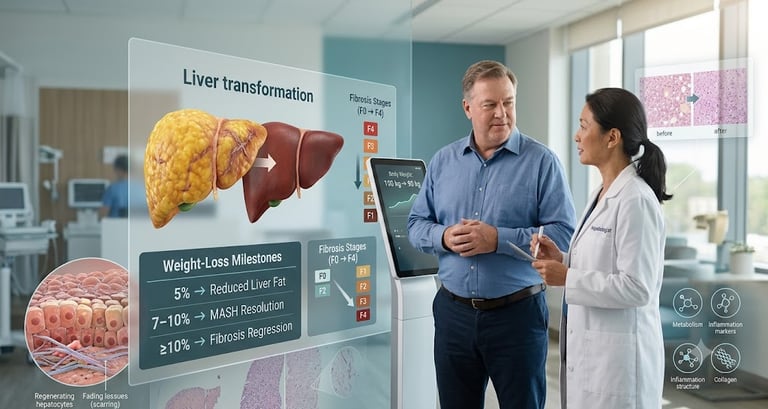

To reverse liver fibrosis (scarring) caused by MASH, clinical research shows you must lose at least 10% of your total body weight. While smaller amounts of weight loss provide other health benefits, liver healing occurs on a distinct, evidence-based staircase:
3% to 5% Weight Loss: Reduces liver fat (steatosis) and prevents new scarring.
7% to 10% Weight Loss: Resolves active liver inflammation (MASH resolution).
10% or More Weight Loss: Reverses existing liver fibrosis and lowers long-term mortality risk.
If a 10% weight loss is not achievable or sustainable through diet and exercise alone, current medical guidelines recommend discussing advanced options with a doctor—such as GLP-1 medications (like semaglutide), liver-targeted therapies (like resmetirom), or metabolic surgery.
Key takeaways
The Graded Weight-Loss Staircase Determines Healing: Liver optimization is not an all-or-nothing milestone; it is a strict dose-response staircase. While a 5% reduction in total body weight acts as the clinical "floor" to drop liver fat (steatosis) and arrest disease progression, it takes a target of 10% or greater to reliably trigger actual fibrosis regression and clear out existing scar tissue.
Fibrosis Staging, Not Liver Fat, Dictates Survival: While liver fat and enzyme levels (ALT/AST) fluctuate rapidly, the baseline fibrosis stage (F2 to F4) is the singular independent predictor of long-term mortality and liver failure. Clinical metrics matter because they track hard survival endpoints—long-term cohort data proves that failing to resolve active steatohepatitis carries a four-fold increase in 15-year mortality.
MRI-PDFF Confirms a Definitive 5.3% Fat-Drop Cutoff: Advanced noninvasive diagnostics have replaced rough historical estimates with hard thresholds. Precise 2025 MRI-based proton density fat fraction (MRI-PDFF) tracking establishes that a 5.3% weight loss serves as the exact reproducible pivot point required to consistently reduce objective liver fat metrics.
Pharmacotherapy Is First-Line, Not a Last Resort: Modern hepatology guidelines reject the outdated "try harder to diet" dogma. Intentional weight loss via lifestyle modification alone is highly unsustainable for the majority of advanced patients; individualized pharmacotherapy is now clinically positioned as a first-line, multidisciplinary standard of care rather than a fallback for lifestyle failure.
The ESSENCE Trial Validates the 10% Benchmark: Data from the landmark 2025 phase 3 ESSENCE trial of semaglutide provides definitive, randomized proof-of-concept for the 10% threshold. Patients hitting a mean weight loss of 10.5% achieved a staggering 62.9% rate of MASH resolution without worsening fibrosis.
Resmetirom Proves Weight Loss Isn't the Only Pathway: The approval of resmetirom (a THR-beta agonist) completely shatters the "weight loss or bust" paradigm. As a weight-neutral drug, it reverses active MASH and fibrosis through independent metabolic pathways—offering a crucial, guideline-backed lifeline for lean MASH phenotypes who cannot use weight reduction as a therapeutic lever.
Metabolic Surgery Offers Unmatched Fibrosis Remission: For eligible patients with severe obesity, metabolic/bariatric surgery stands out as the most durable mechanism for sustained disease reversal. Massive meta-analysis data covering over 70,000 patients reveals a 70% MASH remission rate and a 57% fibrosis remission rate, with a low 4% major complication profile.
True Intervention Requires a Staged Diagnostic Roadmap: A patient's care blueprint must be dictated by objective staging rather than a scale. Early-stage disease (F0–F1) justifies a baseline 5% containment goal, while bridging fibrosis (F2–F3) mandates aggressive scaling toward 10%+ weight management, targeted therapeutics, and active tracking via noninvasive biomarkers like FIB-4 and elastography.
Introduction
If you've been told you have MASH (metabolic dysfunction-associated steatohepatitis) or fatty liver with fibrosis, you've probably also been told to "lose weight." It's true advice. It's also frustratingly vague.
How much weight, exactly? Lose it how fast? Does 5% do anything, or do you need 10%? And if the scale won't move no matter what you try, are you out of options?
This article answers those questions with actual numbers — not "eat better and exercise more," but the specific weight-loss thresholds tied to specific liver outcomes, pulled from biopsy studies, MRI-based trials, and the major 2025–2026 clinical literature on MASLD (metabolic dysfunction-associated steatotic liver disease) and its more serious form, MASH.
More importantly, we'll walk through what these numbers mean clinically — why a 5% loss matters for fat but does almost nothing for fibrosis, why 10% is the number hepatologists actually care about, and what your options are if lifestyle change alone isn't getting you there.
1. What MASLD, MASH, and Fibrosis Actually Mean
Before the numbers, the vocabulary, because the terminology changed recently, and it trips people up.
MASLD (metabolic dysfunction-associated steatotic liver disease) is the umbrella term that replaced "NAFLD" (nonalcoholic fatty liver disease). It simply means fat has built up in the liver alongside a metabolic risk factor like obesity, type 2 diabetes, or high blood pressure.
MASH (metabolic dysfunction-associated steatohepatitis) is the more aggressive subtype, which used to be called NASH. Here, the fatty liver has become inflamed, and liver cells are being damaged (a process called "ballooning" on biopsy).
Fibrosis is the scarring that results from that ongoing injury. It's staged F0 (none) through F4 (cirrhosis).
According to a 2025 comprehensive review in the International Journal of Molecular Sciences, the global prevalence of MASLD has climbed sharply over the past two decades, making it now the leading cause of chronic liver disease worldwide, with rising downstream rates of cirrhosis, liver cancer, and cardiovascular complications.
Why fibrosis is the one to watch: Steatosis (fat) and inflammation can wax and wane. Fibrosis stage is the measurement that most consistently predicts who goes on to develop cirrhosis, liver failure, or liver-related death. It's the number your hepatologist is actually tracking, even if the conversation centers on weight.
2. The Core Question: How Much Weight Loss Is Enough?
Here's the short answer, suitable for a quick read — then we'll unpack each number.
Quick answer: Roughly 5% weight loss starts improving liver fat. About 7–10% is associated with MASH resolution (the inflammation calming down). And 10% or more is the threshold most strongly linked to actual fibrosis regression — scar tissue stepping back a stage. Below 5%, measurable liver benefit is inconsistent.
This isn't one number — it's a dose-response staircase. Different amounts of weight loss unlock different levels of liver healing, and the research over the past year has gotten much more precise about where each step sits.
The weight-loss staircase
Here is the breakdown of how progressive weight loss thresholds drive specific clinical improvements and build diagnostic confidence in treating MASH:
3–5% Weight Loss
Clinical Impact: Liver fat content (steatosis) begins to drop, showing measurable changes on MRI-PDFF or biopsy.
Confidence Level: Strong, well-established early marker.
5–7% Weight Loss
Clinical Impact: Transaminases (ALT/AST liver enzymes) show clear improvement, and liver fat reduction becomes significantly more consistent.
Confidence Level: Strong clinical indicator of metabolic recovery.
7–10% Weight Loss
Clinical Impact: Active MASH resolution becomes highly probable, and liver fibrosis (scarring) begins to stabilize.
Confidence Level: Strong, guideline-supported therapeutic milestone.
≥10% Weight Loss
Clinical Impact: True structural fibrosis regression (improving by one or more stages) becomes substantially more likely.
Confidence Level: Strong, globally recognized guideline target for established fibrosis.
≥15–20% Weight Loss (Typically via Pharmacologic or Surgical Intervention)
Clinical Impact: Yields the highest rates of dual response: simultaneous MASH resolution and significant fibrosis regression.
Confidence Level: Emerging, heavily supported by modern clinical trial data.
3. The Science: What Each Threshold Is Based On
This is where it gets clinically interesting — because each threshold traces back to a specific study design, and the type of evidence behind a number changes how confidently you should act on it.
The foundational 5% steatosis / fibrosis-prevention threshold
Much of the current guideline language tracing weight loss to liver outcomes goes back to biopsy-based cohort data showing a clear split at the 5% mark. Among patients who achieved at least 5% weight loss, none developed new fibrosis over follow-up, compared with roughly a quarter of those who lost less than 5%. Similarly, no fibrosis worsening was seen in higher responders, while it was common in patients who lost less weight.<sup>[2]</sup>
Clinical interpretation: This is why "5%" gets repeated so often in patient handouts — it's the minimum effective dose below which fibrosis prevention can't be reliably expected. It is a floor, not a target. Hitting only 5% should be framed to patients as "you've likely stopped things from getting worse," not "you've fixed the problem."
The 2025 MRI-based refinement: 5.3% as a steatosis-improvement cutoff
A 2025 study published in Hepatology Research used MRI-based proton density fat fraction (MRI-PDFF) — a noninvasive, quantitative measure of liver fat — to track 111 patients with MASLD over one year, primarily following a low-carbohydrate diet without new medications. The researchers found a dose-response relationship: the more weight patients lost, the more their MRI-PDFF and ALT (a liver enzyme) improved. They proposed that a 5.3% weight loss could serve as a practical treatment-goal cutoff for MASLD patients.
Clinical interpretation: This study matters because it used MRI, not just blood tests or ultrasound — MRI-PDFF is considered one of the more reliable noninvasive ways to quantify liver fat changes over time. It reinforces that the "5%" range isn't a rough rule of thumb; it's reproducible across different patient populations and measurement methods. For a patient and clinician setting a realistic first goal, 5% is concrete, achievable, and evidence-backed — even if it's not the finish line for someone who already has significant fibrosis.
Why did 7–10% became the guideline standard for MASH
A 2025 review in Current Diabetes Reports by Takawy and Abdelmalek, hepatologists at the Mayo Clinic, synthesized the broader weight-loss literature across lifestyle change, medication, and surgery. Their key clinical point: weight loss is foundational to treating MASLD/MASH, but achieving and sustaining it through lifestyle change alone is genuinely difficult for most patients, which is precisely why a multidisciplinary approach (dietitians, individualized pharmacotherapy, and surgical options where appropriate) is now recommended rather than diet-and-exercise advice alone.
This aligns with the broader literature consensus: weight loss of roughly 7–10% is associated with histologic improvements in MASLD/MASH, including steatohepatitis resolution and fibrosis regression, and current clinical guidelines treat intentional weight loss in this range as the cornerstone of MASLD/MASH therapy.
Clinical interpretation: The jump from "5% prevents harm" to "7–10% actively reverses disease" is the single most important distinction in this entire topic. If your care plan only targets 5%, ask whether a higher target is appropriate for your fibrosis stage.
The 2026 hepatology consensus: 10% as the fibrosis-reversal benchmark
A May 2026 review in the Cleveland Clinic Journal of Medicine, authored by a multidisciplinary Cleveland Clinic team, states the clinical bottom line plainly: to reverse fibrosis in late-stage MASH, guidelines recommend patients lose at least 10% of body weight — while explicitly acknowledging that this much weight loss is a major challenge for most patients through lifestyle modification alone, and that not all MASH patients are even overweight or obese.
That last point deserves emphasis: a meaningful minority of MASH patients are lean. Weight loss targets are not universally applicable, and this is exactly why the review's title frames its content as going "beyond telling patients to lose weight" — toward pharmacologic, surgical, and endoscopic options discussed later in this article.
Clinical interpretation: Once a patient has documented bridging fibrosis (F2-F3) or worse, "try harder to lose weight" is an incomplete care plan if 10% sustained loss hasn't been achieved or isn't achievable. This is the threshold at which a hepatologist should actively be considering pharmacotherapy alongside lifestyle counseling, not after it fails.
4. Why Fibrosis Is the Number That Matters Most
Liver fat can fluctuate. Fibrosis stage is the metric tied to actual mortality risk — and the data on this is stark.
A long-term French cohort study following bariatric surgery patients with biopsy-confirmed MASH for a median of over a decade found that patients with significant fibrosis (stage F2 or higher) at baseline had meaningfully worse 15-year survival than those without (79.8% vs. 94.0%). The same study found patients with persistent MASH after surgery had more than four times the risk of death over 15 years compared with those who achieved MASH resolution.
Clinical interpretation: This is why hepatologists talk about MASH resolution and fibrosis regression as surrogate endpoints for survival — they're not just biopsy aesthetics, they track with whether a patient lives meaningfully longer. When your doctor frames weight loss as "important for your liver," what they actually mean is "important for how long you live and whether you need a transplant." It's worth saying that explicitly, because it changes how seriously a 10% target should be taken.
5. Beyond Lifestyle: Medications That Move the Needle
If lifestyle change alone can't get you to the 7–10%+ range — and for many patients, it can't, especially long-term — two FDA-approved options now exist, plus more on the way.
Semaglutide: weight loss as the mechanism, fibrosis improvement as the result
The phase 3 ESSENCE trial (semaglutide vs. placebo in patients with biopsy-confirmed MASH and stage F2-F3 fibrosis) reported its interim 72-week histologic results in 2025, and a 2025 JHEP Reports commentary by Michel and Schattenberg put the findings in clinical context.
At 72 weeks:
62.9% of semaglutide-treated patients achieved steatohepatitis resolution without worsening fibrosis, versus 34.3% on placebo — a 28.7 percentage-point difference.<sup>[10]</sup>
32.7% of semaglutide patients achieved both MASH resolution and fibrosis improvement, compared with 16.1% on placebo.
Mean body weight reduction was approximately 10.5% with semaglutide.
No new safety signals emerged in this liver-disease population, and no signal of drug-induced liver injury was observed.
Clinical interpretation: Notice that the weight loss achieved (~10.5%) lines up almost exactly with the 10% fibrosis-reversal benchmark from the Cleveland Clinic review above. ESSENCE is essentially the pharmacologic proof of the lifestyle-derived threshold — when you hit 10%+ loss by any mechanism, fibrosis improvement becomes substantially more achievable. The mechanism matters less than reliably reaching the number; semaglutide's main clinical value here is making 10%+ loss sustainable for patients who can't get there with diet and exercise alone.
Resmetirom: fibrosis improvement without relying on weight loss
Resmetirom, a thyroid hormone receptor-beta agonist, became the first FDA-approved MASH medication in 2024 for patients with moderate-to-advanced fibrosis. Critically, it's a weight-neutral drug — its benefit on fibrosis and steatohepatitis doesn't depend on weight loss at all, which makes it a relevant option for lean MASH patients, who can't pursue meaningful weight loss as a treatment lever in the first place.
Clinical interpretation: This is the clearest evidence against a "weight loss is the only path" mental model. Resmetirom proves the liver can improve through a separate metabolic pathway entirely. For patients who are not overweight, or for whom GLP-1 drugs are contraindicated or not tolerated, this is now a guideline-recognized alternative — not a consolation prize.
6. Bariatric and Endoscopic Surgery: When Lifestyle Isn't Enough
For patients with severe obesity who qualify, bariatric surgery remains the most reliable way to achieve and sustain the 10%+ weight loss tied to fibrosis regression.
A 2026 meta-analysis pooling 29 studies and over 70,000 patients with biopsy- or elastography-confirmed MASLD found bariatric/metabolic surgery achieved a pooled MASH/MAFLD remission rate of 70% and a fibrosis remission rate of 57%, with major postoperative complications occurring in only about 4% of patients.
The same long-term French cohort referenced above found that, one year after bariatric surgery, more than 60% of patients lost over 5% of body weight, 16% lost over 10%, and fibrosis regression occurred mainly in patients who also achieved MASH resolution.
Clinical interpretation: Surgery isn't a shortcut around the dose-response relationship — it's a delivery mechanism for reaching and sustaining the same 10%+ threshold that drives fibrosis regression through any pathway. The data suggest it's currently the most durable way to do that for patients with severe obesity, which is why current guidelines support bariatric surgery as a treatment option for qualifying MASLD/MASH patients, not merely a weight-loss procedure with incidental liver benefits.
7. Evidence Summary Table
1. Resmetirom & Semaglutide Trials (Medical Management)
Michel & Schattenberg / ESSENCE Trial (2025)
Study Design: Phase 3 randomized controlled trial (RCT), interim week-72 analysis.
Population: 800 patients with biopsy-confirmed F2–F3 MASH.
Weight Loss Finding: Achieved a mean weight loss of approximately 10.5% using Semaglutide.
Liver Outcome: Resulted in a 62.9% MASH resolution rate, with 32.7% achieving dual resolution (simultaneous MASH resolution and fibrosis stage improvement).
2. Surgical & Bariatric Interventions
Bariatric/MBS Meta-Analysis (2026)
Study Design: Comprehensive meta-analysis pooling data across 29 individual studies.
Population: 71,904 patients.
Weight Loss Finding: Evaluation of substantial, surgically achieved, and long-term sustained weight loss.
Liver Outcome: Achieved a 70% MASH remission rate alongside a 57% structural fibrosis remission rate.
Lassailly et al. Bariatric Cohort (2024–2025)
Study Design: Long-term prospective cohort study with a 15-year follow-up window.
Population: 2,641 bariatric surgery patients.
Weight Loss Finding: Documented a high-magnitude weight loss (10% total body weight loss sustained at 1 year by a subset of patients).
Liver Outcome: Demonstrated a direct correlation between long-term survival, significant fibrosis regression, and sustained MASH resolution.
3. Lifestyle & Dietary Cohorts
Suzuki et al. (2025)
Study Design: Prospective cohort study utilizing MRI-PDFF tracking.
Population: 111 patients tracking a primary low-carbohydrate dietary intervention.
Weight Loss Finding: A clear dose-response curve was identified; a precise 5.3% weight-loss threshold.
Liver Outcome: Demonstrable, objective reductions in total liver fat fraction (MRI-PDFF) and serum ALT levels.
4. Expert Clinical & Narrative Reviews
Sierra et al. / Cleveland Clinic Journal of Medicine (2026)
Study Design: Clinical review focusing on therapeutic targets.
Population: Patients presenting with late-stage MASH.
Weight Loss Finding: Concluded that a minimum threshold of 10% total body weight loss is required.
Liver Outcome: The definitive target necessary to achieve actual structural fibrosis reversal.
Takawy & Abdelmalek / Current Diabetes Reports (2025)
Study Design: Narrative clinical review.
Population: General MASLD and MASH cohorts.
Weight Loss Finding: Highlights a 7–10% body weight loss as the core evidence-based therapeutic target, while noting that lifestyle interventions alone are notoriously difficult for patients to sustain long-term.
Liver Outcome: Required threshold to drive predictable MASH resolution and measurable fibrosis stabilization/improvement.
Sheikh et al. / IJMS (2025)
Study Design: Comprehensive dietary and metabolic review.
Population: General MASLD/MASH spectrum.
Weight Loss Finding: Evaluated the comparative clinical efficacy of Mediterranean, high-protein, and structured intermittent fasting patterns.
Liver Outcome: Pronounced enhancements in systemic insulin sensitivity and broader cardiometabolic serum markers.
A note on limitations: Several of these studies (notably the MRI-PDFF cohort and the bariatric cohort) are observational, not randomized — meaning weight loss correlates strongly with liver improvement but other factors (diet quality, exercise, medication changes) move alongside it and aren't fully isolated. The ESSENCE trial is randomized and placebo-controlled, which is why its findings carry more causal weight. Readers should weigh randomized evidence more heavily than cohort associations when the two seem to conflict.
8. Your Practical Action Plan
This isn't a meal plan — it's a sequencing framework based on the evidence above, to discuss with your physician or hepatologist.
Step 1: Know your fibrosis stage before you set a target
A 5% goal makes sense if you're early-stage (F0-F1). It's likely insufficient if you have F2 or higher. Ask your doctor for your FibroScan (transient elastography) score, MRI elastography result, or biopsy stage — don't guess.
Step 2: Set a realistic, staged target
First milestone: 5% body weight loss, sustained for at least 3–6 months. This is achievable for most people and has real evidence behind it for halting progression.
Second milestone: 7–10%, particularly if you have any documented fibrosis. This is where MASH resolution becomes a realistic goal.
If you have F2-F3 fibrosis and lifestyle alone hasn't reached 7–10% after a genuine attempt, this is the point at which current guideline-level evidence supports discussing pharmacotherapy (semaglutide or resmetirom, depending on your profile) or bariatric evaluation — not as a failure of willpower, but as the next clinically indicated step.
Step 3: Choose dietary patterns with actual liver-specific evidence
The 2025 IJMS comprehensive review highlights Mediterranean-style eating, higher-protein approaches, and intermittent fasting as patterns with evidence for improving insulin sensitivity and metabolic markers relevant to MASLD. None of these requires extreme restriction — consistency over months matters more than which specific pattern you choose.
Step 4: Don't skip strength and aerobic activity, even without weight loss
Liver and cardiometabolic benefits are attainable through improved diet quality and exercise even independent of weight loss on the scale — exercise is not just a weight-loss tool, it has direct hepatic benefit.
Step 5: Re-check your numbers, not just your weight
ALT/AST, noninvasive fibrosis scores (FIB-4, elastography), and ideally periodic imaging are how you and your doctor actually know whether weight loss is translating into liver healing — the scale alone can't tell you that.
⚠️ Safety note: Rapid, severe weight loss (very-low-calorie diets, especially without medical supervision) can in some cases transiently worsen liver inflammation. Any weight-loss plan involving more than modest caloric restriction, especially for patients with existing fibrosis, should be supervised by a physician or registered dietitian.
9. Common Myths & Mistakes
Myth: "Any weight loss helps the liver the same amount." False. The relationship is graded — 3% does something different than 10%. Treating all weight loss as equivalent leads people to stop too early, right before the threshold that actually changes fibrosis stage.
Myth: "If I'm not overweight, I don't need to worry about MASH." False, and clinically important. Lean MASH exists, which is exactly why resmetirom — a weight-neutral drug — was developed and approved.<sup>[6]</sup>
Myth: "Losing weight fast is always better." Not necessarily, and potentially counterproductive. Sustainability matters more than speed; the studies underpinning these thresholds tracked weight loss over 6–18+ months, not crash diets.
Mistake: Stopping at 5% and assuming the job is done. 5% is a floor for halting progression, not a ceiling for reversing existing fibrosis. If you have documented fibrosis, 5% is the beginning of the plan, not the end.
Mistake: Viewing medication as a last resort after "real" effort fails. Current guideline-level literature explicitly frames pharmacotherapy as part of a multidisciplinary first-line approach for patients who are unlikely to sustain 7–10% loss through lifestyle alone, not a fallback for those who didn't try hard enough.
10. FAQs
Q: How much weight loss is needed to reverse liver fibrosis? A: Current evidence points to roughly 10% or more sustained body weight loss as the threshold most strongly associated with actual fibrosis stage improvement, particularly in patients with established MASH and F2-F3 fibrosis.<
Q: Can 5% weight loss improve fatty liver? A: Yes — 5% is associated with measurable improvement in liver fat (steatosis) and liver enzymes, and appears to prevent new fibrosis from developing, even though it's generally not enough to reverse fibrosis that's already present.
Q: How long does it take to see liver improvement after weight loss? A: The MRI-based cohort study saw measurable liver fat changes over a 1-year observation period, and the ESSENCE trial measured its primary histologic outcomes at 72 weeks — both suggest sustained loss over many months, not weeks, is what the evidence is based on.
Q: Does losing weight cure MASH permanently? A: "Cure" isn't the right framing — MASH and fibrosis can recur if weight is regained or metabolic risk factors return. Sustained maintenance, not a one-time loss, is what the long-term survival data is built on.
Q: What if I can't lose weight through diet and exercise alone? A: This is common and explicitly anticipated in current guidance — both semaglutide and resmetirom are FDA-approved options for MASH with fibrosis, and bariatric surgery is a guideline-supported option for qualifying patients.
Q: Is fibrosis reversal actually possible, or just "stabilization"? A: Genuine regression — moving from a higher fibrosis stage to a lower one — has been documented in both the bariatric surgery cohort and the ESSENCE trial, not just disease stabilization.
Q: Do I need a liver biopsy to know my fibrosis stage? A: Not necessarily as a first step. Noninvasive tools like FIB-4 scoring, transient elastography (FibroScan), or MRI elastography are now standard first-line assessments; biopsy is typically reserved for unclear or higher-risk cases.
Q: Does exercise help even if I don't lose weight? A: Yes. Liver fat and cardiometabolic markers can improve with exercise and improved diet quality independent of weight change on the scale, which is why activity remains part of the plan even during a weight-loss plateau.
Q: Are GLP-1 drugs like semaglutide a replacement for diet and exercise in MASH? A: No — in the ESSENCE trial, semaglutide was used alongside standard care, not as a substitute for it. It's best understood as a tool that makes reaching the 10%+ threshold achievable for more patients, not a replacement for lifestyle change.
Q: Is fibrosis stage or weight loss the better predictor of how long I'll live? A: Fibrosis stage. The 15-year cohort data show survival differences tracking with baseline fibrosis severity and with whether MASH resolved after treatment — weight loss matters specifically because it's the most reliable lever for changing fibrosis stage, not because the number on the scale itself predicts survival.
Q: What's the difference between MASLD, MASH, and NAFLD/NASH? A: MASLD and MASH are the updated names (as of 2023) for what was previously called NAFLD and NASH, respectively. The conditions are the same; only the terminology and diagnostic criteria were refined to better reflect the metabolic drivers of the disease.
11. Conclusion & Next Steps
The honest, evidence-based answer to "how much weight loss helps MASH and fibrosis" isn't a single number — it's a staircase: 5% to start protecting your liver, 7–10% to realistically reverse steatohepatitis, and 10%+ to give yourself the best documented chance at actual fibrosis regression.
If you're early in this process, your first job is simple: get your fibrosis stage measured, and set a 5% goal you can actually sustain for six months. If you already know you have significant fibrosis and lifestyle change alone hasn't moved the needle, the evidence now clearly supports bringing pharmacotherapy or surgical evaluation into the conversation — not as a failure, but as the clinically appropriate next step.
Talk to your doctor about:
Getting a current fibrosis stage assessment (FIB-4, elastography, or MRI)
Setting a personalized weight-loss target based on that stage
Whether semaglutide, resmetirom, or a bariatric evaluation fits your specific profile
Disclaimer: This article is for informational purposes only and does not constitute medical advice. Individual circumstances vary, and treatment decisions should always be made in consultation with qualified healthcare professionals.
Related Articles
Why Your Scale Isn’t Moving: The Science of Fat Burning Beyond Weight Loss | DR T S DIDWAL
How Glycemic Index and Glycemic Load Influence Type 2 Diabetes | DR T S DIDWAL
The Metabolic Triad: Why Diabetes, Obesity & CVD Are One Epidemic | DR T S DIDWAL
References
Sheikh MY, Younus MF, Shergill A, Hasan MN. Diet and Lifestyle Interventions in Metabolic Dysfunction-Associated Fatty Liver Disease: A Comprehensive Review. Int J Mol Sci. 2025;26(19):9625. https://doi.org/10.3390/ijms26199625
Vilar-Gomez E, Martinez-Perez Y, Calzadilla-Bertot L, et al. Weight loss through lifestyle modification significantly reduces features of nonalcoholic steatohepatitis. Gastroenterology. 2015;149(2):367-378.
Suzuki Y, Maekawa S, Osawa L, Komiyama Y, Takada H, Muraoka M, et al. Evaluation of weight loss and improvement of steatotic liver disease using magnetic resonance imaging in patients with metabolic dysfunction associated steatotic liver disease. Hepatol Res. 2025;55(5):638-647. https://doi.org/10.1111/hepr.14163
Takawy MW, Abdelmalek MF. Impact of Weight Loss on Metabolic Dysfunction Associated Steatohepatitis and Hepatic Fibrosis. Curr Diab Rep. 2025;25:23. https://doi.org/10.1007/s11892-025-01579-1
Koutoukidis DA, Astbury NM, Tudor KE, et al. Association of Weight Loss Interventions With Changes in Biomarkers of Nonalcoholic Fatty Liver Disease: A Systematic Review and Meta-analysis. JAMA Intern Med. 2019;179(9):1262-1271.
Sierra L, Liu L, Khurana A, Patel R, Chatterjee A, Firkins S, Simons-Linares R. Reversing fibrosis in metabolic dysfunction–associated steatohepatitis—beyond telling patients to lose weight. Cleve Clin J Med. 2026;93(5):279-286. https://doi.org/10.3949/ccjm.93a.25082
Lassailly G, et al. Resolution of Metabolic Dysfunction-associated Steatohepatitis With No Worsening of Fibrosis After Bariatric Surgery Improves 15-year Survival: A Prospective Cohort Study. Clin Gastroenterol Hepatol. 2024.
Lassailly G, et al. (AASLD 2023/2024 presentation data). MASH resolution without fibrosis worsening after bariatric surgery improves long-term survival. American Association for the Study of Liver Diseases.
Michel M, Schattenberg JM. Targeting fibrosis and steatohepatitis through the metabolism – results from the ESSENCE trial. JHEP Rep. 2025;7(9):101492. https://doi.org/10.1016/j.jhepr.2025.101492
Sanyal AJ, Newsome PN, Kliers I, et al. Phase 3 Trial of Semaglutide in Metabolic Dysfunction-Associated Steatohepatitis. N Engl J Med. 2025;392(21):2089-2099. https://doi.org/10.1056/NEJMoa2413258
Sanyal AJ, Newsome PN, Kliers I, et al.; ESSENCE Study Group. (Interim histologic analysis at week 72, presented AASLD 2025.)
Michel M, Schattenberg JM. JHEP Rep. 2025;7(9):101492 (safety and noninvasive test findings).
Harrison SA, Bedossa P, Guy CD, et al. A Phase 3, Randomized, Controlled Trial of Resmetirom in NASH with Liver Fibrosis. N Engl J Med. 2024;390(6):497-509. https://doi.org/10.1056/NEJMoa2309000
American Association for the Study of Liver Diseases (AASLD). Resmetirom therapy for metabolic dysfunction-associated steatotic liver disease: October 2024 updates to AASLD Practice Guidance. Hepatology. 2025;81(1):312-320.
Metabolic and bariatric surgery in MAFLD: a meta-analysis of endocrine outcomes, fibrosis remission, and postoperative complications. 2026 (29 studies, n=71,904).
Lassailly G, et al. Resolution of MASH with no worsening of fibrosis after bariatric surgery improves 15-year survival: a prospective cohort study. Lille Bariatric Cohort, 1994-2021.
Stine JG, et al. Lifestyle intervention for metabolic dysfunction-associated fatty liver disease: a 24-h integrated behavior perspective.
European Association for the Study of the Liver (EASL), European Association for the Study of Diabetes (EASD), European Association for the Study of Obesity (EASO). EASL-EASD-EASO Clinical Practice Guidelines on the management of metabolic dysfunction-associated steatotic liver disease (MASLD). J Hepatol. 2024;81(1):1-51.
Rinella ME, Neuschwander-Tetri BA, Siddiqui MS, et al. AASLD Practice Guidance on the clinical assessment and management of nonalcoholic fatty liver disease. Hepatology. 2023;77(5):1797-1835.
American Diabetes Association Professional Practice Committee. Comprehensive Medical Evaluation and Assessment of Comorbidities: Standards of Care in Diabetes—2025. Diabetes Care. 2025;48(Suppl 1):S59-S85.