Can Your Brain Actually Regrow New Cells? What the Latest Neuroscience Reveals
Discover whether the adult brain can grow new neurons. Learn how neurogenesis in the hippocampus affects memory, depression, aging, and brain health.
AGING
Dr. T.S. Didwal, M.D.(Internal Medicine)
3/11/202617 min read
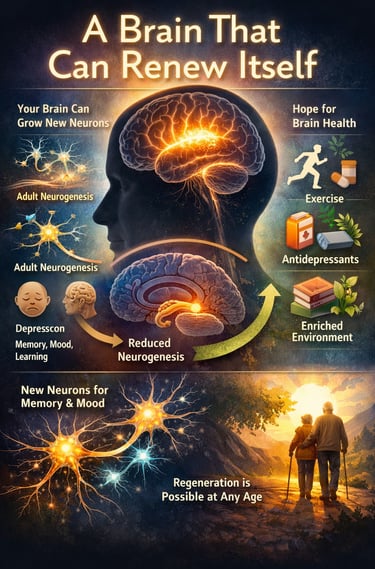
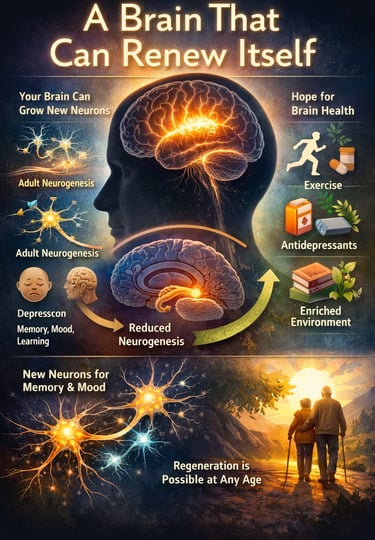
New neuroscience research shows the adult brain can generate new neurons through neurogenesis. Learn how the hippocampus, stress, exercise, and aging influence brain regeneration and mental health.
For most of modern medical history, one assumption about the human brain seemed unquestionable: neurons lost in adulthood could never be replaced. According to this long-standing belief, the brain matures in early life and then gradually declines, with aging, stress, and disease slowly eroding its structure and function.
Over the past three decades, however, neuroscience has undergone a profound shift. A growing body of research now shows that the adult brain retains the remarkable ability to generate new neurons, a process known as adult neurogenesis. This discovery has fundamentally changed how scientists think about brain plasticity, mental health, and cognitive aging (Chen et al., 2025).
The most active region for this regeneration appears to be the hippocampus, a small but critical brain structure involved in memory formation, emotional regulation, and learning. Within the hippocampus lies the dentate gyrus, where neural stem cells can divide and mature into functioning neurons that integrate into existing brain circuits. These newly formed cells may help the brain perform pattern separation, improve cognitive flexibility, and regulate mood (Sharma et al., 2025).
Why does this matter? Because many of the most common neurological and psychiatric disorders — including depression, anxiety, cognitive decline, and Alzheimer’s disease — involve dysfunction of the hippocampus and impaired neuroplasticity. Emerging research suggests that reduced adult hippocampal neurogenesis (AHN) may contribute to these conditions, while treatments that restore neurogenesis — including exercise, antidepressant therapy, and enriched environments — may improve brain function (Shetty & Hitoshi, 2025).
Recent human research has further strengthened this concept. A landmark study examining brain tissue across the lifespan confirmed that neurogenesis persists in the adult and aging human hippocampus, although it declines with age and is significantly reduced in Alzheimer’s disease (Disouky et al., 2026).
In other words, the adult brain is not a static organ slowly running down. It is a dynamic, adaptable system capable of renewal, and understanding how this process works may open new possibilities for protecting memory, mental health, and cognitive resilience throughout life.
What This Article Will Teach You
This article explains the science of adult neurogenesis, the brain’s ability to generate new neurons throughout life. You will learn how the hippocampus supports memory, learning, and emotional regulation, and how factors like stress, sleep, exercise, and aging influence brain plasticity. The article also explores how reduced neurogenesis may contribute to depression, cognitive decline, and Alzheimer’s disease, and highlights emerging research on therapies that could help support brain regeneration and long-term mental health.
Key Takeaways
• The adult brain can generate new neurons in the hippocampus
• Chronic stress suppresses neurogenesis through cortisol and inflammation
• Exercise is the strongest lifestyle promoter of new brain cell formation
• Neurogenesis declines with aging and Alzheimer’s disease
• Lifestyle interventions can partially restore brain plasticity
Clinical Pearls
1. The "Fertilizer" Effect (BDNF)
Scientific Perspective: Aerobic exercise upregulates Brain-Derived Neurotrophic Factor (BDNF). BDNF acts as a high-affinity ligand for the TrkB receptor, promoting the survival and differentiation of neural progenitor cells in the dentate gyrus.
Think of BDNF as "Miracle-Gro" for your brain. When you get your heart rate up, your body releases a protein that helps your brain grow new cells and keeps the old ones from dying.
2. The Hippocampal "Volume" Dial
Scientific Perspective: Chronic hypercortisolemia (high cortisol) leads to hippocampal atrophy by suppressing cell proliferation and increasing neuroinflammation. This is a primary structural hallmark of treatment-resistant depression.
Stress is literally toxic to the "memory center" of your brain. Constant worry acts like a volume knob that turns down the production of new brain cells, which is why your memory feels "foggy" when you’re burnt out.
3. The "Use It or Lose It" Recruitment
Scientific Perspective: Newly born neurons undergo a "critical period" where they must be integrated into existing excitatory circuits to survive. Synaptic integration is heavily dependent on novel cognitive demands (pattern separation).
Your brain is efficient—it won’t keep a new cell it doesn't need. To keep "baby" neurons alive, you have to give them a job. Learning something totally new, like a language or a difficult skill, "hires" those cells so they don't get pruned away.
4. The Sleep-Cleaning Cycle
Scientific Perspective: During slow-wave sleep, the glymphatic system clears metabolic waste (like amyloid-beta) that otherwise inhibits the neurogenic niche. Sleep deprivation triggers a pro-inflammatory microenvironment that stalls stem cell division.
Sleep is when your brain does the "janitorial work." It washes away the day's trash so the "construction crew" can build new cells. Without deep sleep, the job site is too messy for new growth to happen.
5. The Antidepressant "Lag" Explained
Scientific Perspective: The 4-to-6-week delay in SSRI efficacy corresponds to the time required for a neural stem cell to mature and integrate into a functional circuit. The clinical "lift" in mood is often a result of restored neuroplasticity, not just a change in serotonin levels.
People often wonder why antidepressants take weeks to work. It’s because the medicine isn’t just changing a chemical; it’s actually rebuilding parts of your brain. It takes about a month for a new brain cell to "grow up" and start doing its job.
6. Inflammation as a Growth Blocker
Scientific Perspective: A diet high in ultra-processed foods (UPFs) and trans fats triggers systemic neuroinflammation, which shifts the brain’s immune cells (microglia) into a "pro-inflammatory" state that kills off newborn neurons.
Your diet is the "raw material" for your brain. Eating lots of sugar and processed oils is like trying to build a house in a swamp; the environment becomes too inflamed for new cells to survive. Healthy fats, like those in nuts or fish, provide a solid foundation for growth.
What Is Adult Neurogenesis — and Where Does It Happen?
Neurogenesis literally means "the birth of neurons." In the developing brain of a fetus or infant, neurogenesis is happening at an enormous rate. What surprised researchers — and continues to generate excitement — is that this process does not completely stop when we reach adulthood.
The most well-established site of adult neurogenesis in the human brain is the hippocampus — specifically a region called the dentate gyrus. The hippocampus is a seahorse-shaped structure buried deep in the brain's temporal lobe, and it plays a central role in forming new memories, regulating emotions, and helping us navigate space and context.
According to Chen et al. (2025), adult hippocampal neurogenesis (AHN) is a highly dynamic process involving the proliferation, differentiation, migration, and maturation of neural stem cells into fully functional neurons. These newly born neurons, once they integrate into existing brain circuits, are thought to play a critical role in pattern separation (the brain's ability to distinguish between similar experiences), emotional regulation, and cognitive flexibility — the ability to adapt thinking to new situations.
A second site of potential adult neurogenesis, the olfactory bulb (related to the sense of smell), has also been identified in animal studies, though the human evidence here is still being debated.
What is not debated is this: what happens in the hippocampus matters enormously for your mental and cognitive health — and the rate at which new neurons are born there can be influenced, for better or worse, by factors within our control.
The Stress Connection: How Chronic Stress Silences Neurogenesis
If you've ever gone through a prolonged period of stress — caregiving, grief, financial hardship, a difficult relationship — and noticed your memory becoming foggy, your motivation draining away, and your mood darkening, there is neurobiological logic behind that experience.
Sharma et al. (2025) provide a comprehensive look at how stress directly suppresses hippocampal neurogenesis. When the brain perceives a threat — physical or psychological — it activates the hypothalamic-pituitary-adrenal (HPA) axis, flooding the body with stress hormones, particularly cortisol (called corticosterone in rodents). In the short term, this is adaptive. In the long term, chronically elevated cortisol is essentially toxic to the hippocampus.
The mechanisms are multiple and interconnected:
Reduced cell proliferation: High cortisol inhibits neural stem cells from dividing, meaning fewer new neurons are being produced.
Impaired cell survival: Even when new neurons are born, chronically elevated stress hormones reduce their chances of surviving long enough to become fully functional.
Inflammation: Chronic stress promotes neuroinflammation — a state of low-grade, persistent immune activation in the brain — which further disrupts the neurogenic process.
Epigenetic changes: Stress can alter the way genes are expressed in hippocampal cells without changing the underlying DNA, creating lasting changes in brain function that can, troublingly, be passed on across generations.
This is why stress management is not merely a lifestyle preference. It is, literally, brain architecture. The good news embedded in this research is the same as the warning: because neurogenesis is so responsive to environment and lifestyle, the factors that suppress it are largely the same ones that, when addressed, can restore it.
Neurogenesis and Mental Health: The Depression-Neurogenesis Link
One of the most compelling hypotheses in modern psychiatry is the neurogenic hypothesis of depression, which proposes that reduced hippocampal neurogenesis is not merely a consequence of depression, but a potential contributing cause — and that effective antidepressant treatment works, at least in part, by restoring it.
The evidence is striking. People who have experienced major depression show measurable reductions in hippocampal volume. Animal studies consistently show that social defeat stress, chronic unpredictable stress, and other depression models reduce neurogenesis. Conversely, virtually every effective antidepressant treatment — SSRIs, SNRIs, ketamine, electroconvulsive therapy, and even physical exercise — has been shown to increase hippocampal neurogenesis in preclinical models.
Shetty and Hitoshi (2025) note in their editorial that this convergence of evidence across treatment modalities is not coincidental. The fact that such diverse interventions all share a neurogenic effect suggests that hippocampal neurogenesis may be a final common pathway — a biological bottleneck through which many forms of effective brain treatment operate, regardless of their specific mechanism.
This insight is clinically significant. If we could directly and reliably stimulate neurogenesis — without the side effects of current medications, and without requiring weeks of treatment before effects emerge — we might have a transformative new approach to mood disorders. That is exactly what researchers are working toward.
Neurogenesis in Aging and Alzheimer's Disease: New Findings from 2026
Perhaps the most striking recent development in neurogenesis research comes from a landmark 2026 study published in Nature by Disouky et al. This study examined human hippocampal neurogenesis directly — something that is technically very difficult to do — across the lifespan, including in individuals with Alzheimer's disease.
The findings are both encouraging and sobering. On the encouraging side, the study confirms that neurogenesis does indeed occur in the adult and aging human hippocampus — putting to rest lingering doubts raised by earlier studies that had cast uncertainty on whether human adult neurogenesis was real at significant levels. On the sobering side, the research documents that neurogenesis declines with advancing age and that this decline is significantly accelerated in Alzheimer's disease.
This matters because the hippocampus is ground zero for Alzheimer's pathology. The disease is characterized by the accumulation of amyloid-beta plaques and tau tangles — abnormal protein deposits that disrupt neural communication and kill neurons. The finding that neurogenesis is suppressed in Alzheimer's patients adds a new dimension to understanding the disease: it is not merely destroying existing neurons; it may also be shutting down the brain's capacity to regenerate.
This raises a fascinating therapeutic question: could boosting neurogenesis in people with early Alzheimer's disease help compensate for neuron loss and slow cognitive decline? While that question remains open, it is now being taken seriously by researchers in a way it was not just a decade ago.
Neuroplasticity: The Bigger Picture
• The adult brain is not biologically static.
For decades, neuroscience textbooks taught that neurons lost in adulthood could never be replaced. Modern research has fundamentally revised this view. Evidence now shows that the adult human brain retains the capacity to generate new neurons through a process known as adult neurogenesis, particularly within the hippocampus, a structure central to memory formation, emotional regulation, and cognitive flexibility.
• The hippocampus appears to be the primary neurogenic niche.
Neural stem cells located in the dentate gyrus of the hippocampus can proliferate, differentiate, and integrate into existing neural circuits. These newly formed neurons may support critical cognitive processes such as pattern separation, learning adaptability, and emotional processing, linking neurogenesis directly to both cognition and mental health.
• Chronic stress is a powerful suppressor of neurogenesis.
Activation of the hypothalamic–pituitary–adrenal (HPA) axis during prolonged stress elevates cortisol levels, which inhibit neural stem cell proliferation and reduce survival of newly generated neurons. Stress-related neuroinflammation and epigenetic changes may further impair hippocampal plasticity.
• Reduced neurogenesis may contribute to major psychiatric disorders.
The neurogenic hypothesis of depression proposes that impaired hippocampal neurogenesis may be a contributing biological mechanism underlying depressive illness. Interestingly, many effective antidepressant interventions—including SSRIs, ketamine, electroconvulsive therapy, and aerobic exercise—appear to enhance neurogenesis in experimental models.
• Aging and Alzheimer’s disease further suppress neurogenesis.
Recent human studies indicate that although neurogenesis persists across the lifespan, its rate declines with age and is markedly reduced in Alzheimer’s disease, potentially contributing to progressive memory loss and hippocampal atrophy.
• Lifestyle interventions remain the most reliable neurogenic stimuli.
Among modifiable factors, aerobic exercise, adequate sleep, cognitive stimulation, social engagement, and anti-inflammatory dietary patterns show consistent associations with enhanced neuroplasticity and hippocampal health.
• Future therapies may target neurogenesis directly.
Emerging research is exploring pharmacological pathways—including BDNF signaling, Wnt pathways, and stem-cell-based approaches—that could potentially stimulate neuronal regeneration as treatments for neurodegenerative and psychiatric disorders.
• The broader implication is transformative.
Rather than viewing the brain as a slowly deteriorating organ, modern neuroscience increasingly portrays it as a dynamic and adaptive system capable of renewal throughout life.
What Promotes Neurogenesis? Evidence-Based Strategies
This is where the science becomes directly actionable. Based on the convergent findings across the studies reviewed here, the following factors have strong evidence for supporting adult hippocampal neurogenesis:
1. Aerobic Exercise
Physical exercise — particularly sustained aerobic activity like brisk walking, jogging, swimming, or cycling — is consistently the most powerful lifestyle promoter of hippocampal neurogenesis identified in the scientific literature. Exercise increases levels of brain-derived neurotrophic factor (BDNF), a protein that acts like fertilizer for new neurons, supporting their growth, survival, and integration into brain circuits. Chen et al. (2025) emphasize that exercise-induced neurogenesis is one of the most reproducible findings across species, including in humans.
The dose doesn't need to be extreme. Even moderate, consistent aerobic activity — 30 minutes most days — appears to be sufficient to produce meaningful neurogenic effects.
2. Cognitive Stimulation and Learning
The brain is use-dependent: circuits that are regularly engaged tend to strengthen, and newly born neurons that are recruited into active circuits tend to survive, while those that remain unused are pruned. Engaging in activities that challenge the brain — learning a new language, playing a musical instrument, solving puzzles, engaging in complex professional work — helps maintain and enhance hippocampal function.
Importantly, the novelty of the challenge matters. Routine activities, even cognitively demanding ones you've done for years, may provide less neurogenic stimulus than genuinely new learning.
3. Sleep
During sleep — particularly during slow-wave (deep) sleep — the brain consolidates memories, clears metabolic waste products through the glymphatic system, and engages in significant restorative processes. Poor sleep is associated with reduced hippocampal volume and impaired neurogenesis. Sharma et al. (2025) note that sleep disturbance is both a consequence and a cause of hippocampal stress, creating a cycle that, if left unaddressed, compounds over time.
Prioritizing sleep hygiene — consistent sleep and wake times, a dark and cool sleep environment, limiting screens before bed — is not just good general health advice. It is a direct brain-health intervention.
4. Social Connection
Loneliness and social isolation are among the most potent activators of the brain's stress response. Conversely, positive social relationships and a sense of belonging appear to buffer against the neurogenic suppression caused by stress. Social engagement that involves genuine emotional reciprocity — not passive social media consumption — is the relevant variable here.
5. Diet and Nutrition
Several dietary factors have been linked to neurogenesis support, including omega-3 fatty acids (found in fatty fish, flaxseed, and walnuts), polyphenols (found in berries, dark chocolate, green tea, and olive oil), and caloric restriction in moderate forms. High-sugar, high-fat ultra-processed diets, by contrast, are associated with neuroinflammation and suppressed neurogenesis.
6. Stress Management
Given the profound anti-neurogenic effects of chronic stress detailed above, any effective stress-management practice — mindfulness meditation, yoga, therapy, time in nature, creative expression — has the potential to protect and restore hippocampal neurogenesis indirectly, by lowering circulating stress hormones and reducing neuroinflammation.
Emerging Therapeutic Approaches: What's on the Horizon
Beyond lifestyle interventions, researchers are actively developing pharmacological and cell-based therapies designed to directly stimulate neurogenesis as a treatment for brain disorders.
Chen et al. (2025) review several promising avenues, including:
Small molecule drugs that target specific signaling pathways (such as Wnt, Notch, and BDNF/TrkB pathways) are known to regulate neural stem cell activity.
Stem cell transplantation approaches, in which externally grown neural progenitor cells are introduced into the hippocampus, though significant challenges around cell survival, integration, and immune response remain.
Gene therapy strategies that aim to upregulate pro-neurogenic genes or silence those that suppress neurogenesis.
Non-invasive brain stimulation techniques, including transcranial magnetic stimulation (TMS) and transcranial direct current stimulation (tDCS), show early promise for enhancing hippocampal plasticity.
Shetty and Hitoshi (2025) note that while none of these approaches is yet ready for routine clinical use, the pace of progress is accelerating. The translation of neurogenesis research from animal models to human applications is one of the most active areas in neuroscience, with clinical trials increasingly incorporating neurogenic endpoints.
A Note on What We Don't Yet Know
Science is honest about its limits, and so should we be. Several important questions remain unresolved:
How much neurogenesis is "enough"? We do not yet have a clear quantitative relationship between rates of neurogenesis and specific clinical outcomes in humans.
Does enhancing neurogenesis directly cause improvement in symptoms, or is it a marker of broader brain health improvement triggered by the same underlying processes?
Individual variation is substantial. Genetic factors, prior brain exposures, baseline stress levels, age, sex, and many other variables likely influence how responsive any given person's brain is to pro-neurogenic interventions.
These are not reasons for skepticism about neurogenesis research — they are the normal, healthy uncertainties of frontier science. The foundational evidence is robust and growing. The therapeutic implications are real, even if the precise clinical translation is still being worked out.
Faqs
Q1. Can adults really grow new brain cells? I thought that wasn't possible.
Yes — this is one of the most important scientific revisions of recent decades. While it was once believed that the adult brain could not generate new neurons, research has firmly established that certain brain regions, particularly the hippocampus, do continue to produce new neurons throughout adulthood. A landmark 2026 study published in Nature by Disouky et al. confirmed this directly in human brain tissue across the lifespan. The process is not as rapid or widespread as in the developing brain, but it is real, meaningful, and responsive to the choices we make.
Q2. Can I actually do anything to improve my own neurogenesis, or is it all determined by genetics?
Genetics play a role, but lifestyle and environment matter enormously — and the good news is that the factors that promote neurogenesis are largely within our control. Regular aerobic exercise, quality sleep, genuine social connection, a nutrient-rich diet, cognitive challenge, and effective stress management all have scientific support as neurogenesis-promoting factors. Conversely, chronic stress, poor sleep, social isolation, and an ultra-processed diet suppress it. You have more influence over your brain's regenerative capacity than most people realize.
Q3. Is this relevant to depression? I've heard the hippocampus is involved.
Very much so. The "neurogenic hypothesis of depression" proposes that reduced hippocampal neurogenesis is a key biological feature of depression — and that restoring it may be part of how antidepressants work. This is supported by evidence that virtually every effective antidepressant treatment, from SSRIs to exercise to ketamine, increases hippocampal neurogenesis in research models. This doesn't mean neurogenesis is the only mechanism, but it is increasingly recognized as an important one. If you are managing depression, discussing this with your healthcare provider and exploring neurogenesis-supportive lifestyle practices alongside any prescribed treatment is well worth considering.
Q4. Does neurogenesis slow down as we age? Should older adults be worried?
Neurogenesis does decline with age — this is confirmed by the research, including Disouky et al. (2026). However, this decline is not absolute, and it is modifiable. Older adults who exercise regularly, sleep well, stay cognitively and socially engaged, and manage stress effectively show better hippocampal health than those who do not. Age is a factor, but it is far from destiny. In fact, some of the most compelling research on exercise and neurogenesis involves older adults, in whom the benefits are clearly measurable.
Q5. What does neurogenesis have to do with Alzheimer's disease?
The connection is significant. Disouky et al. (2026) found that neurogenesis is substantially reduced in people with Alzheimer's disease, beyond what aging alone would predict. Since the hippocampus is the brain region most severely affected by Alzheimer's in its early stages, this suppression of neurogenesis may contribute to the memory and cognitive symptoms of the disease. Researchers are now exploring whether stimulating neurogenesis could help slow or partially compensate for Alzheimer's-related neuronal loss — a genuinely exciting avenue that is currently under active investigation.
Q6. Are there medications that can boost neurogenesis?
Several existing medications — particularly antidepressants in the SSRI class — are known to increase hippocampal neurogenesis as part of their mechanism of action. Beyond existing drugs, researchers are actively developing new therapies specifically designed to promote neurogenesis by targeting pathways such as BDNF/TrkB, Wnt, and Notch signaling. Non-invasive brain stimulation techniques (such as TMS) also show promise. However, none of these novel neurogenesis-specific therapies has yet reached routine clinical approval. For now, the most evidence-backed neurogenesis support remains lifestyle-based, ideally in combination with any treatments your healthcare provider recommends.
Q7. If neurogenesis is so important, why haven't I heard more about it from my doctor?
This is a fair question. The science of adult neurogenesis is advancing rapidly, but there is always a lag between research findings and widespread clinical awareness. Many of the most compelling studies — including several cited in this article — were published in 2025 and 2026. As this field matures and more clinical trials are completed, neurogenesis-informed approaches to brain health are likely to become more mainstream in medical practice. In the meantime, discussing the lifestyle factors that support brain health with your healthcare provider — particularly exercise, sleep, and stress management — is always appropriate and evidence-backed.
Common Questions People Ask About Growing New Brain Cells
Can exercise grow new brain cells?
Research shows aerobic exercise increases brain-derived neurotrophic factor (BDNF), a protein that supports the growth and survival of neurons in the hippocampus.
Does stress kill brain cells?
Chronic stress raises cortisol levels, which can suppress neurogenesis and shrink the hippocampus over time.
Can diet improve brain regeneration?
Nutrients such as omega-3 fatty acids and polyphenols support brain plasticity, while ultra-processed diets may increase neuroinflammation that harms new neurons.
Do antidepressants grow new brain cells?
Many antidepressants appear to stimulate hippocampal neurogenesis, which may partly explain why their benefits emerge gradually over several weeks.
Can older adults still grow new neurons?
Yes. Although neurogenesis declines with age, studies show it continues in the adult hippocampus and can be supported by exercise, sleep, and cognitive engagement.
Author’s Note
Advances in neuroscience over the past two decades have reshaped how scientists understand the human brain. One of the most significant developments is the recognition that the adult brain retains a degree of regenerative potential through processes such as neurogenesis and neuroplasticity. While earlier models portrayed the brain as largely fixed after development, emerging evidence suggests that certain regions—particularly the hippocampus—may retain the ability to generate new neurons and reorganise neural circuits across the lifespan.
This article was written to translate complex neuroscience research into clear, accessible language without sacrificing scientific accuracy. The goal is not only to explain the biology of adult hippocampal neurogenesis, but also to place it within the broader context of mental health, aging, and neurological disease. Research reviewed here draws from recent peer-reviewed studies in neuroscience, stem cell biology, and behavioral brain research published between 2025 and 2026.
It is important to recognize that neurogenesis research is still evolving. While evidence supporting adult hippocampal neurogenesis in humans has grown substantially, important questions remain regarding its magnitude, functional significance, and therapeutic potential. Scientific understanding progresses through ongoing investigation, replication, and debate, and future studies will continue refining our knowledge of how the adult brain adapts and repairs itself.
For readers, the most practical implication of this research is encouraging: the brain is highly responsive to environmental and behavioral influences. Factors such as physical activity, cognitive engagement, sleep quality, stress regulation, and social interaction appear to support brain plasticity and overall neurological health.
This article is intended for educational purposes and to promote informed discussion about brain health and neuroscience research. It should not be interpreted as medical advice or a substitute for consultation with qualified healthcare professionals.
Disclaimer: This article is for informational purposes only and does not constitute medical advice. Individual circumstances vary, and treatment decisions should always be made in consultation with qualified healthcare professionals.
Related Articles
Mitochondria, Motor Units, and Muscle Aging: A Complete Guide | DR T S DIDWAL
Exercise and Longevity: The Science of Protecting Brain and Heart Health as You Age | DR T S DIDWAL
The Science of Healthy Brain Aging: Microglia, Metabolism & Cognitive Fitness | DR T S DIDWAL
The Aging Muscle Paradox: How Senescent Cells Cause Insulin Resistance and The Strategies to Reverse It | DR T S DIDWAL
References
Chen, L., Li, Z., Wang, W., Zhou, Y., Li, W., & Wang, Y. (2025). Adult hippocampal neurogenesis: New avenues for treatment of brain disorders. Stem Cell Reports, 20(9), 102600. https://doi.org/10.1016/j.stemcr.2025.102600
Disouky, A., Sanborn, M. A., Sabitha, K. R., et al. (2026). Human hippocampal neurogenesis in adulthood, ageing and Alzheimer's disease. Nature. https://doi.org/10.1038/s41586-026-10169-4
Gazerani, P. (2025). The neuroplastic brain: Current breakthroughs and emerging frontiers. Brain Research, 1858, 149643. https://doi.org/10.1016/j.brainres.2025.149643
Sharma, V. K., Sharma, P., Mannan, A., Dhiman, S., Mohan, M., Singh, S., & Singh, T. G. (2025). Hippocampal neurogenesis: Bridging stress, cognitive decline, and therapeutic strategies for neural health. Behavioural Brain Research, 494, 115720. https://doi.org/10.1016/j.bbr.2025.115720
Shetty, A. K., & Hitoshi, S. (2025). Editorial: Therapeutic potential of adult neurogenesis in neurodegenerative and neuropsychiatric disorders. Frontiers in Neuroscience, 19, 1719276. https://doi.org/10.3389/fnins.2025.1719276