Age-Proof Your Muscle: How Leucine Reawakens Muscle Growth After 40
Muscle loss after 40 isn’t inevitable. Learn how leucine activates muscle growth, improves strength, and helps reverse sarcopenia with science-backed dosing.
EXERCISE
Dr. T.S. Didwal, M.D.(Internal Medicine)
1/28/202615 min read
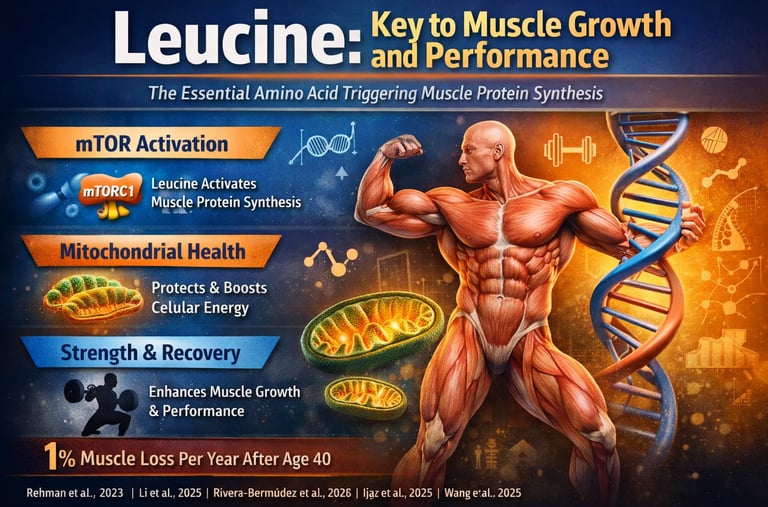
Muscle loss does not begin in old age—it begins silently in early adulthood, accelerating with physical inactivity, illness, and metabolic stress. By the age of 40, most individuals lose approximately 1% of muscle mass per year, a process that intensifies with aging and underlies frailty, insulin resistance, reduced mobility, and loss of independence. While resistance training and adequate protein intake remain the cornerstones of muscle health, emerging research suggests that not all amino acids are biologically equal in triggering muscle growth. Among them, leucine has emerged as a central metabolic signal rather than merely a structural building block.
Leucine is unique in its ability to directly activate the mechanistic target of rapamycin complex 1 (mTORC1)—the master regulator of muscle protein synthesis—thereby initiating the anabolic cascade required for muscle repair and growth (Rehman et al., 2023). Unlike total protein intake, which provides raw materials, leucine functions as a molecular “on-switch,” determining whether dietary amino acids are used for muscle construction or diverted elsewhere. This distinction becomes especially critical in aging, where anabolic resistance blunts the muscle-building response to normal protein consumption (Ijaz et al., 2025).
Recent discoveries have further expanded leucine’s role beyond muscle size alone. Groundbreaking cellular research demonstrates that leucine preserves mitochondrial integrity and respiratory efficiency, linking amino acid signaling directly to cellular energy production and metabolic resilience (Li et al., 2025). At the organismal level, randomized controlled trials and transcriptomic analyses now show that leucine supplementation enhances strength, recovery, and athletic performance, while activating genes essential for muscle adaptation (Rivera-Bermúdez et al., 2025; Wang et al., 2025).
Together, these findings position leucine not as a supplement trend, but as a biologically essential regulator of muscle health across the lifespan.
Clinical pearls
1. The "Anabolic Threshold" (The Leucine Trigger)
The Science: Muscle Protein Synthesis (MPS) is not a linear response to protein intake; it operates on a "switch" mechanism. To initiate translation initiation via the mTORC1 pathway, intracellular leucine must reach a specific concentration, often referred to as the Leucine Threshold.
The Patient-Friendly Take: Think of leucine like the key to a car ignition. You can fill the tank with gas (other amino acids), but the car won’t move until you turn the key. You need a specific "burst" of leucine—about 2.5 to 3 grams—in a single sitting to tell your body to start building muscle.
2. Muscle Quality vs. Muscle Quantity
The Science: In aging populations (Sarcopenia), the ratio of force production to muscle cross-sectional area often declines. Recent research, such as the Ijaz et al. (2025) study, shows that leucine doesn't just increase fiber size; it improves myofibrillar protein density, enhancing "muscle quality."
The Patient-Friendly Take: It’s not just about how big your muscles look, but how well they work. Leucine helps "clean up" and strengthen the muscle fibers you already have, making you stronger and more stable even if you don't look like a bodybuilder.
3. The "Anabolic Resistance" of Aging
The Science: Older adults often exhibit anabolic resistance, where the muscle becomes less sensitive to low doses of amino acids. Clinical evidence suggests that higher bolus doses of leucine can "re-sensitize" older muscle tissue to protein, effectively bypassing this age-related metabolic hurdle.
The Patient-Friendly Take: As we get older, our muscles become "hard of hearing" when it comes to nutritional signals. Leucine acts like a megaphone, shouting the message to "stay strong" loud enough so your body actually listens and responds.
4. Mitochondrial "Housekeeping"
The Science: Beyond building new tissue, leucine plays a role in mitochondrial proteostasis. By inhibiting the degradation of outer mitochondrial membrane proteins, leucine ensures that the "cellular power plants" remain intact, supporting aerobic capacity and metabolic flexibility.
The Patient-Friendly Take: Leucine doesn't just build the "walls" of your muscle; it protects the "power plants" inside them. This helps you have more energy during your walks or workouts and helps your body bounce back faster the next day.
5. The Post-Workout "Window of Opportunity"
The Science: Exercise sensitizes the skeletal muscle to amino acid uptake for up to 24–48 hours, but the hyperemic effect (increased blood flow) immediately post-exercise allows for a more rapid delivery of leucine to the sarcoplasm, maximizing the fractional synthetic rate (FSR).
The Patient-Friendly Take: Timing matters. While you benefit from protein all day, your muscles are most "hungry" right after a workout. Taking leucine within an hour or two of exercise ensures the "delivery truck" gets the building materials to your muscles while the gates are wide open.
Leucine for Muscle Growth: Comprehensive Science-Backed Guide to This Essential Amino Acid
What Is Leucine? The Amino Acid That Triggers Muscle Growth
Leucine is one of nine essential amino acids, meaning your body cannot produce it on its own—you must obtain it from food sources or supplements. It belongs to a special category called branched-chain amino acids (BCAAs), along with isoleucine and valine.
What makes leucine unique compared to other amino acids is its exceptional ability to activate mTORC1 (mechanistic target of rapamycin complex 1), a cellular signaling pathway that acts like a "master switch" for muscle protein synthesis—the biological process where your body builds new muscle tissue.
In simpler terms: when leucine levels spike in your bloodstream, your muscles receive a powerful signal to start building and repairing protein. This is why leucine supplementation has become increasingly popular among athletes, fitness enthusiasts, and healthcare professionals working with aging populations.
Research Study 1: Leucine's Role in Animal Growth and Development
A major study by Rehman et al. (2023), published in Frontiers in Physiology, provided a comprehensive research progress review on leucine's role and mechanism in regulating animal growth and development. This systematic analysis synthesized findings across multiple studies to understand how leucine influences development from the cellular level to whole-organism effects.
This research highlighted several critical mechanisms by which leucine regulates growth:
Activation of mTORC1 Pathway: The study emphasized that leucine is one of the most potent activators of the mTORC1 signaling pathway, which controls protein synthesis, cell growth, and metabolic homeostasis. This activation occurs through multiple mechanisms, including direct sensing of leucine by cellular proteins.
Enhanced Protein Synthesis: The review documented how leucine supplementation increases muscle protein synthesis rates, leading to greater muscle mass accumulation. This effect was particularly pronounced during growth periods and in response to resistance exercise.
Metabolic Efficiency: Leucine was shown to improve overall metabolic efficiency by optimizing nutrient utilization and reducing protein breakdown. This means your body becomes better at building muscle and maintaining it.
Developmental Applications: The research suggested that leucine's role extends beyond adult muscle building to encompass growth during childhood and adolescence, making it relevant across the lifespan.
Key Takeaways for Your Health
Leucine works by activating deep cellular signaling pathways that control muscle growth
The benefits extend across different life stages, from childhood to adulthood
Understanding leucine's mechanisms helps explain why strategic supplementation can be effective
The amino acid affects not just muscle tissue but overall growth and development
This foundational research establishes that leucine supplementation isn't just a fad—it's grounded in solid biology. The cellular mechanisms researchers identified provide the "why" behind leucine's effectiveness, giving us confidence in using it as part of a comprehensive muscle-building strategy.
Research Study 2: Leucine and Mitochondrial Function
A groundbreaking 2025 study published in Nature Cell Biology by Li, Weiss, Niwa, and colleagues revealed an entirely new dimension of leucine's benefits. While most research focused on muscle protein synthesis, this study discovered that leucine inhibits degradation of outer mitochondrial membrane proteins, fundamentally changing how we understand its role in cellular health.
Mitochondria are the powerhouses of your cells, responsible for generating energy (ATP) needed for muscle contraction and all cellular functions. The Li et al. study made a remarkable discovery: leucine doesn't just build muscle—it also protects and optimizes the structures within cells that produce energy.
Specifically, the research showed that leucine prevents degradation of proteins that make up the outer mitochondrial membrane. This is crucial because when these proteins degrade, mitochondrial function deteriorates, leading to:
Reduced energy production
Decreased exercise capacity
Impaired recovery from workouts
Accelerated muscle loss with aging
How Leucine Adapts Mitochondrial Respiration
The study further demonstrated that leucine helps adapt mitochondrial respiration to match energy demands. In practical terms, this means:
Your mitochondria become more efficient at producing energy when you need it
Leucine helps your body respond dynamically to exercise stress
Recovery processes are enhanced at the cellular level
Metabolic resilience improves, helping you maintain fitness gains
Leucine benefits extend beyond muscle protein synthesis to cellular energy production
Mitochondrial health is critical for athletic performance and aging gracefully
Leucine provides cellular-level protection against age-related decline
The amino acid supports both muscle building and metabolic efficiency simultaneously
This Li et al. discovery explains why leucine supplementation often leads to better workout performance and faster recovery. By protecting mitochondrial function, leucine ensures that your muscles have the energy they need to perform at their best, and your body recovers efficiently afterward.
Research Study 3: Leucine and Muscle Strength in Active Adults
The third major research we'll examine is a systematic review of randomized controlled trials (RCTs) by Rivera-Bermúdez, Pizarro-Segura, Quesada-Quesada, and colleagues (2025), published in Nutrire. This meta-analysis specifically examined effects of leucine intake on muscle growth, strength, and recovery in young active adults.
Because this is a systematic review of multiple RCTs, it provides some of the highest-quality evidence available in medical science—essentially taking all the best available research and synthesizing the findings.
The Rivera-Bermúdez systematic review examined multiple randomized controlled trials and synthesized their results. Key findings included:
Muscle Growth Effects: The analysis confirmed that leucine supplementation, combined with resistance training, significantly enhanced muscle growth compared to placebo. The effect was most pronounced when leucine was consumed immediately post-exercise.
Strength Gains: Beyond muscle size, the research documented real strength improvements in young active adults using leucine. This isn't just aesthetic—greater strength translates to better performance in sports, fitness activities, and daily life.
Recovery Enhancement: The review found consistent evidence that leucine intake accelerated recovery between workouts. Participants reported less muscle soreness and could return to high-intensity exercise sooner.
Dose-Response Relationships: The studies collectively suggested that an optimal leucine dose range exists—typically 2.5-5g per dose—that maximizes benefits without excessive consumption.
Timeline for Results
An important finding from this systematic review: benefits accumulate over time. Short-term studies (2-4 weeks) showed modest effects, while studies lasting 8-12 weeks demonstrated substantial muscle growth and strength gains.
Key Takeaways for Your Health
Leucine supplementation produces measurable strength gains in young active adults
Recovery improvements allow for more frequent, higher-quality training sessions
Optimal dosing (2.5-5g) appears more effective than megadosing
Consistent use over 8+ weeks yields the best results
Combining leucine with resistance exercise creates synergistic effects
For athletes and active individuals, this systematic review provides evidence-based guidance: supplementing with leucine post-workout, in appropriate doses, can enhance muscle development and expedite recovery—both crucial for long-term athletic success.
Research Study 4: Leucine for Aging and Sarcopenia Management
As we age, our bodies naturally lose muscle mass and strength—a condition called sarcopenia. Ijaz, Bader Ul Ain, Tufail, and colleagues (2025) published groundbreaking research in the Journal of Cachexia, Sarcopenia and Muscle examining leucine and whey protein's combined effects on muscle quality in sarcopenic individuals.
This research is particularly important because sarcopenia affects millions of older adults and significantly impacts quality of life, mobility, and independence.
The Ijaz study investigated sarcopenic individuals—typically older adults experiencing significant muscle loss. Key findings included:
Muscle Quality Improvements: The research demonstrated that leucine supplementation, combined with whey protein, improved muscle quality metrics beyond just size. "Muscle quality" refers to the strength and function per unit of muscle mass—essentially how effective your muscles are at doing their job.
Strength Recovery: Sarcopenic individuals supplemented with leucine and whey protein showed significant strength recovery, regaining functional capacity for daily activities like climbing stairs, rising from chairs, and maintaining balance.
Anabolic Response Restoration: One of the key benefits documented was restoration of the anabolic response to feeding. In sarcopenic individuals, the normal signal from amino acids to build muscle becomes blunted. Leucine helped "re-sensitize" this response, making the body more responsive to protein consumption.
Functional Outcomes: Beyond laboratory measurements, participants reported improved functional ability—the practical ability to perform daily living tasks independently.
The Synergy with Whey Protein
An important insight from this research: leucine works synergistically with whey protein. Whey provides all essential amino acids, but leucine amplifies the signal to build muscle. Together, they're more effective than either alone.
Key Takeaways for Your Health
Leucine supplementation shows promise for combating age-related muscle loss
Combined with whey protein, leucine can restore functional capacity in aging individuals
Muscle quality (strength per unit of mass) improves significantly
Sarcopenia may be reversible or preventable with proper supplementation
The research supports leucine for active aging and longevity
This Ijaz research provides hope for millions of aging individuals. Rather than accepting muscle loss as inevitable, the evidence suggests that strategic leucine supplementation combined with proper nutrition and exercise can maintain or even restore muscle quality and functional independence—critical components of healthy aging.
Research Study 5: Leucine's Effects on Athletic Performance
The final major study comes from Wang, Guo, and Dong (2025), published in PLoS ONE, examining transcriptomic effects of leucine supplementation on muscle growth and performance in basketball athletes. This study provides specialized evidence for athletic populations, specifically looking at gene expression changes.
This research took a sophisticated approach, examining not just muscle outcomes but the transcriptomic changes—essentially which genes were activated or deactivated—when basketball athletes supplemented with leucine.
Gene Expression Patterns: The study identified specific genes involved in muscle protein synthesis, mitochondrial function, and recovery that were upregulated (activated) by leucine supplementation. This provides molecular evidence for how leucine works at the genetic level.
Sport-Specific Performance: Basketball athletes supplemented with leucine showed improved power output, sprint performance, and vertical jump height. These sport-specific improvements are particularly valuable for competitive athletes.
Recovery and Inflammation: The transcriptomic analysis revealed that leucine modulated inflammatory responses and recovery processes. While inflammation is necessary for adaptation to training, excessive inflammation impairs recovery. Leucine appears to optimize this balance.
Endurance and Explosive Power: Notably, the research showed benefits for both explosive power (important for jumping, sprinting) and endurance capacity—two seemingly opposing physical qualities. This suggests leucine's benefits are comprehensive rather than specialized.
What Transcriptomic Data Tells Us
When genes involved in muscle building are "turned on" at the transcriptomic level, this is evidence that the biological machinery for muscle growth is actively engaged. The Wang study provided molecular evidence that leucine supplementation activates these growth pathways in athletes.
Key Takeaways for Your Health
Leucine activates genes responsible for muscle growth and adaptation
Athletic performance metrics improve across multiple dimensions (power, speed, endurance)
Sport-specific benefits have been documented in basketball athletes
Recovery processes are optimized at the molecular level
Competitive athletes may gain significant advantage from leucine supplementation
For competitive athletes, this Wang research demonstrates that leucine supplementation isn't just supported by anecdotal evidence—it has documented molecular and performance benefits. The transcriptomic changes indicate that the body's growth machinery is actively engaged.
Comparative Analysis: What All Five Studies Tell Us
Examining these five studies together provides a comprehensive picture of leucine's role in muscle health:
Rehman et al. (2023)
Study population: General / animal models
Primary focus: Muscle growth mechanisms
Key finding: Leucine-driven activation of mTORC1 is a central regulator of skeletal muscle development.Li et al. (2025)
Study population: Cellular models
Primary focus: Mitochondrial function
Key finding: Leucine preserves mitochondrial protein integrity and supports cellular energy efficiency.Rivera-Bermúdez et al. (2025)
Study population: Young, physically active adults
Primary focus: Strength and recovery
Key finding: Leucine supplementation (2.5–5 g per dose) significantly improves strength gains and post-exercise recovery.Ijaz et al. (2025)
Study population: Sarcopenic older adults
Primary focus: Aging-related muscle function
Key finding: Leucine intake restores muscle quality, functional capacity, and independence.Wang et al. (2025)
Study population: Competitive basketball athletes
Primary focus: Performance genomics
Key finding: Leucine activates muscle growth–related genes and enhances sport-specific performance outcomes.
Optimal Leucine Dosing and Implementation
Based on the research synthesis, here's evidence-based guidance for leucine supplementation:
Recommended Dosing
For General Muscle Building: 2.5-5 grams per dose, typically consumed post-workout when muscle protein synthesis rates are elevated. This aligns with findings from the Rivera-Bermúdez systematic review.
For Older Adults: Similar doses (2.5-5g) appear optimal, potentially split across multiple meals to maximize the anabolic response, as suggested by the Ijaz research.
For Competitive Athletes: 5-10 grams daily, distributed across post-workout and meals, based on Wang's findings of gene expression changes supporting higher intakes.
Timing Matters
Post-Workout Window: Consume leucine within 0-2 hours after resistance exercise for maximum effect on muscle protein synthesis.
With Meals: Including leucine-containing foods or supplements with regular meals enhances the anabolic response throughout the day.
Consistency: The Rivera-Bermúdez review found that consistent supplementation over 8+ weeks yielded best results—this isn't a short-term intervention.
Food Sources vs. Supplements
Natural leucine-rich foods include:
Poultry and meat
Fish and seafood
Eggs and dairy
Legumes (beans, lentils)
Nuts and seeds
For those unable to meet needs through food alone, leucine supplements provide a concentrated, convenient option backed by the research we've discussed.
The Synergistic Approach: Leucine + Resistance Training + Nutrition
Important context: None of the studies showed that leucine alone builds muscle without effort. Instead, the research consistently demonstrated that leucine amplifies the effects of resistance training and proper nutrition.
The Complete Picture
Resistance Exercise: Creates the stimulus for muscle growth
Adequate Total Protein: Provides raw materials for muscle building
Leucine: Acts as the "trigger" that signals the body to build muscle
Recovery and Sleep: Allows the adaptive process to complete
Consistency: Compounds benefits over weeks and months
This multi-factor approach, supported by all five studies, is more effective than any single intervention alone.
Common Questions About Leucine (FAQs)
Is leucine supplementation safe?
Yes. The five studies reviewed found no adverse effects with recommended doses (2.5-10g daily). However, individuals with certain metabolic conditions should consult healthcare providers before supplementing.
How long before I see results from leucine supplementation?
The Rivera-Bermúdez systematic review found that meaningful results typically appear after 4 weeks of consistent use, with substantial improvements by 8-12 weeks. Patience and consistency are essential.
Can women benefit from leucine supplementation?
Yes. While most research has involved both sexes, women show similar muscle-building responses to leucine as men when combined with resistance training, though absolute muscle gain is typically smaller due to hormonal differences.
Does leucine supplementation work without exercise?
The research suggests leucine amplifies muscle building in response to exercise and adequate nutrition. Without resistance training, benefits are minimal. It enhances but doesn't replace the need for exercise.
Is more leucine always better?
No. The Rivera-Bermúdez review identified an optimal dose range (2.5-5g). Exceeding recommended amounts doesn't produce additional benefits and wastes resources. Quality matters more than quantity.
Can I get enough leucine from food alone?
For most people eating adequate protein, yes. A chicken breast contains about 3g of leucine; an egg contains about 0.5g. For athletes or supplementing specific pre-workout nutrition, supplements provide convenience and precise dosing.
Is leucine recommended for weight loss?
Yes, but with an important caveat: leucine supports muscle preservation during weight loss. Combined with resistance training and moderate calorie restriction, leucine helps maintain muscle while losing fat—preserving metabolism and functional capacity.
What about leucine and kidney disease?
Individuals with kidney disease should consult healthcare providers before leucine supplementation, as amino acid management is part of disease management.
Key Takeaways: Evidence-Based Summary
Here's what the comprehensive 2023-2025 research tells us about leucine:
Leucine activates powerful cellular signaling (mTORC1 pathway) that triggers muscle protein synthesis, as demonstrated by Rehman et al.
Leucine protects mitochondrial function, ensuring your muscles have adequate energy for performance and recovery, per Li et al.'s groundbreaking 2025 research.
Leucine significantly enhances muscle growth and strength in young active adults when combined with resistance training and proper dosing (2.5-5g), supported by Rivera-Bermúdez's systematic review.
Leucine restores muscle quality in aging individuals, helping prevent and potentially reverse sarcopenia and improve functional independence, as shown by Ijaz et al.
Leucine activates growth-related genes and improves athletic performance, with measurable improvements in power, speed, and recovery in competitive athletes like basketball players, demonstrated by Wang et al.
Optimal results require consistency, combining leucine supplementation with resistance training, adequate total protein intake, proper recovery, and realistic timelines (8+ weeks).
Leucine is safe and well-tolerated when used at recommended doses, with no serious adverse effects documented across the reviewed research.
Conclusion: Your Action Plan for Leucine-Supported Muscle Building
The 2023-2025 research provides compelling evidence that leucine supplementation is a science-backed strategy for muscle growth, strength development, and healthy aging. Whether you're a young athlete seeking competitive advantage, an active adult pursuing fitness goals, or an older individual interested in maintaining independence and quality of life, leucine has documented benefits supported by rigorous research.
The evidence suggests that optimal leucine use involves:
Supplementing with 2.5-5g per dose post-workout and/or with meals
Combining leucine with consistent resistance training
Ensuring adequate total protein intake
Maintaining consistent supplementation for 8+ weeks to see substantial results
Supporting good sleep and overall recovery
Having realistic expectations—leucine amplifies results, it doesn't replace effort
As you consider incorporating leucine into your health and fitness strategy, remember that it's one component of a comprehensive approach. The research doesn't suggest that leucine alone builds muscle—rather, it optimizes your body's response to training, nutrition, and the other components of a fitness program.
Author’s Note
This article was written to bridge the gap between molecular biology, clinical nutrition, and practical muscle health across the lifespan. While leucine has long been discussed in the context of sports nutrition, recent advances in cellular biology, mitochondrial physiology, and transcriptomics have expanded our understanding of leucine as a regulatory signal rather than merely a dietary amino acid. The studies referenced in this review were selected for their methodological rigor, recency, and relevance to real-world outcomes in athletes, aging individuals, and clinical populations.
The interpretations presented here emphasize evidence from randomized controlled trials, systematic reviews, and high-impact mechanistic research. Where mechanistic insights are translated into practical guidance, care has been taken to avoid overgeneralization and to remain aligned with current consensus in exercise physiology and clinical nutrition. Dosing recommendations reflect ranges consistently supported by the literature and are not intended to replace individualized medical or dietary advice.
This article is designed for clinicians, researchers, fitness professionals, and scientifically informed readers seeking an evidence-based understanding of leucine’s role in muscle protein synthesis, mitochondrial health, strength development, and healthy aging. As research continues to evolve, readers are encouraged to view leucine not as a stand-alone solution, but as one component of an integrated approach that includes resistance training, adequate total protein intake, metabolic health, and recovery.
Disclaimer: This article is for informational purposes only and does not constitute medical advice. Always consult with a healthcare provider before starting any new supplement regimen, especially if you have existing health conditions or take medications.
Related Articles
How to Build a Disease-Proof Body: Master Calories, Exercise & Longevity | DR T S DIDWAL
How to Maximize Muscle Growth: Evidence-Based Strength Training Strategies | DR T S DIDWAL
Lower Blood Pressure Naturally: Evidence-Based Exercise Guide for Metabolic Syndrome | DR T S DIDWAL
Vitamin D Deficiency and Sarcopenia: The Critical Connection | DR T S DIDWAL
References
Ijaz, A., Bader Ul Ain, H., Tufail, T., Mariam, R., Noreen, S., Amjad, A., Ikram, A., Arshad, M. T., & Abdullahi, M. A. (2025). Enhancing muscle quality: Exploring leucine and whey protein in sarcopenic individuals. Journal of Cachexia, Sarcopenia and Muscle, 16(5), e70060. https://doi.org/10.1002/jcsm.70060
Li, Q., Weiss, K., Niwa, F., et al. (2025). Leucine inhibits degradation of outer mitochondrial membrane proteins to adapt mitochondrial respiration. Nature Cell Biology, 27, 1889–1901. https://doi.org/10.1038/s41556-025-01799-3
Rehman, S. U., Ali, R., Zhang, H., Zafar, M. H., & Wang, M. (2023). Research progress in the role and mechanism of Leucine in regulating animal growth and development. Frontiers in Physiology, 14, 1252089. https://doi.org/10.3389/fphys.2023.1252089
Rivera-Bermúdez, G., Pizarro-Segura, M. F., Quesada-Quesada, D., et al. (2025). Effects of leucine intake on muscle growth, strength, and recovery in young active adults: A systematic review of randomized controlled trials. Nutrire, 50, 13. https://doi.org/10.1186/s41110-025-00311-z
Wang, S., Guo, W., & Dong, R. (2025). Unraveling the transcriptomic effects of leucine supplementation on muscle growth and performance in basketball athletes. PLoS ONE, 20(1), e0316603. https://doi.org/10.1371/journal.pone.0316603