Why Your Body Resists Weight Loss: Understanding the Science of Weight Regain
Learn why your body resists weight loss. Discover how metabolic adaptation, hunger hormones, and set-point biology trigger weight regain—and what you can do about it.
OBESITY
Dr. T.S. Didwal, M.D.(Internal Medicine)
6/23/202615 min read
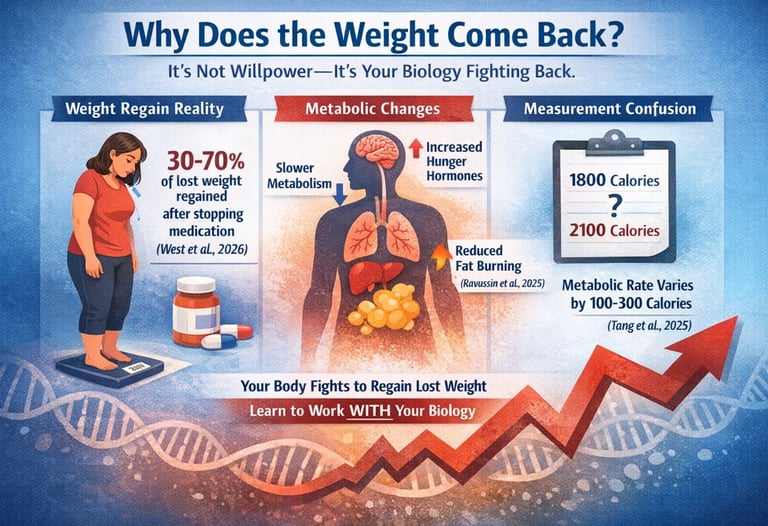
Weight regain occurs because the body activates a biological defense system known as metabolic adaptation. After weight loss, metabolism slows, hunger hormones rise, satiety hormones fall, and the brain increases food-seeking signals. Research shows these changes can persist for months or years, making long-term weight maintenance challenging.
Key Takeaways:
1. Weight Regain is Biology, Not a Lack of Willpower
When you lose weight, your body actively fights to get it back. This physiological defense mechanism is known as adaptive thermogenesis.
The Metabolic Drop: Following weight loss, your resting metabolic rate (RMR) often drops by 5% to 15% more than what your new, smaller body size predicts.
The Appetite Spike: Simultaneously, your endocrine system increases hunger hormones while suppressing satiety signals.
The Takeaway: Your body perceives weight loss as a starvation threat. Experiencing intense hunger post-diet is a biological reflex, not a personal failure.
2. Stopping GLP-1 Anti-Obesity Medications Triggers Rebound Regain
Anti-obesity medications like semaglutide and tirzepatide have revolutionized weight management, but they are not a permanent cure.
The 2026 Data: A comprehensive meta-analysis published in The BMJ (2026) revealed that patients regained 30% to 70% of their lost weight within 12 months of discontinuing GLP-1 receptor agonists.
The Takeaway: Chronic weight management drugs do not permanently alter your baseline biology. Once the medication leaves your system, the underlying biological drivers of weight regain return.
3. The Four Distinct Levers of Metabolic Adaptation
Metabolic adaptation is a multi-layered defense system. Your body utilizes four distinct physiological levers to force weight regain:
Suppressed Energy Expenditure: Your resting metabolism slows down to conserve energy.
Hormonal Dysregulation: The hunger hormone ghrelin rises, while the fullness hormone leptin plummets.
Increased Muscle Efficiency: Your muscles adapt to burn fewer calories during exercise, meaning you expend less energy doing the exact same workout.
Decreased NEAT: Your Non-Exercise Activity Thermogenesis (unconscious movements like fidgeting and pacing) naturally declines
4. Tirzepatide Protects Metabolism During Weight Loss, But Not After
New clinical trials show that dual GIP/GLP-1 receptor agonists offer unique metabolic advantages during active weight loss, though they do not offer permanent immunity to regain.
The Research: A landmark study by Ravussin et al. (2025) found that tirzepatide significantly improved fat oxidation and metabolic flexibility compared to a placebo, minimizing the standard metabolic slowdown while actively taking the drug.
The Catch: As highlighted by The BMJ data, these protective metabolic benefits fade rapidly once the medical therapy is stopped.
5. Online Calorie Calculators are Less Precise Than You Think
Many dieters rely on online calculators to determine their daily caloric needs, but these formulas have a high margin of error.
The Discrepancy: Validated metabolic equations can differ by 100 to 300 calories per day for the same individual.
The Science: Research by Tang et al. (2025) demonstrated that what many assume is "metabolic damage" is often just a measurement artifact or calculator inaccuracy. Treat calorie tracking software as a baseline estimate rather than a flawless prescription.
6. Emerging Animal Data Explains the Cellular Timing Problem
Why is weight maintenance harder for someone who used to have obesity compared to someone who was always lean? Animal models are beginning to find answers.
The Discovery: Morita et al. (2025) discovered that obese liver tissue responds differently to fasting and feeding cycles at a cellular level than healthy tissue.
The Clinical Caveat: While this offers an incredibly compelling mechanism for why the body resists weight maintenance, it remains animal research. Human trials are still required before this data can inform clinical guidelines.
7. Muscle Mass and Dietary Protein are Your Best Metabolic Insurance
If you want to protect your metabolism from dropping during a fat loss phase, you must prioritize lean muscle tissue.
Resistance Training: Lifting weights 2 to 4 times per week signals to your body that it needs to preserve calorie-burning muscle mass.
High-Protein Diet: Consuming 0.7 to 1.0 grams of protein per pound of body weight protects metabolic rate and stimulates satiety.
The Takeaway: Relying solely on cardio during weight loss can lead to muscle wasting, which further depresses your resting metabolic rate.
8. Long-Term Weight Maintenance Requires a Chronic-Disease Mindset
Because your body utilizes multiple overlapping systems to defend its highest "set-point" weight, short-term diets are statistically bound to fail. Sustainable results require treating obesity as a chronic, long-term condition.
The Strategy: Lasting weight maintenance requires an integrated lifestyle approach: combining consistent strength training, a high-protein diet, realistic caloric expectations, optimized sleep, and potential long-term medical therapy.
The Golden Rule: You must design your sustainable weight maintenance strategy on day one of your fitness journey, not after the diet ends
Introduction
You did everything right. You cut calories, you exercised, you watched the number on the scale fall — and then, slowly, it climbed back up.
If this sounds familiar, you are not alone, and you did not fail. Weight regain after weight loss is one of the most consistent findings in obesity research, affecting the large majority of people who lose weight through diet, exercise, or even medication.
For decades, this was framed as a willpower problem. New research from 2025 and 2026 tells a different story. Your body has a coordinated, multi-system biological response to weight loss — involving your brain, your hormones, your liver, and your muscles — that actively works to restore the weight you lost. Researchers call this metabolic adaptation, and it is now understood to be a defensive, evolutionarily ancient survival mechanism rather than a personal shortcoming.
1. What Is Metabolic Adaptation?
Metabolic adaptation (sometimes called "adaptive thermogenesis") is the disproportionate drop in energy expenditure that happens after weight loss — beyond what would be predicted simply from having a smaller body.
Here's the key distinction clinicians make:
Expected decline: A smaller body needs fewer calories. If you lose 20 pounds, your resting metabolic rate (RMR) should drop somewhat, simply because you have less tissue to maintain.
Adaptive decline: On top of that expected drop, your body often burns an additional 50–150 calories per day less than predicted, according to the review by Martínez-Gómez and Roberts, who found resting metabolic rate decreases by 5-15% beyond what's predicted by body composition changes alone.
Think of it like a thermostat. Your body has a comfortable energy "set point" range. When you create a calorie deficit, your body doesn't just passively shrink — it actively recalibrates multiple systems to defend its previous energy balance.
The Four Pillars of Metabolic Adaptation
Reduced resting and active energy expenditure — your body burns fewer calories at rest and during the same activities
Hormonal shifts — elevated ghrelin (the hunger hormone) and decreased leptin (the satiety hormone) persist long after weight loss
Increased exercise efficiency — your body becomes better at conserving energy during the same workout, so you burn fewer calories doing identical activity
Behavioral and neural shifts — increased food-seeking behavior and reduced "spontaneous" movement (fidgeting, taking stairs, etc.) that you may not even notice
This is why two people eating the exact same calories can have very different outcomes — their adaptive response, genetics, and starting metabolic flexibility all differ.
2. The New Science: What 2025–2026 Research Actually Shows
This section is the core of what's changed recently. Five major papers from 2025–2026 have reshaped how clinicians think about weight regain. Let's go through each one — what it found, and just as importantly, what it does and doesn't prove.
2.1 The Medication-Cessation Problem: West et al. (2026), BMJ
This is arguably the most clinically important paper in this space in years. It's a systematic review and meta-analysis — meaning researchers pooled data across multiple trials rather than relying on a single study.
What it found:
People who stop GLP-1 receptor agonists (like semaglutide) or other anti-obesity medications regained 30–70% of their lost weight within 12 months
Metabolic changes driving hunger and reduced energy expenditure persisted even after the drug left the body
Behavioral support alone, without continued pharmacotherapy, had limited power to prevent this regain
Clinical relevance: This study supports treating obesity pharmacotherapy more like blood pressure or cholesterol medication — something that controls a chronic condition while you take it, rather than a course of treatment that "cures" the underlying biology. If a patient stops metformin, blood sugar rises again; this research suggests a similar pattern with anti-obesity medications.
2.2 Tirzepatide and Metabolic Flexibility: Ravussin et al. (2025), Cell Metabolism
This trial looked specifically at what happens to metabolism during tirzepatide-induced weight loss, not after stopping it.
What it found:
Tirzepatide did not significantly impact metabolic adaptation during weight loss, increased fat oxidation, improved metabolic flexibility compared to placebo, and kept resting metabolic rate relatively stable despite significant weight loss
This suggests the drug may preserve metabolic function better than calorie restriction alone
Clinical relevance: "Metabolic flexibility" refers to your body's ability to switch efficiently between burning carbohydrate and burning fat for fuel. Better flexibility generally correlates with easier weight maintenance and improved metabolic health markers.
2.3 The Liver's Hidden Role: Morita et al. (2025), Science Signaling
This study took a more mechanistic, molecular-biology approach — looking inside liver tissue rather than measuring whole-body outcomes.
What it found:
The starvation-responsive metabolic network in the liver shows structural robustness but temporal vulnerability, with obese mouse liver demonstrating different metabolic responses compared to healthy liver tissue
Specific pathways involved in glucose and lipid regulation become dysregulated during energy restriction, and the timing of fasting and feeding affected outcomes
Clinical relevance: This helps explain why people with obesity often experience more intense hunger and a harder time maintaining weight loss than people without obesity attempting the same calorie deficit — the underlying liver signaling network behaves differently.
2.4 The Measurement Problem: Tang et al. (2025), Frontiers in Nutrition
This paper isn't about biology — it's about how we measure biology, which turns out to matter enormously.
What it found:
Different prediction equations for calculating expected metabolic rate yield conflicting results, with metabolic adaptation measurements fluctuating by 100-300 calories depending on which equation is used
This single methodological issue helps explain inconsistent findings across the broader weight-loss research literature
Clinical relevance: This is genuinely one of the most useful — and humbling — findings for anyone interpreting weight-loss research, including the other studies in this article. If your doctor or an online calculator says you should be burning X calories, that number itself has built-in uncertainty of up to several hundred calories depending on the formula used (Harris-Benedict, Mifflin-St Jeor, Katch-McArdle, and others all give different answers).
2.5 The Comprehensive Review: van Baak & Mariman (2025), Current Obesity Reports
This is a narrative review, meaning it synthesizes existing research rather than presenting new experimental data.
What it found: Metabolic adaptation includes decreased energy expenditure, typically 50-100 calories below predicted, persistent hormonal changes including elevated ghrelin and decreased leptin, dysregulated appetite signaling, neuroendocrine pressure toward regain, and active defense of a set point weight range through multiple compensatory mechanisms.
Clinical relevance: This is the most useful "big picture" summary in this article, pulling together energy balance, hormones, and neuroscience into a single coherent framework.
3 Why Your Body Defends a Set Point
From an evolutionary standpoint, your body cannot distinguish between "intentional weight loss for health" and "famine." Both look the same biologically: less energy coming in than the body is used to.
When this happens, your body activates what researchers describe as a coordinated defense:
Reduced metabolic rate so you burn less of your limited fuel
Enhanced nutrient absorption so more calories from each meal are captured
Increased hunger signaling (rising ghrelin) so you're driven to find food
Decreased satiety signaling (falling leptin) so you feel fuller for shorter periods
Reduced spontaneous physical activity — an unconscious energy-conservation strategy
According to the review by van Baak and Mariman, the body defends a set point weight range through multiple compensatory mechanisms simultaneously rather than through any single pathway — which is exactly why no single intervention (diet alone, exercise alone, or willpower alone) reliably overcomes it on its own.
4 Evidence Summary Table: Key Studies at a Glance
West et al. (2026) — BMJ
Study Type: Meta-analysis.
Key Finding: Patients experienced a 30% to 70% weight regain within 12 months following the discontinuation of anti-obesity medications.
Clinical Takeaway: Obesity requires long-term, chronic-disease-style treatment planning rather than short-term interventions.
Ravussin et al. (2025) — Cell Metabolism
Study Type: Randomized controlled trial (RCT).
Key Finding: Tirzepatide effectively preserved resting metabolic rate and increased fat oxidation compared to placebo.
Clinical Takeaway: Dual receptor agonists may offer distinct metabolic advantages during active weight loss phases.
Morita et al. (2025) — Science Signaling
Study Type: Animal / molecular mechanistic study.
Key Finding: Murine liver networks demonstrate specific temporal vulnerabilities and altered fasting responses in obesity.
Clinical Takeaway: Provides a cellular explanation for weight resistance, but requires human clinical validation.
Tang et al. (2025) — Frontiers in Nutrition
Study Type: Secondary statistical analysis.
Key Finding: Resting metabolic rate predictions vary by 100 to 300 kcal per day depending on the equation utilized.
Clinical Takeaway: Avoid over-relying on single online calculator values; treat them as baseline estimates.
van Baak & Mariman (2025) — Current Obesity Reports
Study Type: Narrative review.
Key Finding: Multiple overlapping physiological systems jointly defend an individual's weight set point.
Clinical Takeaway: Multi-pronged behavioral and medical strategies consistently outperform single-lever approaches.
Martínez-Gómez & Roberts (2022) — JSCR
Study Type: Narrative review.
Key Finding: Resting metabolic rate (RMR) drops 5% to 15% beyond what body size predicts; resistance training mitigates this decline.
Clinical Takeaway: Prioritize strength training and high protein intake during active weight loss to protect lean mass.
Farhana & Rehman (2025) — StatPearls
Study Type: Clinical reference review.
Key Finding: Weight loss triggers concurrent beneficial and adaptive metabolic shifts.
Clinical Takeaway: Significant systemic health benefits persist even when full weight-regain prevention is not achieved.
5 Practical Strategies to Reduce Weight Regain
None of these strategies "switches off" metabolic adaptation entirely — no current intervention does. But each addresses a different piece of the puzzle, and combined, they meaningfully change outcomes.
5.1 Preserve Muscle With Resistance Training and Protein
Muscle tissue is metabolically active even at rest. According to Martínez-Gómez and Roberts, resistance training helps preserve metabolic rate during weight loss.
Practical targets:
Protein: roughly 0.7–1.0 grams per pound of body weight daily (check with a doctor or dietitian if you have kidney disease or other relevant conditions)
Resistance training: 2–4 sessions per week
Progressive overload: gradually increasing weight or resistance over time so muscles continue adapting
5.2 Train Metabolic Flexibility
Metabolic flexibility — the ability to shift efficiently between burning carbohydrate and fat — appears to support easier maintenance.
Steady-state ("zone 2") cardio several times weekly
Reducing constant grazing/snacking in favor of structured meals, which may help insulin and fuel-switching patterns
Discuss intermittent fasting approaches with a healthcare provider before starting, especially if you have a history of disordered eating, diabetes, or are on glucose-lowering medication
5.3 Don't Over-Trust a Single Calorie Number
Given that prediction equations can disagree by 100–300 calories, treat any calculator's output as a starting estimate, not a precise prescription.
Use bio-feedback — energy levels, sleep quality, hunger patterns, and consistency of the trend over 2–3 weeks — alongside the number on a calculator
If progress stalls despite adherence, the math may be the issue, not your effort
5.4 Plan for Maintenance From Day One
Maintenance is a different physiological and behavioral phase than active weight loss, not simply "the diet, but less strict."
Build the eating pattern and exercise habits you can sustain for years, not weeks, starting during the loss phase
Expect a higher, not zero, level of ongoing hunger compared to your pre-diet baseline, and plan structurally for it (protein- and fiber-forward meals, consistent meal timing) rather than relying on willpower alone
5.5 Discuss Long-Term Medical Support if Appropriate
If you're using or considering anti-obesity medication, the West et al. findings are directly relevant to how you and your provider plan duration of treatment, tapering strategy (if any), and what supportive habits to put in place before any dose reduction.
A Quick Self-Check Framework
Ask yourself these four questions periodically during maintenance:
Am I sleeping enough? (Sleep deprivation independently worsens hunger hormones)
Is my protein intake consistent, not just on "good days"?
Am I strength training at least twice weekly?
Have I built in a plan for what happens if the scale moves up 3–5 pounds — rather than waiting until it's 15?
6. Should You Stay on Weight-Loss Medication Long-Term?
This is a deeply individual medical decision, not a one-size-fits-all answer — but here's how to think about it using the current evidence.
Arguments for viewing it as long-term therapy
The West et al. meta-analysis shows substantial average regain after stopping
Obesity is increasingly classified clinically as a chronic, relapsing condition rather than a temporary state
Comparable chronic-disease medications (for blood pressure, cholesterol, diabetes) are typically continued indefinitely once started
Arguments for caution or a different approach
Long-term safety and cost data for newer agents (like tirzepatide) over many years are still accumulating
Side effects, individual response, and personal preference vary significantly
Some individuals successfully maintain losses through sustained behavioral and lifestyle change alone — individual variability is real, as Farhana and Rehman note, with genetic, environmental, and behavioral factors all playing roles
Bottom line: This decision belongs in a conversation with your prescribing physician, who can weigh your specific health history, response to treatment, and goals — not in a blanket recommendation from any article.
7. Common Myths and Mistakes About Metabolic Adaptation
The "Permanently Broken Metabolism" Fallacy
Myth: "My metabolism is permanently damaged or broken after chronic dieting."
Reality: Metabolic adaptation is a dynamic, fluid response to energetic deficits rather than a permanent structural injury. For the vast majority of individuals, resting metabolic rate remains highly responsive to ongoing behavioral, nutritional, and physical interventions.
The Willpower Misconception
Myth: "If I just possessed more willpower, I would not regain the weight."
Reality: Weight regain is primarily orchestrated by complex neuroendocrine feedback loops (such as elevations in ghrelin and suppressions in leptin) that operate largely outside conscious, voluntary control.
The Cardio Overreliance
Myth: "Engaging in cardio alone will protect my metabolism from slowing down."
Reality: While cardiovascular exercise supports overall energy expenditure, progressive resistance training holds significantly stronger clinical evidence for preserving lean skeletal muscle tissue and defending resting metabolic rate during a caloric deficit.
The Infallible Calculator Assumption
Myth: "The online calorie calculator provided my exact baseline metabolic rate."
Reality: Validated prediction equations routinely demonstrate variance of 100 to 300 calories per day for the same individual. Mathematical models should be treated as directional estimates rather than precise clinical prescriptions.
The Pharmacological Immunity Misunderstanding
Myth: "Advanced medications like tirzepatide eliminate metabolic adaptation."
Reality: While clinical data shows tirzepatide optimizes fat oxidation and mitigates certain adaptive slowdowns during active treatment, it does not permanently erase adaptation. The risk of rapid weight rebound remains highly significant if the medication is discontinued.
The Binary Success Framework
Myth: "Regaining any amount of weight means the intervention was a total failure."
Reality: Clinical markers demonstrate that even transient periods of weight loss yield persistent, long-term improvements in insulin sensitivity, blood pressure regulation, and systemic inflammatory profiles, irrespective of subsequent partial regain.
8. Frequently Asked Questions
Is my metabolism permanently damaged after weight loss? No. Metabolic adaptation occurs and can persist, but it isn't permanent structural damage for most people. Your metabolism continues to respond to your current behavior, body composition, and circumstances.
Will I always need medication to keep weight off? Not necessarily for everyone. Evidence suggests many people benefit from long-term pharmacotherapy, similar to other chronic conditions, but individual responses vary considerably. This should be decided with your healthcare provider.
How many calories does metabolic adaptation actually cost? Typically an additional 50–150 calories per day beyond what body composition alone would predict, though this figure can shift by 100–300 calories depending on which prediction equation is used to calculate it.
Can exercise prevent metabolic adaptation entirely? No — exercise, especially resistance training, reduces but does not eliminate metabolic adaptation. You'll also become more efficient at a given exercise over time, burning slightly fewer calories for the same activity.
Why do I feel hungrier after losing weight? Ghrelin (hunger hormone) tends to rise and leptin (satiety hormone) tends to fall after weight loss, creating a biological — not psychological — drive toward eating more.
Is tirzepatide better than dieting alone for preventing regain? One 2025 trial found it preserved metabolic function and increased fat oxidation better than placebo during active treatment. Whether this translates into less regain after stopping the medication is a separate question, and the West et al. (2026) findings suggest regain still occurs broadly once any anti-obesity medication is discontinued.
Does everyone regain the same amount of weight? No. Regain ranged from 30–70% in the meta-analysis, reflecting real variability by medication type, individual biology, and behavioral factors — not a fixed number that applies to every person.
Are mouse studies on liver metabolism relevant to me? They offer plausible mechanistic insight into why obesity may affect metabolic adaptation differently than a lean starting point, but they require human confirmation before being treated as established human physiology.
What's the single best thing I can do to prevent regain? There isn't one. The strongest evidence points to combining strategies — protein intake, resistance training, realistic calorie expectations, sleep, and possibly medical support — rather than any single intervention.
Should I trust online calorie calculators? Use them as a rough starting estimate, not a precise figure, given documented variability of 100–300 calories between different equations.
Does weight loss still help my health even if I eventually regain some weight? Yes. Improvements in insulin sensitivity, inflammation, and lipid profiles during the loss phase can provide lasting benefit even if some weight returns.
How long does metabolic adaptation last? It can persist for months to years after weight loss in many individuals, though the magnitude may lessen over time with sustained healthy behaviors, particularly resistance training and adequate protein intake.
9. Conclusion and Next Steps
Weight regain is not a referendum on your discipline. It's a predictable, well-documented biological response involving your hormones, your liver, your muscles, and your brain — all working in concert to defend a weight your body has come to consider "normal."
The 2025–2026 research summarized here doesn't offer a single fix, but it does offer clarity: persistent biological pressure requires a persistent, multi-pronged strategy — not a 12-week sprint followed by hoping willpower carries you the rest of the way.
Your next steps:
Talk to a healthcare provider about having your metabolic rate and relevant labs assessed, and whether medication—short or long-term—fits your situation
Prioritize resistance training and protein starting now, not after you've already regained weight
Treat calculator numbers as estimates, adjusting based on your real-world trends over weeks, not days
Build your maintenance plan during weight loss, not after
Practice self-compassion — the biology described in this article is real, measurable, and not a character flaw
Disclaimer: This article is for informational purposes only and does not constitute medical advice. Always consult qualified healthcare professionals before making changes to your weight management approach, starting medications, or modifying exercise routines.
Related Articles
Why Obesity is a Disease, Not a Lifestyle Choice: Latest Evidence-Based Insights | DR T S DIDWAL
How Insulin Resistance Accelerates Cardiovascular Aging | DR T S DIDWAL
Physical Activity, Adiposity, and Metabolic Health: What Science Reveals | DR T S DIDWAL
HIIT Benefits: Evidence for Weight Loss, Heart Health, & Mental Well-Being | DR T S DIDWAL
References
Farhana, A., & Rehman, A. (2025). Metabolic consequences of weight reduction. StatPearls Publishing. https://www.ncbi.nlm.nih.gov/books/NBK572145/
Martínez-Gómez, M. G., & Roberts, B. M. (2022). Metabolic adaptations to weight loss: A brief review. Journal of Strength and Conditioning Research, 36(10), 2970–2981. https://doi.org/10.1519/JSC.0000000000003991
Morita, K., et al. (2025). Structural robustness and temporal vulnerability of the starvation-responsive metabolic network in healthy and obese mouse liver. Science Signaling, 18(883), eads2547. https://doi.org/10.1126/scisignal.ads2547
Ravussin, E., et al. (2025). Tirzepatide did not impact metabolic adaptation in people with obesity, but increased fat oxidation. Cell Metabolism, 37(5), 1060–1074.e4. https://doi.org/10.1016/j.cmet.2025.03.011
Tang, M., Wang, J., Xiang, Y., & Xu, R. (2025). Metabolic adaptation fluctuates with different prediction equations. Frontiers in Nutrition, 12, Article 1543263. https://doi.org/10.3389/fnut.2025.1543263
van Baak, M. A., & Mariman, E. C. (2025). Physiology of weight regain after weight loss: Latest insights. Current Obesity Reports, 14, 28. https://doi.org/10.1007/s13679-025-00619-x
West, S., et al. (2026). Weight regain after cessation of medication for weight management: Systematic review and meta-analysis. BMJ, 392, e085304. https://doi.org/10.1136/bmj-2025-085304