Midlife Weight Loss: Can Just 5–10% Really Add Years to Your Life?
Losing just 5–10% of body weight in midlife can reduce heart disease, diabetes, and mortality risk. Here’s what science says and what works.
OBESITY
Dr. T.S. Didwal, M.D.(Internal Medicine)
5/4/202613 min read
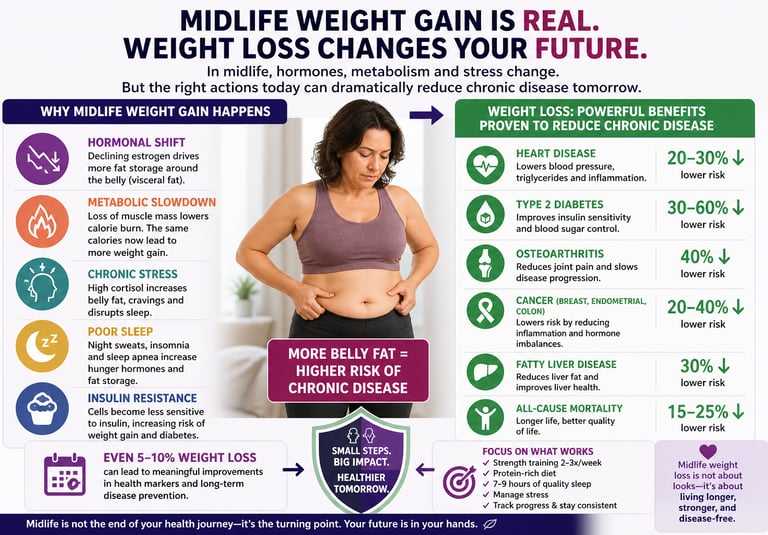
Weight loss during midlife (ages 40–60) is not just about appearance—it delivers measurable improvements in metabolic health, cardiovascular risk, and long-term survival. Current evidence from leading bodies like the American College of Cardiology and longitudinal studies published in JAMA Network Open confirms that even modest, sustained weight reduction produces clinically meaningful benefits.
Key Benefits of Midlife Weight Loss (Backed by Evidence)
1. Cardiovascular Risk Reduction
Losing just 5–10% of body weight significantly improves:
Blood pressure
Triglycerides and LDL cholesterol
Systemic inflammation (e.g., CRP)
These changes translate into a lower risk of heart attack and stroke, the leading causes of death in women.
2. Improved Insulin Sensitivity and Diabetes Prevention
Midlife is a high-risk period for insulin resistance due to hormonal changes.
Weight loss:
Enhances insulin sensitivity
Reduces fasting glucose and HbA1c
Lowers progression from prediabetes to type 2 diabetes
This is especially critical for populations with higher visceral fat risk, including South Asian women.
3. Reduction in Visceral (Belly) Fat
Unlike subcutaneous fat, visceral fat is metabolically active and harmful.
Weight loss preferentially reduces:
Abdominal fat
Liver fat (NAFLD risk)
Pro-inflammatory cytokine activity
This directly improves metabolic and cardiovascular outcomes.
4. Preservation of Functional Health and Mobility
When combined with resistance training, weight loss:
Preserves lean muscle mass
Improves strength and balance
Reduces risk of frailty and falls
This is crucial for maintaining independence with aging.
5. Hormonal and Symptom Benefits
Weight loss during perimenopause and menopause is associated with:
Reduced severity of hot flashes
Improved sleep quality
Better mood regulation
These effects are partly mediated through improved metabolic and inflammatory profiles.
6. Lower Risk of Chronic Diseases
Evidence shows reduced incidence of:
Type 2 diabetes
Cardiovascular disease
Osteoarthritis (due to lower joint load)
Certain cancers (e.g., breast, endometrial)
7. Increased Longevity
Long-term follow-up data demonstrate that intentional weight loss in midlife is linked to lower all-cause mortality, even if individuals do not reach a “normal” BMI.
This reframes weight loss as a survival intervention, not a cosmetic goal.
How Much Weight Loss Is Enough?
Clinically meaningful target: 5–10% of body weight
Example:
80 kg → 4–8 kg loss
Benefits begin early and increase with sustained loss
Importantly, consistency matters more than speed.
Why Midlife Weight Loss Has Disproportionate Benefits
Midlife is a metabolic tipping point due to:
Declining estrogen
Increased visceral fat deposition
Loss of muscle mass (sarcopenia)
Intervening at this stage:
Prevents progression to chronic disease
Reverses early metabolic dysfunction
Alters long-term health trajectory
What Works Best (Evidence-Based)
For optimal results, combine:
Resistance training (2–3×/week) → preserves muscle, boosts metabolism
Higher protein intake (1.2–1.6 g/kg/day) → supports satiety and lean mass
Sleep optimization (7–9 hours) → regulates appetite hormones
Self-monitoring (diet, activity, weight trends) → improves adherence
Medical evaluation when needed → identify hormonal/metabolic contributors
Bottom Line
Weight loss in midlife
Improves heart health and metabolic function
Reduces belly fat and inflammation
Lowers risk of diabetes, cancer, and early death
Enhances quality of life, energy, and functional independence
Even modest weight loss delivers substantial health gains—making midlife one of the most important windows for intervention.
Section 1: The Scale of the Problem — A Global and National Crisis
Global Burden Is Growing, Fast
A landmark sub-study of the Global Burden of Disease 2021 dataset, published in Women's Health (London) in 2026, paints a sobering picture of where midlife women stand globally. Bhagavathula, Aldhaleei, and Abegaz analyzed trends in overweight and obesity among midlife women in the United States from 1990 to 2021 and projected these trends forward to 2050.
Their findings reveal that overweight and obesity rates among U.S. women aged 40–60 have risen sharply over the past three decades, and the trajectory — without significant intervention — points toward continued escalation through mid-century. The authors project that by 2050, the proportion of midlife women classified as overweight or obese will reach historically unprecedented levels, carrying with it a corresponding surge in diabetes, cardiovascular disease, osteoarthritis, and certain cancers (Bhagavathula et al., 2026).
This is not a background statistic. It is a public health emergency unfolding in slow motion inside the bodies of millions of women who are, right now, trying to figure out why the strategies that worked in their 30s have stopped working entirely.
Why Midlife? Why Women?
Midlife, broadly defined as ages 40 to 65, is a uniquely vulnerable window for women's weight. During this period, women experience:
Perimenopause and menopause, bringing declining estrogen, altered fat distribution, and loss of lean muscle mass
Increased visceral adiposity, meaning fat accumulates preferentially around the abdomen rather than the hips and thighs
Psychological and social stressors including caregiving responsibilities, career pressures, sleep disruption, and mood changes associated with hormonal flux
Understanding these drivers is not just academically interesting — it is clinically essential, because interventions that ignore these root causes are far less likely to succeed.
Section 2: The Biology Behind the Battle — Why Midlife Weight Gain Is Different
Hormones, Metabolism, and the Estrogen Effect
Published in Current Obesity Reports, Hurtado, Saadedine, Kapoor, Shufelt, and Faubion (2024) provide one of the most comprehensive mechanistic reviews available on this topic. Their work clarifies what is actually happening inside the bodies of midlife women — and why so many standard weight loss recommendations fall short.
Key biological changes documented by Hurtado et al. (2024) include:
Declining estrogen levels drive a redistribution of body fat from the gluteo-femoral region (hips and thighs) to the visceral abdominal region. This is not merely cosmetic — visceral fat is metabolically active, pro-inflammatory, and a major driver of insulin resistance and cardiovascular risk.
Loss of lean muscle mass (sarcopenia) begins accelerating in the mid-40s, lowering basal metabolic rate. A woman who eats the same number of calories at 50 as she did at 35 will, biologically, store more of them as fat — because her resting metabolism has slowed, often by several hundred calories per day.
Disrupted appetite regulation compounds this. Hormonal changes affect leptin and ghrelin — the hormones that signal fullness and hunger — making it physiologically harder for midlife women to maintain the caloric deficit needed for weight management using willpower alone.
Sleep disruption, which is extremely common during perimenopause due to night sweats and anxiety, independently contributes to weight gain by elevating cortisol (a fat-storage hormone) and increasing appetite for calorie-dense foods.
Insulin sensitivity decreases during this life stage, making carbohydrate metabolism less efficient and increasing the risk of prediabetes even in women with no prior metabolic concerns.
The Stress-Weight Cycle
Hurtado et al. (2024) also highlight the role of psychosocial stress. Midlife women disproportionately shoulder caregiving burdens — for both children and aging parents — alongside professional responsibilities. Chronic stress elevates cortisol, which promotes abdominal fat deposition and creates a neurobiological drive toward high-calorie "comfort" foods. The result is a self-reinforcing cycle that standard diet advice consistently underestimates.
Section 3: The Cardiovascular Stakes — Why This Is Not Just About Appearance
Weight Loss at Midlife Directly Improves Heart Outcomes
One of the most important findings of recent years comes from the American College of Cardiology (2025), which reviewed evidence showing that weight loss in middle-aged individuals produces measurable, clinically significant improvements in cardiovascular outcomes. The ACC's analysis found that even modest weight loss — in the range of 5–10% of body weight — led to meaningful reductions in blood pressure, triglycerides, and markers of systemic inflammation, all of which are key risk factors for heart disease (American College of Cardiology, 2025).
Particularly noteworthy in the ACC's review is the finding that patient-provided weight loss monitoring (WLM) treatment — meaning approaches where patients track and manage their own data with professional support as a supplement, rather than the sole driver — produced better outcomes than professional support alone. This has profound implications for how we design weight management programs for midlife women: autonomy and self-monitoring matter. Women who are empowered with tools, education, and agency show better results than those in purely passive, clinician-directed programs.
This is a paradigm shift worth underscoring. The most effective cardiovascular weight management strategy is not one where a doctor simply prescribes a diet. It is one where the patient is an active, informed partner in her own care.
The Long-Term Survival Data
The JAMA Network Open study by Strandberg et al. (2025) provides strong longitudinal evidence that intentional weight loss in midlife is associated with significant reductions in chronic disease and mortality risk. In this large, long-term cohort, adults aged 40–60 were followed for decades, with careful adjustment for confounders and exclusion of illness-related weight loss. Participants who achieved sustained weight reduction—particularly those with overweight or obesity—showed lower incidence of type 2 diabetes, cardiovascular disease, and overall multimorbidity compared to those with stable or increasing weight.
Importantly, the study demonstrates that even modest weight loss (≈5–10%) confers meaningful health benefits, without the need to reach an “ideal” BMI. Mortality analyses showed reduced all-cause and cardiovascular deaths among those with intentional weight loss, supporting a causal relationship rather than reverse causation. Mechanistically, benefits are linked to improvements in insulin sensitivity, visceral fat reduction, and inflammation. Overall, the findings position midlife weight loss as a powerful, evidence-based intervention for extending both lifespan and healthspan.
Section 4: Current Challenges and Why Standard Advice Often Fails Midlife Women
The Midlife Weight Gain Paradox
Hung and Adams (2026), writing in Current Opinion in Obstetrics and Gynecology, articulate what they call the "midlife weight gain paradox": the women who most need effective weight management strategies are often the least well-served by standard public health messaging. Generic advice to "eat less and exercise more" ignores the biological realities of hormonal transition, metabolic change, and the social determinants of health that disproportionately affect women in this life stage.
Their review identifies several specific gaps in current clinical practice:
Under-recognition of perimenopause as a weight risk window. Many clinicians do not proactively counsel women entering perimenopause about weight management strategies, missing the optimal prevention window.
Failure to address muscle preservation. Most weight loss programs optimize for caloric restriction but neglect resistance training — the single most evidence-based intervention for preserving lean muscle mass and maintaining metabolic rate.
Inadequate psychological support. Behavioral and emotional dimensions of midlife weight gain, including stress eating, body image shifts, and depression (common during hormonal transition), are rarely addressed in standard care settings.
One-size-fits-all dietary guidance. Macronutrient needs, particularly protein requirements, increase in midlife. Women who follow general population dietary guidelines may be systematically under-eating protein at precisely the stage when adequate intake is most critical for muscle preservation.
Section 5: What Actually Works — Evidence-Based Solutions
1. Resistance Training: The Non-Negotiable Foundation
The evidence is unequivocal: resistance (strength) training is the most powerful tool midlife women have for preserving lean muscle, maintaining metabolic rate, and improving body composition. This does not mean bodybuilding. It means progressive loading of major muscle groups 2–3 times per week through bodyweight exercises, resistance bands, free weights, or machines.
Hung and Adams (2026) specifically highlight resistance training as a cornerstone of midlife weight management, noting that aerobic exercise alone — while valuable for cardiovascular health — does not adequately address the muscle loss that drives metabolic slowdown.
Practical target: 2–3 sessions per week, 30–45 minutes each, targeting major muscle groups.
2. Protein Optimization
Adequate dietary protein (aiming for 1.2–1.6 grams per kilogram of body weight daily, per current evidence) supports muscle protein synthesis, increases satiety, and has a higher thermic effect than carbohydrates or fats — meaning your body burns more calories just digesting it. For a 70 kg woman, this means roughly 84–112 grams of protein daily, distributed across meals.
3. Sleep as a Medical Intervention
Hurtado et al. (2024) document the profound metabolic consequences of sleep disruption in midlife women. Addressing sleep — whether through management of perimenopausal night sweats, cognitive behavioral therapy for insomnia (CBT-I), or evaluation for sleep apnea (which is underdiagnosed in women) — should be treated as a front-line weight management strategy, not an afterthought.
Practical target: 7–9 hours per night. Discuss night sweat management options with your provider if hot flashes are disrupting sleep.
4. Self-Monitoring and Empowered Agency
The ACC (2025) review is clear: patient-led monitoring outperforms passive professional support alone. This means tracking food intake, activity, sleep, and weight trends using whatever tools work for you — apps, journals, wearables — and bringing that data into clinical conversations. You are the expert on your own body. Effective healthcare harnesses that expertise.
5. Hormonal and Medical Evaluation
For women in perimenopause or menopause, hormonal status should be evaluated as part of a comprehensive weight management workup. Menopausal hormone therapy (MHT) may, in appropriately selected women, support favorable body composition outcomes — this is an evolving area and a conversation to have with a qualified provider.
Additionally, conditions such as hypothyroidism, polycystic ovarian syndrome (PCOS), insulin resistance, and depression — all of which can cause or exacerbate weight gain — should be screened for and treated.
6. Behavioral and Psychological Support
Stress management through evidence-based approaches — mindfulness-based stress reduction (MBSR), CBT, structured social support — addresses the cortisol-driven component of midlife weight gain. These are not "soft" interventions. They are biochemically active ones.
7. Pharmacological Options (When Indicated)
For obesity-related health risks, newer pharmacological agents including GLP-1 receptor agonists have demonstrated significant efficacy. These should be discussed with a healthcare provider as part of a comprehensive plan, not pursued in isolation.
Section 6: Practical Applications — Your 30-Day Starting Framework
The following framework is designed to be immediately actionable. It is not a diet. It is a biological recalibration strategy grounded in the research reviewed above.
Week 1 — Baseline and Assessment
Track food intake for 7 days using any app (MyFitnessPal, Cronometer, etc.) without changing habits — the goal is awareness, not restriction
Schedule a comprehensive blood panel with your provider: thyroid, fasting insulin, HbA1c, lipid panel, Vitamin D
Begin a sleep log noting bedtime, wake time, and sleep quality
Week 2 — Protein and Movement Foundation
Increase protein at each meal: add an egg at breakfast, Greek yogurt as a snack, and a palm-sized protein portion at lunch and dinner
Begin resistance training: 2 sessions this week using bodyweight (squats, push-ups, lunges, rows with a resistance band)
Week 3 — Sleep and Stress
Implement a consistent sleep and wake time (even weekends)
Add one 10-minute daily stress management practice: a walk, breathwork, journaling, or yoga
Review protein targets with your week 2 data
Week 4 — Integration and Clinical Conversation
Review your 4-week food, sleep, and movement data
Schedule a focused conversation with your provider about midlife weight management: bring your data, ask about hormonal evaluation, and discuss whether any pharmacological or hormonal options are appropriate for you
Set a 90-day goal that is behavior-based (not scale-based), e.g., "I will strength train twice weekly and sleep 7+ hours 5 nights per week"
Frequently Asked Questions (FAQs)
Q1. Is weight gain during perimenopause inevitable? Weight gain during perimenopause is extremely common and driven by real biological changes — but its severity is not predetermined. Research shows that proactive strategies including resistance training, protein optimization, sleep management, and stress reduction can significantly limit weight gain during this transition. Early intervention, ideally before significant weight accumulates, produces the best outcomes.
Q2. Why is my belly getting bigger even though I haven't changed what I eat? This is one of the most frequently reported experiences of midlife women, and the answer lies in estrogen. As estrogen levels decline, fat storage shifts from the hips and thighs to the abdomen — specifically to visceral (deep belly) fat. Your caloric intake may not have changed, but where your body stores fat has. Additionally, metabolic rate declines with muscle loss, meaning the same calories now produce a caloric surplus that was previously neutral. This is biology, not failure.
Q3. I've tried everything. Could there be an underlying medical cause? Absolutely — and this is an important question to raise with your provider. Hypothyroidism, insulin resistance, polycystic ovarian syndrome, Cushing's syndrome, and certain medications (antidepressants, beta-blockers, corticosteroids) can all contribute to weight gain that is difficult to address without treating the underlying cause. A comprehensive blood panel and medication review are sensible first steps.
Q4. Does weight loss at my age (50s) actually make a meaningful difference to my health? Yes — powerfully so. The JAMA Network Open study by Strandberg et al. (2025) demonstrates that intentional weight loss in midlife is associated with significantly lower chronic disease incidence and all-cause mortality. The cardiovascular benefit data from the American College of Cardiology (2025) further shows that even 5–10% weight loss produces measurable improvements in heart health markers. It is never too late, and the benefits are real and lasting.
Q5. Should I be doing cardio or weights to lose weight in midlife? Both have value, but the evidence increasingly points to resistance training as the priority for midlife women. Cardio supports cardiovascular health and mood, but it does not adequately address the muscle loss that drives metabolic slowdown. A program combining 2–3 days of resistance training with 150+ minutes per week of moderate-intensity cardio (walking, cycling, swimming) is currently the most evidence-supported approach.
Q6. Are weight loss medications like GLP-1s appropriate for midlife women? GLP-1 receptor agonists (such as semaglutide and tirzepatide) have demonstrated significant efficacy for weight loss and have emerging cardiovascular benefit data. They may be appropriate for women with a BMI ≥30, or ≥27 with weight-related health conditions, when lifestyle interventions alone have been insufficient. This is a nuanced clinical decision that should be made in partnership with a qualified healthcare provider, weighing individual health history, risk factors, and goals.
Q7. My doctor hasn't brought up my weight during perimenopause. Should I bring it up myself? Yes — and this is a gap that research explicitly identifies. Many clinicians do not proactively address weight management during perimenopause despite this being one of the highest-risk windows for weight accumulation with long-term health consequences. You are entirely within your rights to initiate this conversation. Come prepared with any tracking data you have, a list of your symptoms, and specific questions about hormonal evaluation, metabolic screening, and weight management support options.
Call to Action (CTA): Your Next Step Starts Now
You've read the science. Now it's time to act — and you don't have to do it alone.
Here is a simple, three-part action plan to begin today:
Step 1 — Know Your Numbers. Book a comprehensive blood panel with your doctor this week. Ask specifically for: thyroid function (TSH, free T3/T4), fasting insulin, HbA1c, lipid panel, and Vitamin D. Understanding your baseline metabolic health is the foundation of everything that follows.
Step 2 — Start One New Habit This Week. Not ten — one. Based on the evidence, the highest-impact single change for most midlife women is adding resistance training. Commit to two 30-minute sessions this week. You can find free beginner resistance training programs for women over 40 on YouTube — no gym required.
Step 3 — Join the Conversation. If this article resonated with you, share it with a friend who is navigating the same challenges. The more women who understand that midlife weight changes are biological — not moral failures — the more effectively we can collectively advocate for better care, better research, and better support systems.
Conclusion: The Paradigm Shift
The research published between 2024 and 2026 represents more than an incremental update to what we know about midlife weight gain. It represents a paradigm shift in how we understand, frame, and respond to this issue.
Weight gain during midlife is not a cosmetic inconvenience. It is a metabolic event with measurable consequences for cardiovascular health, chronic disease risk, and all-cause mortality. It is driven by identifiable, modifiable biological forces — not by character deficiencies or declining motivation. And it responds, powerfully and meaningfully, to evidence-based intervention.
Most importantly, the data confirms that it is worth fighting for — not because of how a woman looks, but because of how long and how well she lives.
Women in midlife deserve healthcare that takes these realities seriously. They deserve providers who proactively address the perimenopause-weight connection. They deserve access to the full spectrum of evidence-based tools — from resistance training and protein optimization to sleep medicine, behavioral support, hormonal evaluation, and pharmacology when appropriate. And they deserve to see themselves in the research that is being done.
The science is here. It is robust, it is growing, and it is on your side.
Disclaimer: This article is for informational purposes only and does not constitute medical advice. Individual circumstances vary, and treatment decisions should always be made in consultation with qualified healthcare professionals.
Related Articles
The #1 Diet Strategy to Reduce Visceral Fat According to Latest Research
Why Belly Fat Causes Insulin Resistance: Portal Theory Explained Simply
Obesity and Fatty Liver Disease: What Science Says About Risk and Health | DR T S DIDWAL
References
American College of Cardiology. (2025, June 3). Weight loss can lead to better CV outcomes in middle age, patient-provided WLM treatment more effective than professional support alone. https://www.acc.org/Latest-in-Cardiology/Journal-Scans/2025/06/03/16/38/Weight-Loss-Can-Lead-to-Better-CV-Outcomes
Bhagavathula, A. S., Aldhaleei, W. A., & Abegaz, T. M. (2026). Trends and projections of overweight and obesity among midlife women in the United States, 1990–2050: A sub-study of the Global Burden of Disease 2021. Women's Health (London), 22, 17455057261430197. https://doi.org/10.1177/17455057261430197
Hung, S., & Adams, K. E. (2026). Midlife weight gain: Challenges and solutions. Current Opinion in Obstetrics and Gynecology, 38(2), 94–102. https://doi.org/10.1097/GCO.0000000000001093
Hurtado, M. D., Saadedine, M., Kapoor, E., Shufelt, C. L., & Faubion, S. S. (2024). Weight gain in midlife women. Current Obesity Reports, 13(2), 352–363. https://doi.org/10.1007/s13679-024-00555-2
Strandberg, T. E., Strandberg, A. Y., Jyväkorpi, S., et al. (2025). Weight loss in midlife, chronic disease incidence, and all-cause mortality during extended follow-up. JAMA Network Open, 8(5), e2511825. https://doi.org/10.1001/jamanetworkopen.2025.11825