How to Slow Cardiac Aging: 5 Evidence-Based Strategies for Heart Longevity
Discover 5 evidence-based strategies to slow cardiac aging by improving endothelial function, mitochondrial health, and reducing inflammation.
Dr. T.S. Didwal, M.D.(Internal Medicine)
2/27/202614 min read
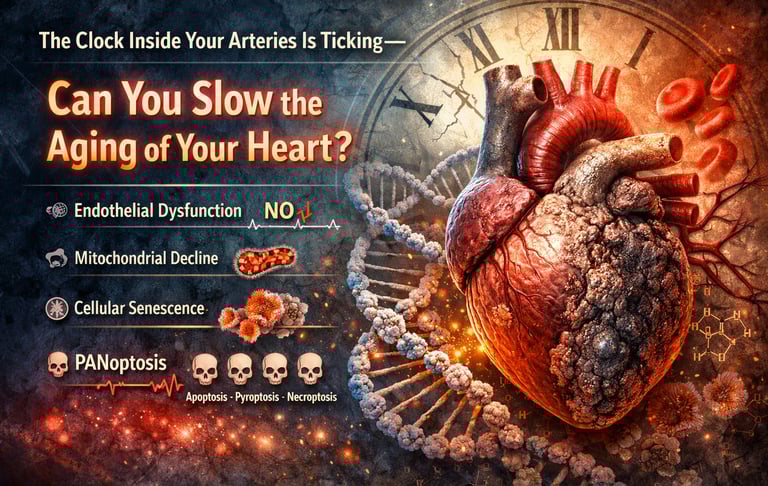
The Clock Inside Your Arteries Is Ticking — But It’s Not What You Think
What if heart disease doesn’t begin with cholesterol — but with aging cells silently losing their ability to produce energy, regulate inflammation, and repair vascular damage?
For decades, cardiovascular prevention focused on lipids, blood pressure, and glucose. Yet emerging research in cardiovascular aging, endothelial dysfunction, mitochondrial decline, and cellular senescence suggests something deeper is unfolding long before a heart attack or stroke occurs. The real driver may be a progressive breakdown in the biological systems that keep arteries flexible and heart muscle resilient.
One of the earliest shifts occurs in the vascular endothelium, where declining nitric oxide bioavailability impairs vasodilation and accelerates arterial stiffness (Adhikari et al., 2025). Simultaneously, aging cardiomyocytes accumulate mitochondrial dysfunction, oxidative stress, and DNA damage, activating inflammatory pathways and promoting senescence-associated secretory phenotype (SASP) signaling (Bai et al., 2025; Li et al., 2025). These senescent cells don’t simply sit idle — they secrete cytokines and reactive oxygen species that amplify tissue damage and drive inflammaging.
More recently, investigators have identified PANoptosis, an integrated inflammatory cell death pathway combining apoptosis, pyroptosis, and necroptosis, as a contributor to age-related cardiomyocyte loss and myocardial fibrosis (Shu et al., 2026). The result is a self-reinforcing cycle: endothelial dysfunction leads to vascular stiffening; mitochondrial decline increases reactive oxygen species; senescence spreads; cardiac remodeling accelerates.
Yet there is cautious optimism. Targeted interventions — including exercise-induced mitochondrial biogenesis, NAD+ restoration, senolytics, AMPK activation, and nitric oxide pathway modulation — are emerging as mechanistically grounded strategies to slow or even partially reverse aspects of cardiovascular aging (Feng et al., 2025; Li et al., 2025).
Clinical pearls,
1. The "Leafy Green" Nitric Oxide Boost
The Science: Aging causes an enzyme called eNOS to "uncouple." Instead of producing life-saving Nitric Oxide (NO) which keeps vessels flexible, it begins producing oxidative stress.
The Pearl: Think of dietary nitrates (found in arugula, spinach, and beets) as "raw materials" for your blood vessels. When your internal machinery (eNOS) slows down with age, providing these external nitrate sources helps maintain vasodilation and keeps your blood pressure from "stiffening" upward.
2. Exercise as a "Cellular Garbage Disposal"
The Science: Cardiovascular aging is characterized by a buildup of "zombie" (senescent) cells that refuse to die and instead leak inflammatory toxins (SASP).
The Pearl: Regular aerobic exercise triggers autophagy—your body’s natural recycling program. It essentially identifies damaged cellular components and "zombie" signals in your heart tissue and clears them out before they can cause permanent scarring or "inflammaging."
3. Your Heart’s "Energy Crisis" (NAD+)
The Science: Mitochondria are the power plants of your heart cells. As we age, levels of NAD+ (a critical co-enzyme) drop, leading to mitochondrial "brownouts" and DNA damage.
The Pearl: To keep the "lights on" in your heart muscle, focus on strategies that support mitochondrial health. This includes zone 2 cardio and potentially discussing NAD+ precursors (like NMN or NR) with a doctor to ensure your heart cells have the fuel required for constant repair.
4. The Danger of "Silent" Cell Death (PANoptosis)
The Science: The 2026 research identifies PANoptosis—a triple-threat pathway of cell death—as a major reason why heart muscle cells (cardiomyocytes) vanish as we get older.
The Pearl: Since heart cells don't regenerate easily, prevention is the only cure. Managing "upstream" triggers like chronic inflammation and high blood sugar is vital because once the "PANoptosome" (the cell's self-destruct button) is pressed, that specific heart muscle is gone for good.
5. Biological Age vs. The Calendar
The Science: Epigenetic "clocks" (DNA methylation) are now more accurate predictors of heart disease risk than your actual birth date.
The Pearl: Don't just settle for a standard cholesterol test. Ask for a "biological age" assessment or a high-sensitivity C-reactive protein (hs-CRP) test. Knowing if your heart is "older" than your body allows you to intensify lifestyle interventions before a clinical disease actually appears.
6. The "Exerkine" Signal
The Science: When you lift weights or run, your muscles release "exerkines" (like Irisin), which travel through the blood to tell the heart to stay young.
The Pearl: View your skeletal muscles as a pharmacy. Every time you exercise, you are essentially "injecting" your heart with a custom-made cocktail of anti-aging chemicals that reduce fibrosis and improve the heart's ability to pump efficiently.
The Big Picture: What Is Cardiovascular Aging?
Before we get into the individual studies, it's worth framing the problem. Cardiovascular aging refers to the structural and functional changes that occur in the heart and blood vessels as we get older — independently of disease. These include:
Arterial stiffening and reduced vascular compliance
Declining endothelial function and impaired vasodilation
Increased oxidative stress and chronic low-grade inflammation (often called "inflammaging")
Mitochondrial dysfunction within cardiomyocytes (heart muscle cells)
Accumulation of senescent cells that secrete damaging inflammatory signals
Dysregulation of cellular repair pathways including autophagy and apoptosis
These changes collectively increase the risk of hypertension, heart failure, coronary artery disease, and arrhythmias. The five studies reviewed here tackle these mechanisms from distinct but complementary angles — together painting a remarkably coherent picture of how we might delay, and perhaps even partially reverse, the cardiovascular aging clock.
Study 1: The Nitric Oxide Crisis — A Silent Driver of Vascular Aging
If there's one molecule that sits at the very heart of vascular health, it's nitric oxide (NO). Produced primarily by endothelial cells lining our blood vessels, nitric oxide regulates vasodilation, platelet aggregation, smooth muscle cell proliferation, and inflammation. When NO bioavailability drops — as it systematically does with age — the consequences ripple through the entire cardiovascular system.
Adhikari et al. (2025) provide one of the most comprehensive mechanistic reviews to date on this phenomenon. Their work dissects precisely why aging erodes NO levels, pointing to several converging processes. First, the enzyme responsible for producing NO — endothelial nitric oxide synthase (eNOS) — becomes "uncoupled" with age, meaning it begins producing superoxide (a damaging free radical) instead of NO. Second, oxidative stress accelerates the degradation of NO before it can exert its protective effects. Third, reduced levels of the critical cofactor tetrahydrobiopterin (BH4) further impair eNOS function.
What makes this study particularly exciting is its focus on emerging therapeutic interventions. The authors highlight several promising approaches including dietary nitrate supplementation (found naturally in beetroot and leafy greens), BH4 precursor supplementation, SGLT2 inhibitors (a class of diabetes medications now shown to boost NO pathways), and even gene therapy approaches targeting eNOS expression. The study also explores the role of senolytic therapies — drugs that clear senescent cells — in restoring NO bioavailability by reducing the inflammatory environment that degrades NO.
Declining nitric oxide bioavailability is a central, mechanistic driver of vascular aging — not merely a bystander
eNOS uncoupling, oxidative stress, and BH4 depletion are key molecular culprits
Dietary nitrates, BH4 supplementation, SGLT2 inhibitors, and senolytics represent a multi-pronged therapeutic toolkit
Restoring NO levels could simultaneously address hypertension, endothelial dysfunction, and atherosclerosis risk
Study 2: Interconnected Pathways — A Systems View of Heart Aging
Published in JACC: Asia, this comprehensive review by Bai et al (2025) takes a systems biology perspective on cardiovascular aging, mapping how multiple hallmarks of aging interact and amplify one another. Rather than viewing aging as a collection of isolated defects, the authors argue convincingly that cardiovascular aging is a deeply interconnected biological network — and that effective interventions must account for this complexity.
The study maps key nodes in this network: telomere attrition, epigenetic dysregulation, mitochondrial dysfunction, cellular senescence, stem cell exhaustion, and dysregulated nutrient sensing (including mTOR, AMPK, and sirtuins). Crucially, the authors demonstrate that these hallmarks don't operate in isolation — senescent cells, for example, secrete a senescence-associated secretory phenotype (SASP) that accelerates mitochondrial dysfunction in neighboring cells, which in turn drives further oxidative stress and promotes additional senescence. It's a vicious cycle.
On the therapeutic side, the paper reviews evidence for caloric restriction mimetics (like rapamycin and metformin), NAD+ precursors (NMN and NR, which support sirtuin activity and mitochondrial health), senolytics (dasatinib + quercetin, fisetin), and epigenetic reprogramming approaches — including partial cellular reprogramming using Yamanaka factors, which has shown striking results in preclinical models of cardiac aging.
The paper is also notable for its discussion of sex differences in cardiovascular aging, noting that while premenopausal women enjoy relative protection from heart disease, post-menopausal hormonal changes accelerate many of the aging hallmarks described above at an accelerated rate compared to age-matched men.
Cardiovascular aging is a systems-level phenomenon driven by deeply interconnected biological hallmarks, not isolated defects
Cellular senescence and SASP act as central amplifiers of cardiovascular deterioration
NAD+ precursors, senolytics, caloric restriction mimetics, and epigenetic reprogramming are among the most promising therapeutic directions
Sex differences in aging trajectories must be accounted for in personalized cardiovascular medicine
Study 3: Exercise as Medicine — The Molecular Case for Moving More
We've long known that regular physical activity is among the most powerful tools for cardiovascular health. But Feng and colleagues (2025) go far deeper than "exercise is good for your heart" — they systematically map the molecular and cellular mechanisms by which exercise counteracts virtually every major hallmark of cardiovascular aging.
Feng et al.(2025) demonstrated that aerobic exercise and resistance training engage distinct but complementary anti-aging pathways in the cardiovascular system. Aerobic exercise, for instance, powerfully upregulates eNOS expression, directly countering the NO decline discussed in Study 1. It also activates PGC-1α, a master regulator of mitochondrial biogenesis — essentially stimulating the heart and vasculature to generate new, healthy mitochondria to replace dysfunctional ones.
Perhaps most fascinatingly, the paper reviews evidence that exercise reduces the burden of senescent cells in the vasculature, partially by activating autophagy — the cellular "recycling" system that clears damaged components. Exercise also modulates telomere biology, with habitual exercisers consistently showing longer telomere lengths in cardiovascular tissues compared to sedentary individuals.
The paper also explores the emerging role of exerkines — signaling molecules released by muscle, heart, and fat tissue during physical activity that exert systemic cardiovascular benefits. These include irisin, BDNF, IL-6 (in its exercise-context anti-inflammatory role), and β-aminoisobutyric acid (BAIBA), all of which appear to have direct cardioprotective effects.
The study is careful to note that exercise dose, type, and timing all matter — and that future personalized exercise prescriptions will likely need to account for an individual's biological age, sex, and specific aging phenotype to maximize cardiovascular benefit.
Exercise is perhaps the most potent multi-target intervention against cardiovascular aging currently available
Aerobic exercise upregulates eNOS, activates PGC-1α/mitochondrial biogenesis, and reduces vascular senescent cell burden
Exerkines released during exercise exerts powerful systemic cardioprotective effects
Personalized exercise prescriptions based on biological age and phenotype represent the future of preventive cardiology
Study 4: PANoptosis — A Newly Recognized Cell Death Pathway in Cardiac Aging
This is perhaps the most cutting-edge study in our roundup — and one of the first to systematically examine the role of PANoptosis in cardiac aging. Shu Shu et al. (2026) introduced a concept that bridges several well-known cell death pathways into a unified framework with profound implications for heart aging.
PANoptosis refers to the simultaneous, interconnected activation of three inflammatory cell death programs: pyroptosis (inflammatory death via gasdermin pores), apoptosis (programmed death), and necroptosis (necrotic-like regulated death). While each pathway has been studied individually in the context of cardiovascular disease, PANoptosis represents their convergence under a shared regulatory complex — the PANoptosome — that becomes increasingly dysregulated with age.
In the aging heart, PANoptosis contributes to the loss of cardiomyocytes (heart muscle cells cannot regenerate well in adults), progressive myocardial fibrosis, and chronic cardiac inflammation. The authors meticulously map how aging-associated stressors — including mitochondrial ROS, damaged DNA, and SASP factors from senescent cells — activate the PANoptosome in cardiomyocytes, triggering this destructive cascade.
What's particularly valuable about this paper is its detailed discussion of targeted intervention strategies. These include inhibitors of specific PANoptosis components (caspase inhibitors, RIPK3 inhibitors, gasdermin cleavage blockers), as well as upstream strategies like mitochondrial ROS scavenging, NLRP3 inflammasome inhibition, and targeting the cGAS-STING pathway — an innate immune sensing system activated by damaged mitochondrial DNA that's emerging as a major driver of both cardiac senescence and PANoptosis.
PANoptosis — the convergent activation of pyroptosis, apoptosis, and necroptosis — is a newly recognized driver of cardiac aging and cardiomyocyte loss
The PANoptosome becomes dysregulated with age due to mitochondrial stress, DNA damage, and SASP signals from senescent cells
RIPK3 inhibitors, gasdermin blockers, NLRP3 inhibitors, and cGAS-STING pathway modulators represent promising targeted therapies
Understanding PANoptosis could unlock new approaches to preventing age-related heart failure and myocardial fibrosis
Study 5: Molecular Mechanisms of Cardiac Aging — A Pharmacological Roadmap
Li et al.(2025) contributed an authoritative pharmacological perspective in Pharmacological Research, cataloguing both the molecular mechanisms of cardiac aging and the expanding arsenal of drug-based interventions being investigated to address them.
The study covers well-established mechanisms, including oxidative stress, mitochondrial dysfunction, impaired autophagy/mitophagy, and cardiomyocyte hypertrophy — the abnormal enlargement of heart cells that occurs with aging and contributes to diastolic dysfunction. But the paper is particularly strong in its coverage of emerging molecular targets that have gained traction in recent years.
These include SIRT1 and SIRT3 activators (sirtuin proteins that link metabolic state to chromatin regulation and mitochondrial function), AMPK activators (which mimic the metabolic effects of caloric restriction), autophagy-enhancing compounds (rapamycin analogs, spermidine), and the increasingly promising class of senolytics and senomorphics. The distinction between these is worth noting: senolytics kill senescent cells, while senomorphics suppress their harmful secretions (SASP) without necessarily eliminating the cells.
The paper also dedicates significant attention to epigenetic interventions, including HDAC inhibitors and DNA methylation modulators — recognizing that the epigenetic "aging clock" in cardiac tissue may be both a biomarker of aging and a tractable therapeutic target. There's also a thoughtful section on the challenges of translating these interventions from preclinical models to human clinical trials, noting the critical importance of timing, dosing, and patient stratification based on biological rather than chronological age.
Cardiac aging is driven by overlapping mechanisms including oxidative stress, impaired mitophagy, cardiomyocyte hypertrophy, and epigenetic dysregulation
SIRT1/SIRT3 activators, AMPK activators, senolytics, and senomorphics represent some of the most pharmacologically advanced anti-aging strategies for the heart
Epigenetic reprogramming of the cardiac aging clock is emerging as both a biomarker and a therapeutic target
The transition from preclinical to clinical translation requires stratification by biological age rather than chronological age
Connecting the Dots: A Unified Framework for Cardiovascular Aging
Cardiovascular Aging Is Not Inevitable — It Is Biological, Measurable, and Modifiable
1️⃣ Cardiovascular disease is fundamentally an aging biology problem
The dominant driver of heart disease is not cholesterol alone — it is progressive vascular and myocardial aging.
Arterial stiffness, endothelial dysfunction, mitochondrial decline, and low-grade inflammation precede clinical events by decades.
Treating downstream pathology without addressing upstream aging mechanisms is biologically incomplete.
2️⃣ Nitric oxide decline is an early inflection point
Reduced nitric oxide bioavailability impairs vasodilation, promotes platelet aggregation, and accelerates vascular remodeling.
eNOS uncoupling and oxidative stress create a feed-forward loop of endothelial injury.
Interventions targeting NO pathways (exercise, dietary nitrates, SGLT2 inhibitors) address a root mechanism — not just blood pressure numbers.
3️⃣ Mitochondrial dysfunction is the energetic core of cardiac aging
Aging cardiomyocytes accumulate mitochondrial DNA damage and reactive oxygen species.
Impaired mitophagy allows dysfunctional mitochondria to persist, amplifying oxidative stress.
Mitochondrial decline activates senescence, inflammasome signaling, and maladaptive hypertrophy.
4️⃣ Cellular senescence is not passive — it is inflammatory
Senescent endothelial cells and cardiomyocytes secrete SASP factors that propagate tissue-level dysfunction.
Senescence spreads locally, creating a microenvironment of chronic inflammation.
Senolytics and senomorphics represent the first generation of mechanism-based gerotherapeutics.
5️⃣ PANoptosis introduces a new paradigm in cardiac cell loss
The convergence of apoptosis, pyroptosis, and necroptosis reflects integrated inflammatory cell death.
PANoptotic signaling links mitochondrial stress, DNA damage, and innate immune activation.
Targeting RIPK3, NLRP3, or cGAS–STING pathways may redefine heart failure prevention.
6️⃣ Exercise remains the most potent multi-target intervention
Aerobic and resistance training simultaneously improve nitric oxide signaling, mitochondrial biogenesis, and autophagy.
Exercise reduces vascular senescent burden and improves endothelial resilience.
No single pharmacologic agent currently matches its systems-level breadth.
7️⃣ The future is precision cardiovascular geroscience
Biological age will replace chronological age in risk stratification.
Multi-target strategies — combining lifestyle, metabolic modulation, and selective gerotherapeutics — will define next-generation prevention.
The shift is underway: from reactive cardiology to proactive aging biology.
The heart does not fail suddenly. It ages molecularly first.
The science is no longer asking whether we can measure this process —
But how aggressively are we willing to intervene?
Frequently Asked Questions (FAQs)
Q: What is the single most important factor in cardiovascular aging? There's no single factor, but mitochondrial dysfunction and cellular senescence appear repeatedly across all five studies as central, amplifying hubs in the cardiovascular aging network. Addressing these may offer the broadest downstream benefits.
Q: Can cardiovascular aging actually be reversed, or only slowed? Current evidence suggests both are possible depending on the intervention and timing. Exercise can meaningfully rejuvenate vascular function even in older adults. Some epigenetic reprogramming approaches in animal models have shown partial reversal of the cardiac aging phenotype. However, translation to humans remains in early stages.
Q: Are any of these therapeutic interventions currently available to patients? Some are — metformin, SGLT2 inhibitors, and dietary nitrates are already used clinically and have documented benefits on cardiovascular aging pathways. NAD+ precursors (NMN, NR) are available as supplements with growing, if still preliminary, clinical evidence. Senolytics (dasatinib + quercetin) are in clinical trials. Others, like PANoptosis inhibitors and epigenetic reprogrammers, are in earlier stages.
Q: How does exercise compare to pharmacological interventions? Remarkably well. Feng et al. (2025) make a compelling case that habitual physical activity engages a broader array of anti-aging mechanisms than any single drug — and with a well-established safety profile. The emerging science of exercise mimetics aims to harness these pathways pharmacologically for those who cannot exercise.
Q: What role do diet and nutrition play? Strongly supportive — particularly diets rich in dietary nitrates (leafy greens, beetroot), polyphenols (quercetin, resveratrol, fisetin), and nutrients that support NAD+ synthesis (tryptophan, niacin). The Mediterranean and DASH dietary patterns align well with the mechanistic insights from these studies.
Q: What is PANoptosis, and why does it matter? PANoptosis is a newly characterised form of inflammatory cell death that integrates three classical death pathways simultaneously. Shu et al. (2026) highlight it as a critical mechanism of cardiomyocyte loss during aging, making PANoptosome-targeted therapies a potentially transformative new direction in heart aging treatment.
Q: What is the difference between senolytics and senomorphics? Senolytics are drugs that selectively eliminate senescent cells from tissues, removing their damaging SASP influence permanently. Senomorphics suppress the secretory activity of senescent cells without killing them — a potentially useful approach when complete cell elimination carries risks. Both strategies are being investigated for cardiovascular aging.
Author’s Note
As a physician trained in internal medicine and deeply engaged in metabolic and exercise science research, I have watched cardiovascular medicine evolve from a lipid-centered model toward a far more complex and compelling framework: aging biology as the upstream driver of disease.
For decades, we have treated heart disease reactively — lowering LDL, prescribing antihypertensives, performing revascularization procedures. These interventions save lives. But they largely address the downstream manifestations of a process that begins much earlier at the level of mitochondria, endothelial cells, inflammatory signaling, and genomic regulation.
What compelled me to write this editorial was the convergence of recent research across nitric oxide biology, mitochondrial energetics, cellular senescence, PANoptosis, and exercise physiology. Independent laboratories across the world are arriving at a strikingly unified conclusion: cardiovascular aging is not random deterioration — it is a measurable, mechanistically driven biological program. And where there are mechanisms, there are intervention points.
This article is not intended to overpromise reversal of aging, nor to promote unproven therapies. Many of the pharmacological strategies discussed remain in early clinical investigation. However, the scientific trajectory is clear. We are moving toward an era of precision cardiovascular geroscience, where biological age, inflammatory burden, mitochondrial resilience, and endothelial function may guide prevention more accurately than chronological age alone.
Most importantly, I want to emphasize this: while advanced therapeutics are emerging, the most powerful interventions available today remain profoundly accessible — structured exercise, metabolic health optimization, nutrient-dense dietary patterns, and early vascular risk assessment.
The heart ages quietly. But it also responds remarkably to intelligent, sustained intervention.
I hope that this synthesis encourages clinicians, researchers, and informed patients alike to think beyond disease treatment — and toward biological preservation of cardiovascular vitality across the lifespan.
Disclaimer: This article is for informational purposes only and does not constitute medical advice. Individual circumstances vary, and treatment decisions should always be made in consultation with qualified healthcare professionals.
Related Articles
Managing Diabesity: A Complete Guide to Weight Loss and Blood Sugar Control | DR T S DIDWAL
The BMI Paradox: Why "Normal Weight" People Still Get High Blood Pressure | DR T S DIDWAL
Breakthrough Research: Leptin Reduction is Required for Sustained Weight Loss | DR T S DIDWAL
References (APA 7th Edition)
Adhikari, H., Patel, P., Javvaji, N., Crabtree, M. J., & Simon, J. N. (2025). Declining nitric oxide bioavailability in cardiovascular aging: Mechanistic insights and emerging interventions. Journal of Cardiovascular Aging, 5, 20. https://dx.doi.org/10.20517/jca.2025.14
Bai, X., Zhang, Y., Qu, J., & Liu, G.-H. (2025). Interconnected pathways and therapeutic implications for cardiovascular aging and diseases. JACC: Asia, 6(2), 109–127. https://doi.org/10.1016/j.jacasi.2025.10.017
Feng, Z., Xing, Y., Yi, W., Gao, F., Sun, Y., & Zhang, X. (2025). Exercise as elixir to combat cardiovascular ageing. Ageing Research Reviews, 111, 102848. https://doi.org/10.1016/j.arr.2025.102848
Li, X., Pang, X., Sun, H., Zhang, B., Wang, H., Wu, N., & Yang, L. (2025). Cardiac aging: Molecular mechanisms and therapeutic interventions. Pharmacological Research, 221, 107954. https://doi.org/10.1016/j.phrs.2025.107954
Shu, Y., Li, S., Yang, S., Zhang, S., Li, B., & Dong, L. (2026). Delaying cardiac aging: Potential mechanisms centered on PANoptosis and targeted intervention strategies. Frontiers in Cardiovascular Medicine, 13, 1759908. https://doi.org/10.3389/fcvm.2026.1759908
Disclaimer: This article is intended for educational and informational purposes only and does not constitute medical advice. Always consult a qualified healthcare professional before making changes to your diet, exercise regimen, or medication.