How Exercise Protects Your Brain: New Evidence on Memory, Aging, and Neuroprotection
Can you reverse brain aging naturally? Discover how exercise affects brain biology, memory, and long-term cognitive health.
EXERCISE
Dr. T.S. Didwal, M.D.(Internal Medicine)
5/1/202613 min read
Can exercise reverse brain aging?
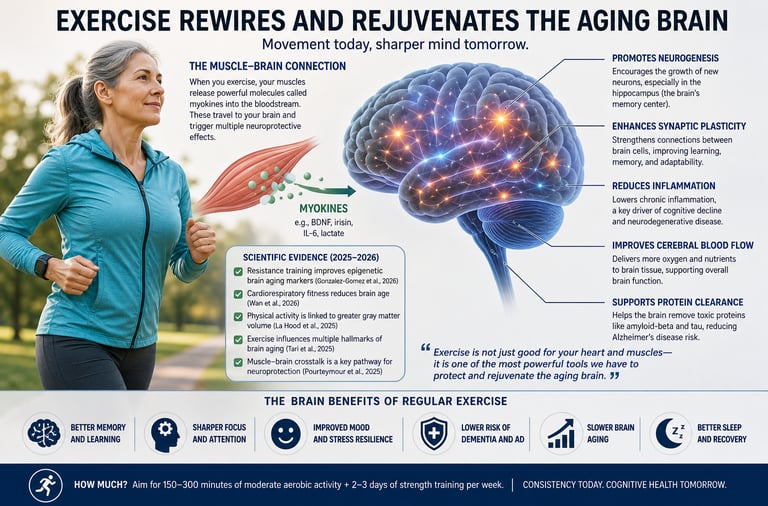
Yes—regular exercise can partially reverse biological markers of brain aging. Recent randomized controlled trials (2025–2026) show that both aerobic and resistance training improve brain age metrics, including DNA methylation clocks, gray matter volume, and cognitive function. While exercise does not completely stop aging, it can significantly slow—and in some cases reverse—key aspects of brain aging biology.
Key Takeaways
Exercise can reduce biological brain age, not just slow decline
Resistance training influences epigenetic aging clocks
Aerobic fitness improves brain structure and function
Muscle-derived myokines (e.g., BDNF) drive neuroprotection
Benefits are dose-dependent but achievable at any age
How Exercise Rejuvenates the Brain
↑ BDNF → enhances neuroplasticity
↑ Cerebral blood flow → improves oxygen delivery
↓ Neuroinflammation → slows degeneration
↑ Synaptic plasticity → strengthens neural networks
↑ Glymphatic clearance → removes toxic proteins
What Exercise Cannot Do
Does not completely reverse chronological brain aging
Cannot guarantee the prevention of Alzheimer’s disease
Effects vary based on intensity, adherence, and baseline health
A Clinician’s Perspective on Brain Aging and Exercise
In clinical practice, one of the most common and quietly distressing concerns I hear from patients over 50 is this: “Doctor, I feel like my memory isn’t what it used to be.” Sometimes it’s misplaced keys or forgotten names; other times, it’s a deeper fear—of cognitive decline, loss of independence, or even dementia. For decades, our responses were limited: manage vascular risk factors, encourage mental engagement, and monitor progression. But over the past few years, a shift has occurred. Emerging evidence suggests that brain aging is not a fixed, unidirectional process—it is biologically dynamic and, to a meaningful extent, modifiable.
Recent advances in neurobiology and epigenetics have introduced the concept of a biological brain age, measured through DNA methylation patterns, neuroimaging markers, and circulating biomarkers. What is particularly striking is that lifestyle interventions—especially structured physical exercise—appear capable of influencing these aging pathways at a molecular level. In a randomized controlled trial, resistance training was shown to significantly improve brain aging biomarkers, suggesting partial reversal of epigenetic aging signals (Gonzalez-Gomez et al., 2026). Complementing this, improvements in cardiorespiratory fitness have been linked to reductions in brain age estimates derived from neuroimaging algorithms (Wan et al., 2026).
Mechanistically, this is plausible. Exercise induces the release of muscle-derived signaling molecules—myokines such as brain-derived neurotrophic factor (BDNF)—which promote neurogenesis, synaptic plasticity, and neuroprotection (Pourteymour et al., 2025). Large-scale reviews further confirm that regular physical activity influences multiple hallmarks of brain aging, including inflammation, vascular function, and protein homeostasis (Tari et al., 2025).
From a clinician’s standpoint, this reframes exercise: not merely as lifestyle advice, but as a targeted intervention capable of modifying the biology of brain aging itself.
What Is a "Brain Aging Clock"?
A biomarker-based estimate of brain biological age using DNA methylation and neuroimaging
Before diving into the research, it helps to understand what scientists mean when they talk about biological brain age versus chronological age. Your chronological age is simply how many years you've been alive. Your biological brain age is estimated from measurable biological markers — such as how your DNA has been chemically modified (a process called methylation), the volume of specific brain regions, the health of white matter tracts, and even proteins in your blood and cerebrospinal fluid.
These "clocks" can reveal a brain that is biologically older or younger than its owner's actual age. A 60-year-old with a biological brain age of 55 is, in a very real neurological sense, aging more gracefully than a 60-year-old whose brain clock reads 68.
The exciting news is that these clocks are not fixed. They respond to lifestyle — and exercise sits at the top of the list of interventions that can shift them in a favorable direction.
The Landmark Studies: What 2025–2026 Research Reveals
1. Resistance Exercise Turns Back the Brain's Biological Clock
One of the most compelling recent studies comes from Gonzalez-Gomez et al. (2026), published in GeroScience. This randomized controlled trial (RCT) — the gold standard of scientific evidence — tested whether resistance exercise (weight training) could alter brain aging clocks in older adults. The results were striking: participants assigned to a resistance exercise program showed measurable reductions in their brain's biological age, as assessed by DNA methylation clocks and other epigenetic biomarkers.
This is not about feeling younger. This is about molecular evidence that the brain is actually aging more slowly at the cellular level. For anyone who has ever wondered whether lifting weights is worth the effort as they age, this study offers a compelling answer: yes, and the effects reach all the way into your brain's biology (Gonzalez-Gomez et al., 2026).
Practical takeaway: Resistance training — even 2–3 sessions per week using body weight, resistance bands, or weights — may produce measurable changes in brain aging biomarkers.
2. Your Muscles Send Anti-Aging Messages to Your Brain
Why does exercise affect the brain at all? The connection is more intimate than most people realize. Pourteymour et al. (2025), publishing in Cell Proliferation, explored the molecular pathways through which physical exercise delays brain aging — specifically, through what scientists call muscle-brain crosstalk.
When you exercise, your muscles don't just contract and burn fuel. They act as endocrine organs, releasing a cocktail of signaling molecules called myokines into the bloodstream. These myokines — including BDNF (brain-derived neurotrophic factor), irisin, IL-6, and others — travel to the brain and exert powerful neuroprotective effects. They stimulate the growth of new neurons (neurogenesis), reduce inflammation, protect against toxic protein accumulation (such as amyloid-beta, associated with Alzheimer's disease), and promote the repair of damaged neural circuits.
In other words, every time you exercise, your muscles are writing letters to your brain, saying: "Stay young. Stay sharp. Keep growing." (Pourteymour et al., 2025).
This mechanism explains why the benefits of exercise on brain health go far beyond improved blood flow. It's a whole-body conversation, orchestrated at the molecular level.
3. A Global Call to Action: Exercise as Brain Medicine
The editorial perspective offered by Majumdar (2025) in Frontiers in Human Neuroscience provides important clinical context. As the global population ages and neurodegenerative disease rates climb, the editorial argues powerfully for positioning physical exercise not merely as a lifestyle recommendation but as a legitimate therapeutic intervention for brain health.
Majumdar (2025) highlights that the evidence base has matured to the point where exercise should be prescribed with the same seriousness as medication — with dose, type, intensity, and duration carefully considered for each individual. This shift in thinking — from exercise as wellness advice to exercise as medicine — has profound implications for how clinicians, patients, and health systems should approach brain aging.
4. The Lancet's Comprehensive Blueprint: Fitness for a Healthy Brain
Perhaps the most authoritative of the recent publications is the comprehensive review by Tari et al. (2025), published in The Lancet — one of the world's most prestigious medical journals. This extensive paper maps out the neuroprotective mechanisms of exercise with remarkable granularity, drawing on decades of research to show how fitness protects the aging brain.
Key mechanisms identified by Tari et al. (2025) include:
Neurogenesis: Exercise promotes the birth of new neurons, particularly in the hippocampus — the brain's memory center.
Synaptic plasticity: Physical activity enhances the brain's ability to form and strengthen connections between neurons.
Vascular health: Exercise improves cerebrovascular function, ensuring that brain tissue receives adequate oxygen and nutrients.
Neuroinflammation reduction: Chronic low-grade inflammation is a driver of cognitive decline; exercise powerfully counteracts this.
Protein clearance: Exercise supports the brain's ability to clear toxic protein aggregates linked to Alzheimer's and Parkinson's diseases.
Stress resilience: Physical fitness buffers the brain against the damaging effects of chronic psychological stress.
The review emphasizes that both aerobic exercise and resistance training are important, and that the benefits are dose-dependent — meaning more consistent exercise generally produces greater neuroprotection, though even modest amounts of activity offer meaningful protection (Tari et al., 2025).
5. Real Brains, Real Structure: What Activity Does to Brain Anatomy
Moving from mechanisms to measurable anatomy, La Hood et al. (2025) conducted a large community-based cohort study examining associations between physical activity and brain structure using neuroimaging. Published in Scientific Reports, this study found that higher levels of physical activity were associated with greater gray matter volume in regions critical to cognition, memory, and executive function.
Gray matter is the brain tissue that processes information — it contains neurons and their connections. When gray matter shrinks (as it does in normal aging and accelerated in dementia), cognitive abilities decline. La Hood et al. (2025) found that physically active individuals had larger, better-preserved gray matter volumes, suggesting that habitual movement is associated with structural brain preservation at a population level.
This study is significant because it draws on a large, diverse community sample — making the findings more generalizable to everyday people, not just highly selected research volunteers.
6. The Fitness-Brain Age Link: RCT Evidence
Returning to the gold standard of RCT evidence, Wan et al. (2026), published in the Journal of Sport and Health Science, directly tested whether improvements in cardiorespiratory fitness — the kind of fitness measured by VO₂ max — would reduce brain age in adults. Participants were randomized to different exercise conditions, and brain age was measured using validated neuroimaging-based algorithms.
The results confirmed that individuals who improved their fitness showed corresponding improvements in brain age measures — meaning their brains appeared biologically younger after the exercise intervention. Critically, the study found that exercise effects on brain age were mediated through fitness improvements, underscoring the importance of actually getting fitter, not just moving more (Wan et al., 2026).
This has an important practical implication: exercising with enough intensity to meaningfully improve your cardiovascular fitness — not just taking gentle strolls — appears necessary to drive the most robust brain aging benefits.
How Much Exercise Do You Actually Need?
Based on the converging evidence from these studies, here is a science-backed framework for brain-protective exercise:
Aerobic Exercise (for cardiovascular fitness and neurogenesis)
Frequency: 3–5 days per week
Intensity: Moderate to vigorous (you should be breathing harder but able to speak in short sentences)
Duration: 30–60 minutes per session
Examples: Brisk walking, cycling, swimming, jogging, dancing
Resistance Training (for brain aging clocks and myokine release)
Frequency: 2–3 days per week
Intensity: Challenging enough to fatigue muscles within 8–15 repetitions
Examples: Weight machines, free weights, resistance bands, bodyweight exercises (squats, push-ups, lunges)
What Counts?
Even everyday activities contribute. Gardening, climbing stairs, carrying groceries, and housework all add up. The key insight from the research is that consistency over time matters more than any single heroic workout session.
Practical Applications: Starting Today
You don't need a gym membership or expensive equipment to begin protecting your brain. Here are evidence-aligned strategies:
1. The 10-Minute Rule Commit to just 10 minutes of movement per day to start. Research consistently shows that even short bouts of exercise improve mood, focus, and blood flow to the brain immediately. Once the habit is established, gradually extend duration.
2. Walk After Every Meal A 10–15 minute walk after meals improves blood sugar regulation (a risk factor for cognitive decline) and contributes to your daily activity totals. It's one of the lowest-barrier, highest-impact habits you can build.
3. Bodyweight Strength Circuit (No Equipment Needed) Three times a week, try: 10 squats → 10 push-ups (modified if needed) → 10 standing lunges → 30-second plank. Rest 1 minute. Repeat 2–3 times. This simple circuit activates the muscle-brain myokine pathway described by Pourteymour et al. (2025).
4. Find Your "Why" and Your "Who" Social exercise (group classes, walking with a friend, a dance class) combines the benefits of physical activity with social engagement — another powerful protector against cognitive decline. If you enjoy it and do it with others, you're far more likely to maintain it.
5. Track Progress — But Gently Wearable devices that track steps, heart rate, and activity minutes can help maintain motivation. Aim to gradually increase activity week by week, rather than dramatically overhauling your routine overnight.
6. Prioritize Sleep and Recovery Exercise is only half the equation. During sleep, the brain's glymphatic system clears metabolic waste. Poor sleep undermines many of the neuroprotective benefits of exercise. Aim for 7–9 hours per night.
Frequently Asked Questions (FAQs)
Q1: Is it too late to start exercising if I'm already in my 60s, 70s, or 80s?
Absolutely not — and science is emphatic on this point. The studies reviewed here include older adults, and multiple have demonstrated brain benefits in people who began exercise programs later in life. The brain retains remarkable plasticity at any age. Starting now is always better than not starting.
Q2: Which is better for brain health — cardio or strength training?
Both are important and work through complementary mechanisms. Aerobic (cardio) exercise is particularly potent for neurogenesis and cardiovascular brain health, while resistance (strength) training has been shown to favorably alter brain aging clocks (Gonzalez-Gomez et al., 2026). Ideally, include both in your weekly routine. If you can only do one, do what you enjoy most — adherence is the single most important factor.
Q3: How quickly can exercise change brain health?
Some benefits are almost immediate: a single bout of aerobic exercise improves mood, focus, and working memory for hours afterward. Structural and biological changes — such as those measured by brain aging clocks — tend to emerge over weeks to months of consistent training, as demonstrated in the RCTs reviewed here (Wan et al., 2026; Gonzalez-Gomez et al., 2026).
Q4: Can exercise prevent Alzheimer's disease?
No intervention has been proven to definitively prevent Alzheimer's disease. However, the evidence strongly suggests that regular physical activity reduces risk significantly, delays onset, and slows progression. The mechanisms — clearing amyloid protein, reducing neuroinflammation, promoting neurogenesis — are directly relevant to Alzheimer's pathology (Tari et al., 2025).
Q5: Do I need to join a gym or buy equipment?
No. Many effective exercises — walking, bodyweight squats, lunges, push-ups, stair climbing — require no equipment whatsoever. The research on muscle-brain crosstalk (Pourteymour et al., 2025) and brain structure (La Hood et al., 2025) relates to overall physical activity levels, not to specific gym-based training.
Q6: What if I have a health condition that limits exercise?
Always consult your doctor before starting a new exercise program if you have existing health conditions. In most cases, a safe and appropriately modified exercise program can be designed even for individuals with chronic illness, physical limitations, or mobility challenges. Physical therapists and exercise physiologists can be valuable resources.
Q7: Does exercise help with mental health conditions like depression and anxiety, or only cognitive decline?
Both. The same neurobiological mechanisms — BDNF release, neuroinflammation reduction, HPA axis regulation — that protect against cognitive decline also confer significant benefits for depression, anxiety, and stress resilience. The brain benefits of exercise are broad-spectrum, not narrowly focused on memory and dementia alone (Majumdar, 2025).
Q8: Does walking alone improve brain age?
Yes, but moderate-to-vigorous activity provides stronger effects on brain aging biomarkers.
9: Who Benefits Most from Exercise for Brain Aging?
Adults over 50 with a sedentary lifestyle
Individuals with insulin resistance or metabolic syndrome
Patients at risk for dementia
People with low cardiorespiratory fitness
Clinical pearls
1. The Epigenetic Reset
Scientific Perspective: Resistance training has been shown to modulate DNA methylation patterns, specifically targeting "aging clocks." This suggests that mechanical loading of musculoskeletal tissue triggers a systemic epigenetic response that can functionally lower the biological age of neural tissue.
Lifting weights doesn't just make your muscles stronger; it actually helps "flip the switches" on your DNA. This makes your brain cells act and look younger than the candles on your last birthday cake.
2. Muscles as Endocrine Organs
Scientific Perspective: The "Muscle-Brain Crosstalk" is mediated by myokines (e.g., Irisin, BDNF, and Cathepsin B). These proteins cross the blood-brain barrier to stimulate hippocampal neurogenesis and facilitate the clearance of proteotoxic aggregates like amyloid-beta.
Think of your muscles as a pharmacy. Every time you exercise, your muscles "prescribe" and release natural chemicals that travel to your brain to help grow new memory cells and clean out the "gunk" that leads to Alzheimer’s.
3. The "Fitness Threshold" for Brain Age
Scientific Perspective: Neuroimaging RCTs indicate that brain age reduction is specifically mediated by improvements in cardiorespiratory fitness (VO₂ max). Movement alone is beneficial, but measurable biological "reversal" of aging is dose-dependent on the physiological adaptation of the cardiovascular system.
While every step counts, intensity matters. To really "turn back the clock," you want to get huffy and puffy. Improving your overall fitness level is the "secret sauce" that correlates most strongly with a younger-looking brain on an MRI.
4. Structural Preservation of Gray Matter
Scientific Perspective: Habitual physical activity is positively correlated with maintained gray matter volume in the prefrontal cortex and hippocampus. This suggests that exercise provides a "structural reserve," mitigating the typical age-related atrophy that leads to executive dysfunction.
Patient Perspective: As we get older, the brain naturally tends to shrink. Regular activity acts like a "preservative" for your brain's physical structure, keeping the parts responsible for decision-making and memory thick and healthy.
5. Neurovascular Integrity and Inflammation
Scientific Perspective: Exercise induces angiogenesis (the formation of new blood vessels) and stabilizes the blood-brain barrier. Furthermore, it downregulates pro-inflammatory cytokines, addressing "inflammaging"—the chronic low-grade inflammation that drives cognitive decline.
Exercise keeps the "plumbing" in your brain in top shape, ensuring plenty of oxygen gets to your cells. It also acts like an anti-inflammatory, calming down the "internal fire" that can damage brain cells over time.
6. The "Exercise Prescription" Model
Scientific Perspective: Clinical guidelines are shifting toward a dual-modality prescription: Aerobic exercise for neurogenesis and vascular health, combined with Resistance training for metabolic signaling and epigenetic modulation. This "synergistic loading" provides the most robust neuroprotection.
For the best results, don't just pick one type of exercise. Treat it like a balanced diet: you need "Cardio" for your heart and brain flow, and "Strength" for your metabolism and DNA health. Doing both is the gold standard for staying sharp.
Authors Note
As a clinician practicing internal medicine, I encounter the consequences of aging not just as laboratory values or imaging findings, but as lived human experiences—declining memory, reduced independence, and the anxiety that accompanies cognitive change. For many years, our therapeutic approach to brain aging was largely reactive. We intervened after decline had already begun. However, the emerging science presented in this article reflects a meaningful shift toward proactive, biology-based prevention.
The evidence discussed here—ranging from randomized controlled trials to large-scale mechanistic reviews—highlights a powerful and often underutilized reality: exercise is not merely supportive care; it is a disease-modifying intervention for brain health. Studies demonstrating improvements in epigenetic aging markers (Gonzalez-Gomez et al., 2026) and reductions in neuroimaging-derived brain age (Wan et al., 2026) underscore that the effects of physical activity extend far beyond symptom management. At a molecular level, exercise influences neurogenesis, inflammation, vascular health, and protein clearance pathways central to neurodegenerative disease (Tari et al., 2025; Pourteymour et al., 2025).
That said, it is important to maintain scientific clarity. Exercise does not “cure” aging, nor does it guarantee prevention of conditions such as Alzheimer’s disease. What it offers is something arguably more powerful: a consistent, accessible, and evidence-based means of shifting the trajectory of brain aging in a favorable direction.
My goal in writing this article is to bridge the gap between rapidly evolving neuroscience and everyday clinical decision-making—so that both patients and practitioners can act earlier, more confidently, and more effectively
Bottom Line
Exercise is one of the few interventions proven to improve brain aging biomarkers. Both aerobic and resistance training influence brain structure, function, and molecular aging pathways. While it does not completely reverse aging, regular exercise can significantly slow—and partially reverse—key aspects of brain decline.
This is a fascinating summary of the current landscape of neurobiology. The shift from seeing exercise as "good for you" to seeing it as a "molecular biological intervention" is a massive leap in how we approach aging.
Disclaimer: This article is for informational purposes only and does not constitute medical advice. Individual circumstances vary, and exercise decisions should always be made in consultation with qualified healthcare professionals.
Related Articles
Does Muscle Loss Cause Cognitive Decline? What the Latest Science Says
The Neurobiology of Fitness: How Aerobic Capacity Shapes Neuroplasticity and Brain Aging
The Science of Healthy Brain Aging: Microglia, Metabolism & Cognitive Fitness | DR T S DIDWAL
The Aging Muscle Paradox: How Senescent Cells Cause Insulin Resistance and The Strategies to Reverse It | DR T S DIDWAL
References
Gonzalez-Gomez, R., Demnitz, N., Coronel, C., et al. (2026). Randomized controlled trial of resistance exercise and brain aging clocks. GeroScience. https://doi.org/10.1007/s11357-026-02141-x
La Hood, A., Moran, C., Than, S., et al. (2025). Associations between physical activity and brain structure in a large community cohort. Scientific Reports, 15, 18896. https://doi.org/10.1038/s41598-025-04010-7
Majumdar, V. (2025). Editorial: Exercising body & brain: the effects of physical exercise on brain health. Frontiers in Human Neuroscience, 19, 1753714. https://doi.org/10.3389/fnhum.2025.1753714
Pourteymour, S., Majhi, R. K., Norheim, F. A., & Drevon, C. A. (2025). Exercise delays brain ageing through muscle-brain crosstalk. Cell Proliferation, 58(7), e70026. https://doi.org/10.1111/cpr.70026
Tari, A. R., Walker, T. L., Huuha, A. M., Sando, S. B., et al. (2025). Neuroprotective mechanisms of exercise and the importance of fitness for healthy brain ageing. The Lancet, 405(10484), 1093–1118. https://doi.org/10.1016/S0140-6736(25)00184-9
Wan, L., Molina-Hidalgo, C., Crisafio, M. E., Grove, G., Leckie, R. L., Kamarck, T. W., Kang, C., DeCataldo, M., Marsland, A. L., Muldoon, M. F., Scudder, M. R., Rasero, J., Gianaros, P. J., & Erickson, K. I. (2026). Fitness and exercise effects on brain age: A randomized clinical trial. Journal of Sport and Health Science, 15(Suppl. C), Article 101079. https://doi.org/10.1016/j.jshs.2025.06.002