High Uric Acid Without Gout: Should You Start Treatment? What New Expert Guidelines Say
Learn when high uric acid without gout should be treated. Discover new expert guidelines, kidney and heart risks, and lifestyle steps to manage hyperuricemia.
METABOLISM
Dr. T.S. Didwal, M.D.(Internal Medicine)
3/11/202616 min read
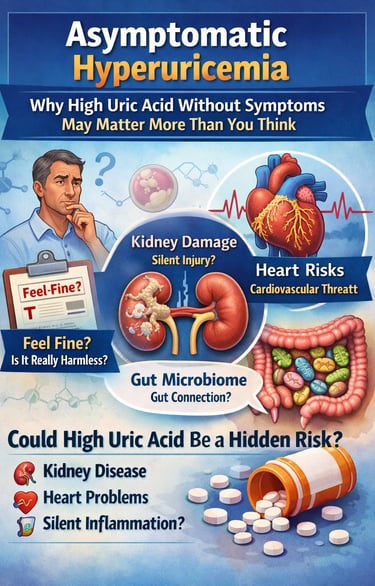
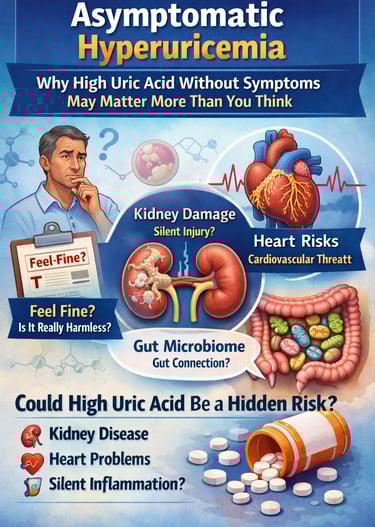
High uric acid without gout is called asymptomatic hyperuricemia. Most people do not need treatment unless uric acid levels are very high (≥9–10 mg/dL) or complications such as kidney disease, cardiovascular risk, or kidney stones are present.
Imagine going for a routine health check and being told that your uric acid level is elevated. You feel completely normal — no joint pain, no kidney stones, no gout attacks. Your doctor mentions a term you may never have heard before: asymptomatic hyperuricemia.
Naturally, the first question that comes to mind is simple: If I have no symptoms, does it really matter?
For decades, many clinicians treated high uric acid without symptoms as a relatively harmless laboratory finding. Unless a patient developed gout or kidney stones, the standard approach was often to monitor the level and avoid unnecessary medication. However, a growing body of modern research suggests that the story may be far more complex. A 52-year-old man with hypertension and uric acid 8.7 mg/dL may not have gout yet, but his kidney and cardiovascular risk profile is different from someone with uric acid 6.0 mg/dL
Recent studies indicate that asymptomatic hyperuricemia may influence several critical systems in the body, including the kidneys, cardiovascular system, and even the gut microbiome (Mucciarelli et al., 2025; Cao et al., 2025). Elevated uric acid has been associated with chronic kidney disease progression, hypertension, and increased cardiovascular risk, raising important questions about whether “asymptomatic” truly means biologically harmless (Johnson et al., 2026).
Even more intriguingly, a large population study from Finland found that people with hyperuricemia without diagnosed gout used significantly more analgesic medications than those with normal uric acid levels — suggesting that subtle inflammation or low-grade discomfort may occur long before classic symptoms appear (Timsans et al., 2026).
These findings are reshaping how scientists and clinicians think about uric acid metabolism, gout prevention, and metabolic health. While not everyone with elevated uric acid requires medication, researchers increasingly view hyperuricemia as a potential early metabolic signal rather than a benign laboratory anomaly.
Understanding what high uric acid really means for long-term health — and when lifestyle changes or treatment might be appropriate — has become an important part of modern preventive medicine.
What You Will Learn
In this article, you’ll discover what asymptomatic hyperuricemia really means, why high uric acid can affect your kidneys, heart, and metabolism even without gout, and when treatment may be necessary. You’ll also learn evidence-based lifestyle strategies to manage uric acid levels and understand the latest expert guidelines to make informed decisions about your long-term health.
Key Takeaways: High Uric Acid Without Gout
1. High uric acid without symptoms is called asymptomatic hyperuricemia.
It occurs when serum uric acid rises above about 6.8 mg/dL, the level at which urate crystals can begin to form in the body.
2. Not everyone with hyperuricemia develops gout.
Only about 30–35% of people with persistently elevated uric acid will eventually experience a gout attack, although risk increases over time.
3. Elevated uric acid may affect more than joints.
Research links hyperuricemia with chronic kidney disease progression, hypertension, and increased cardiovascular risk, even in people without gout symptoms.
4. Treatment is usually recommended only in specific situations.
Experts generally consider urate-lowering therapy when uric acid levels exceed ~9–10 mg/dL or when patients have kidney disease, cardiovascular risk, or recurrent kidney stones.
5. Lifestyle changes can significantly lower uric acid levels.
Reducing fructose-sweetened drinks, alcohol, and purine-rich foods, maintaining a healthy weight, staying hydrated, and exercising regularly can help improve uric acid metabolism.
Clinical Pearls.
1. The "Asymptomatic" Paradox
Scientific Perspective: Data from Timsans et al. (2026) suggest a higher use of analgesics in hyperuricemic patients without gout. This indicates a state of subclinical systemic inflammation or low-grade crystal deposition that doesn't reach the threshold of an "attack" but still impacts quality of life
You might not have "gout," but those nagging aches and pains you’ve been treating with Ibuprofen might actually be your body reacting to high uric acid levels. "No symptoms" doesn't always mean "no impact."
2. The Kidney-Uric Acid "Vicious Cycle"
Scientific Perspective: As highlighted in the URRAH study (2025), hyperuricemia is an independent driver of Chronic Kidney Disease (CKD) progression. High uric acid causes renal vasoconstriction and activates the renin-angiotensin system, which further impairs the kidney's ability to excrete urate.
Think of your kidneys as a filter. High uric acid is like pouring sand into that filter—it scratches the surface and makes the filter less effective over time. Protecting your uric acid levels is a direct way to protect your kidney health for the future.
3. Cardiovascular "Crosstalk"
Scientific Perspective: The 2026 European Expert Consensus identifies uric acid as a pro-oxidant inside the vascular endothelium. It promotes atherosclerosis (hardening of the arteries) and arterial stiffness, making it a critical "red flag" for patients with existing hypertension or diabetes.
High uric acid isn't just about your big toe; it’s about your heart. If your levels are high, it’s a signal that your blood vessels might be under stress. Lowering it can be just as important for heart health as managing your cholesterol.
4. The Gut Microbiome Connection
Scientific Perspective: New research from Cao et al. (2025) shows that the gut is responsible for roughly one-third of uric acid excretion. Dysbiosis (an imbalance of gut bacteria) can impair the breakdown of purines before they even reach the bloodstream.
Your gut is a partner in cleaning your blood. A healthy, high-fiber diet doesn't just help your digestion; it supports the "good bacteria" that help your body get rid of uric acid naturally.
5. The "9.0 mg/dL" Threshold
Scientific Perspective: Clinical guidelines (Kamath & Dharani, 2025) suggest that once levels exceed 9.0–10.0 mg/dL, the risk of spontaneous crystallization and organ damage increases exponentially, regardless of symptoms. This often outweighs the risks of long-term urate-lowering therapy (ULT).
There is a "tipping point." Even if you feel fine, if your number is above 9.0, your blood is essentially "saturated." It’s much easier to prevent crystals from forming now than it is to dissolve them once they’ve caused damage.
6. Precision Lifestyle Medicine
Scientific Perspective: Uric acid management is no longer just "don't eat steak." It involves managing fructose intake (which triggers ATP depletion and urate production) and ensuring proper hydration to support fractional urate excretion.
It’s not just about what you stop eating (like red meat), but what you start doing. Drinking more water and cutting out high-fructose corn syrup (soda/processed sweets) are often more effective than strict dieting alone.
What Is Asymptomatic Hyperuricemia?
Hyperuricemia means your blood uric acid level is above the normal threshold — generally above 6.8 mg/dL (or 0.40 mmol/L). The word asymptomatic means you haven't yet experienced the classic signs of uric acid buildup, such as gout attacks (sudden, excruciating joint pain) or kidney stones.
Uric acid is a natural byproduct of the body breaking down purines — compounds found in certain foods (like red meat, shellfish, and beer) and naturally produced by your body. Normally, uric acid dissolves in the blood and exits the body through urine. But when your body produces too much or excretes too little, levels climb.
What makes this condition particularly tricky is that millions of people live with elevated uric acid for years without obvious pain — yet the latest research is challenging whether "no symptoms" truly means "no harm."
Understanding Uric Acid Levels: What the Numbers Mean
Below 6 mg/dL – Optimal Level
This is generally considered the target uric acid level, especially for people at risk of gout or those already receiving urate-lowering therapy.6–7 mg/dL – Borderline Elevation
Uric acid begins approaching the solubility threshold (~6.8 mg/dL), where urate crystals can start forming in tissues. Monitoring and lifestyle changes may be recommended.7–9 mg/dL – Hyperuricemia
This range is considered clinically elevated. The long-term risk of gout, kidney stones, and metabolic complications gradually increases, particularly if other risk factors such as obesity or hypertension are present.Above 9 mg/dL – High Complication Risk
At this level, the blood is often supersaturated with uric acid, significantly increasing the likelihood of urate crystal formation. Many clinical guidelines recommend considering urate-lowering therapy, even in the absence of gout symptoms.
Are You Really Symptom-Free? Challenging the "Asymptomatic" Label
One of the most thought-provoking studies published in early 2026 directly questions the asymptomatic label itself.
Timsans et al. (2026) conducted a large population-based study in Finland and found that people with hyperuricemia used significantly more analgesics (pain-relieving medications) than those with normal uric acid levels. This pattern held true even in individuals who had never been diagnosed with gout or joint disease. The study raises a critical question: could elevated uric acid be causing low-grade pain or inflammation that people manage with over-the-counter painkillers — without ever connecting it to their uric acid levels?
This matters because if "asymptomatic" hyperuricemia is quietly causing discomfort that people dismiss or self-medicate, the condition may be far less benign than it appears at the surface. It also suggests that the true burden of high uric acid may be underestimated in clinical practice.
How Does High Uric Acid Affect the Kidneys?
The kidneys are one of the most well-established targets of long-term hyperuricemia, and recent research has added crucial detail to this picture.
Mucciarelli et al. (2025) published findings from the URRAH (Uric Acid Right for Heart Health) study, one of Europe's largest observational datasets on hyperuricemia and organ damage. Their research found that asymptomatic hyperuricemia is associated with a significantly higher risk of chronic kidney disease (CKD) progression, independent of other risk factors like blood pressure or diabetes.
Specifically, the URRAH data highlighted that uric acid may damage the kidneys through several mechanisms: by promoting inflammation in kidney tissue, by contributing to hypertension (which in turn harms the kidneys), and by directly impairing the kidney's ability to filter waste. The study also noted that the threshold at which kidney risk begins to rise may be lower than previously believed — meaning "borderline" high uric acid may still deserve clinical attention.
For patients already living with reduced kidney function, this is particularly important. High uric acid and kidney disease can create a vicious cycle, with each making the other worse.
Cardiovascular Risk: When High Uric Acid Meets a Struggling Heart
The link between hyperuricemia and cardiovascular disease has been debated for years — but expert consensus is increasingly leaning toward it being a genuine risk factor, not just a coincidence.
Johnson et al. (2026), writing on behalf of a major European expert panel, published an updated consensus statement on hyperuricemia and high cardiovascular risk. This 2025 update recommends that clinicians treat hyperuricemia more proactively in patients who already have established cardiovascular risk factors — including hypertension, type 2 diabetes, or prior cardiovascular events.
The experts noted that elevated uric acid may directly damage blood vessel walls, promote oxidative stress, trigger systemic inflammation, and contribute to the development of atherosclerosis (hardening of the arteries). The consensus panel advocates for urate-lowering therapy (ULT) in high-risk cardiovascular patients even before gout symptoms develop — a significant shift from the traditional "wait and see" approach.
This guidance is particularly relevant for people managing multiple risk factors simultaneously. If you have high uric acid and elevated blood pressure, high cholesterol, or diabetes, the combined cardiovascular risk profile may be significantly worse than any single factor alone.
The Gut Microbiome and Uric Acid: A Surprising New Connection
One of the most exciting emerging areas of hyperuricemia research involves the gut microbiome — the trillions of bacteria and microorganisms that live in your digestive system.
Cao et al. (2025) published a study examining gut microbiome composition specifically in people with asymptomatic hyperuricemia. Their findings revealed that people with elevated uric acid have a measurably different gut microbiome profile compared to individuals with normal uric acid levels. Key bacterial species involved in purine metabolism and uric acid excretion were altered, suggesting that the gut microbiome may play a role in how the body processes and eliminates uric acid.
This is significant for several reasons. First, it opens up the possibility that gut health interventions — such as dietary changes, probiotics, or prebiotics — could influence uric acid levels in ways we haven't previously understood. Second, it suggests that the gut-kidney-uric acid axis is far more complex than simply "eat less red meat and drink more water."
While it's too early to recommend specific microbiome-based treatments for hyperuricemia, this research points toward a future where personalized gut health strategies may complement traditional urate-lowering approaches.
What Do Patients Actually Think? Perceptions and Treatment Willingness
One of the most human aspects of this condition is the psychological and attitudinal dimension — how people feel about being told they have a medical condition when they don't feel sick.
Dalbeth et al. (2025) conducted an international study examining patient perceptions about asymptomatic hyperuricemia and their views on urate-lowering therapy. The study recruited participants from multiple countries and found some illuminating patterns:
Many people with asymptomatic hyperuricemia did not perceive themselves as having a genuine medical problem, particularly when no symptoms were present.
There was significant hesitancy toward urate-lowering therapy, driven by concerns about taking lifelong medication, potential side effects, and uncertainty about whether treatment was truly necessary without symptoms.
Conversely, patients who had been better educated about the potential downstream risks — gout attacks, kidney disease, and cardiovascular complications — were considerably more open to preventive treatment.
These findings underscore an important clinical reality: information and communication matter enormously. A doctor simply saying "your uric acid is a bit high" without explaining what that means in practical terms is unlikely to motivate behavior change or treatment acceptance.
When Should Asymptomatic Hyperuricemia Actually Be Treated?
This is the question at the heart of the debate — and recent guidance suggests the answer depends heavily on individual circumstances.
Kamath & Dharani (2025), in a clinical review published in the European Journal of Pharmaceutical and Medical Research, provide a useful framework for thinking about when to treat and when not to treat:
Treatment is generally recommended when:
Uric acid levels are very high (typically above 9–10 mg/dL)
The patient also has cardiovascular disease, chronic kidney disease, hypertension, or diabetes
There is a family history of gout or kidney stones
The patient is about to start chemotherapy (which can cause rapid uric acid release)
Treatment may be deferred when:
Uric acid levels are only mildly elevated
There are no comorbidities (no other medical conditions)
The patient is otherwise healthy and willing to make dietary and lifestyle modifications
The risk-benefit profile of long-term medication use does not favor pharmacological intervention
The key takeaway from current evidence is that a one-size-fits-all approach is outdated. Whether you need medication depends on your complete health picture — not just a single blood test number.
Lifestyle Strategies That Support Healthy Uric Acid Levels
Before medication enters the conversation, there is strong evidence supporting lifestyle interventions. Here's what the research consistently endorses:
Dietary adjustments: Limiting purine-rich foods (organ meats, red meat, shellfish, and yeast extracts) and avoiding fructose-sweetened beverages can meaningfully lower uric acid levels.
Hydration: Adequate water intake promotes uric acid excretion through the kidneys. Aiming for 2–3 litres of water daily is a widely recommended starting point.
Alcohol reduction: Beer and spirits are particularly linked to uric acid spikes. Moderate wine consumption appears less problematic, but all alcohol raises uric acid to some degree.
Weight management: Excess body weight is strongly associated with higher uric acid levels. Even modest weight loss can produce meaningful reductions.
Cherry consumption: Tart cherry juice and extract have shown modest but consistent uric acid-lowering effects in several studies, likely through anti-inflammatory and uricosuric mechanisms.
Exercise: Regular moderate exercise supports metabolic health, kidney function, and healthy weight — all of which contribute to better uric acid regulation. Intense exercise, however, can temporarily raise uric acid, so moderation is key.
A Quick Guide to Urate-Lowering Medications
For those who do require pharmacological treatment, the landscape of available medications is well-established and generally well-tolerated:
Allopurinol is the most widely prescribed first-line medication globally. It works by blocking xanthine oxidase, the enzyme responsible for producing uric acid. It is inexpensive, effective, and generally safe for long-term use.
Febuxostat is an alternative xanthine oxidase inhibitor used when allopurinol is not tolerated. Some studies have raised questions about cardiovascular safety, which your doctor should weigh against potential benefits.
Probenecid works differently — it helps the kidneys excrete more uric acid. It is used less commonly but can be appropriate in specific clinical contexts.
The European expert consensus (Johnson et al., 2026) emphasises that the goal of treatment should be to bring serum uric acid below 6.0 mg/dL (or below 5.0 mg/dL in those with tophi — uric acid crystal deposits under the skin). This "treat to target" approach is becoming the international standard.
The Bigger Picture: Why This Research Matters
1. Asymptomatic hyperuricemia is common — and often underestimated.
Elevated serum uric acid levels (>6.8 mg/dL) occur in a substantial proportion of adults worldwide, yet many individuals remain symptom-free for years. Because gout attacks or kidney stones may not develop immediately, hyperuricemia is frequently dismissed as a benign laboratory abnormality. However, emerging research suggests that this interpretation may overlook important metabolic and vascular consequences.
2. Uric acid may act as an early metabolic signal rather than a passive biomarker.
Experimental and epidemiological studies increasingly indicate that hyperuricemia may contribute to endothelial dysfunction, oxidative stress, and low-grade systemic inflammation. These mechanisms are implicated in the development of hypertension, chronic kidney disease, and cardiometabolic disorders, suggesting that elevated uric acid may reflect deeper disturbances in metabolic regulation.
3. Kidney health appears particularly vulnerable.
Large observational cohorts have shown that asymptomatic hyperuricemia is associated with accelerated progression of chronic kidney disease, independent of traditional risk factors such as diabetes or hypertension. Mechanistically, uric acid may promote renal microvascular injury, inflammation, and impaired filtration capacity, potentially creating a self-reinforcing cycle of worsening kidney function.
4. Cardiovascular implications remain a major area of investigation.
An expanding body of literature links high uric acid levels with increased cardiovascular risk, including hypertension, atherosclerosis, and heart failure. While debate continues regarding causality, many experts now consider hyperuricemia a modifiable cardiometabolic risk factor worthy of closer monitoring in high-risk patients.
5. Treatment decisions should remain individualized.
Not every patient with elevated uric acid requires pharmacologic therapy. Current evidence supports a risk-stratified approach, considering factors such as uric acid concentration, kidney function, cardiovascular risk profile, and comorbid conditions before initiating urate-lowering therapy.
6. Lifestyle interventions remain foundational.
Weight control, reduced intake of fructose-sweetened beverages and purine-rich foods, moderation of alcohol consumption, and adequate hydration can meaningfully influence uric acid metabolism and reduce long-term risk.
7. The emerging consensus: “asymptomatic” does not necessarily mean biologically inactive.
Modern research increasingly views asymptomatic hyperuricemia as part of the broader network of metabolic and cardiovascular risk, highlighting the importance of proactive evaluation rather than simple reassurance.
Frequently Asked Questions About Asymptomatic Hyperuricemia
❓ FAQ 1: If I have no gout symptoms, why does my uric acid level matter?
Even without gout attacks, elevated uric acid can silently affect the kidneys and cardiovascular system over time. Research from the URRAH study (Mucciarelli et al., 2025) found that asymptomatic hyperuricemia is independently associated with chronic kidney disease progression. Meanwhile, a 2026 Finnish study (Timsans et al., 2026) found that people with elevated uric acid use more pain medication than those with normal levels — suggesting that "no symptoms" may not tell the whole story.
❓ FAQ 2: Will I definitely develop gout if I have hyperuricemia?
Not necessarily. While hyperuricemia is the primary risk factor for gout, only about one-third of people with consistently elevated uric acid will ever develop a gout attack. However, the longer uric acid remains elevated, the higher the cumulative risk — particularly if you also consume a high-purine diet, drink alcohol regularly, or take medications that raise uric acid (like certain diuretics).
❓ FAQ 3: Is urate-lowering therapy safe for long-term use?
Allopurinol, the most commonly prescribed urate-lowering therapy, has a well-established long-term safety profile when used appropriately and monitored by a physician. Dalbeth et al. (2025) found that many patients are hesitant about lifelong medication, which is understandable — but for those with significant cardiovascular or renal risk factors, the evidence suggests that the benefits of treatment generally outweigh the risks.
❓ FAQ 4: Can I lower my uric acid through diet alone?
Diet can meaningfully influence uric acid levels, and lifestyle changes are always the recommended first step. Reducing purine-rich foods, limiting fructose and alcohol, staying well-hydrated, and maintaining a healthy weight can lower uric acid by approximately 1–2 mg/dL. However, for people with uric acid levels above 9 mg/dL or with significant comorbidities, diet alone is usually insufficient to reach target levels, and medication is likely necessary (Kamath & Dharani, 2025).
❓ FAQ 5: How does gut health relate to my uric acid levels?
This is a growing area of research. A 2025 study by Cao et al. found that people with asymptomatic hyperuricemia have a distinct gut microbiome composition, with alterations in bacteria involved in purine breakdown and uric acid excretion. While specific probiotic or dietary interventions for uric acid management are still being studied, maintaining general gut health through a fibre-rich diet and fermented foods may support healthier uric acid metabolism.
❓ FAQ 6: Should I be worried about my heart if I have high uric acid?
If you already have cardiovascular risk factors — such as high blood pressure, type 2 diabetes, high cholesterol, or a prior cardiovascular event — then yes, elevated uric acid warrants attention. The 2025 European expert consensus (Johnson et al., 2026) recommends considering urate-lowering therapy in high cardiovascular-risk patients with hyperuricemia. Discuss your complete cardiovascular profile with your doctor to assess whether your uric acid level adds meaningfully to your overall risk.
❓ FAQ 7: What number on my blood test means I definitely need treatment?
There is no universal "magic number," but general clinical guidance suggests that uric acid levels above 9–10 mg/dL warrant treatment even without symptoms, as the risk of complications becomes significant. For those with existing kidney disease, heart disease, or hypertension, lower thresholds (above 7–8 mg/dL) may justify treatment. The goal, once treatment is initiated, is typically to bring levels below 6.0 mg/dL — or below 5.0 mg/dL in those with visible uric acid deposits (Kamath & Dharani, 2025; Johnson et al., 2026).
Quick Self-Check: Should You Be Concerned About High Uric Acid?
Many people with high uric acid wonder whether their result is truly concerning. The quick checklist below can help you decide when medical advice is important
You may want to discuss your uric acid levels with your doctor if several of the following apply to you:
• Your serum uric acid level is above 7 mg/dL for men or 6 mg/dL for women.
• Your uric acid level is above 9 mg/dL, even if you have no symptoms.
• You have high blood pressure, type 2 diabetes, or high cholesterol.
• You have chronic kidney disease or reduced kidney function.
• You have a family history of gout or kidney stones.
• You frequently consume beer, sugary beverages, or fructose-sweetened foods.
• You take medications that can raise uric acid, such as thiazide diuretics.
If several of these risk factors are present, clinicians often recommend closer monitoring, lifestyle changes, or preventive treatment to reduce long-term complications.
Author’s Note
As a physician specializing in internal medicine, I have long been interested in how seemingly minor laboratory abnormalities can reveal deeper metabolic processes within the body. Asymptomatic hyperuricemia is one such example. For many years, elevated uric acid without gout symptoms was often viewed as clinically insignificant. However, emerging research suggests that uric acid may interact with cardiovascular health, kidney function, metabolic regulation, and systemic inflammation in ways that are only now becoming fully understood.
This article was developed after reviewing recent peer-reviewed studies and expert consensus statements published between 2025 and 2026 to translate complex scientific evidence into clear, practical insights for readers. My aim is not to promote unnecessary treatment, but to encourage informed conversations between patients and clinicians about what elevated uric acid may signify in the broader context of long-term health.
Medical science evolves continually, and thoughtful interpretation of new evidence remains essential for responsible clinical decision-making.
Disclaimer: This article is for informational purposes only and does not constitute medical advice. Individual circumstances vary, and treatment decisions should always be made in consultation with qualified healthcare professionals.
Related Articles
Obesity and Fatty Liver Disease: What Science Says About Risk and Health | DR T S DIDWAL
Intermittent Fasting: Metabolic Health Benefits and the Evidence on Longevity | DR T S DIDWAL
Activate Your Brown Fat: A New Pathway to Longevity and Metabolic Health | DR T S DIDWAL
References
Cao, F., Yi, W., Wu, M., Gao, A., Kang, T., & Hou, X. (2025). Characteristics of the gut microbiome of asymptomatic hyperuricemia. Frontiers in Endocrinology, 16, 1557225. https://doi.org/10.3389/fendo.2025.1557225
Dalbeth, N., Stewart, S., Gamble, G. D., Mihov, B., Stamp, L. K., Haslett, J., Taylor, W. J., Merriman, T. R., Tabi-Amponsah, A. D., Horne, A., Neogi, T., Pascart, T., Andrés, M., Peral-Garrido, M. L., Norkuviene, E., Vazquez-Mellado, J., Uhlig, T., Sun, M., Li, C., & Petrie, K. J. (2025). Perceptions about asymptomatic hyperuricemia and views about urate-lowering therapy in people with asymptomatic hyperuricemia. Arthritis Care & Research. Advance online publication. https://doi.org/10.1002/acr.25639
Johnson, R., Gruev, I., Yotov, Y., Jackuliak, P., Borghi, C., Domienik-Karłowicz, J., Tykarski, A., Filipiak, K. J., Jaguszewski, M. J., Narkiewicz, K., Barylski, M., Mamcarz, A., Wolf, J., Jarai, Z., Becer, D., Vrablik, M., Vinereanu, D., Wełnicki, M., Widecka, K., & Litwin, M. (2026). Expert consensus for the diagnosis and treatment of patients with hyperuricemia and high cardiovascular risk: 2025 update. European Journal of Internal Medicine, 106727. Advance online publication. https://doi.org/10.1016/j.ejim.2026.106727
Kamath, V., & Dharani, S. (2025). An update on hyperuricemia — When to treat and when not to treat. European Journal of Pharmaceutical and Medical Research, 12(6), 618–621. http://www.ejpmr.com
Mucciarelli, C., De Vincentis, A., Russo, G., Viazzi, F., Pontremoli, R., Beccuti, G., & Cassader, M. (2025). Asymptomatic hyperuricemia and the kidney: Lessons from the URRAH study. Metabolites, 15(1), 11. https://doi.org/10.3390/metabo15010011
Timsans, J., Kauppi, J. E., Rantalaiho, V., et al. (2026). Hyperuricemic persons use more analgesics than normouricemic — is asymptomatic hyperuricemia really asymptomatic? BMC Medicine, 24, 32. https://doi.org/10.1186/s12916-025-04573-2