Why Fructose Makes You Overeat: How It Disrupts the Brain’s Satiety and Reward Signals
Learn how fructose alters brain satiety and reward signaling, suppresses leptin and PYY, and drives overeating independent of willpower or calories.
NUTRITIONMETABOLISM
Dr. T.S. Didwal, M.D.(Internal Medicine)
5/12/202611 min read
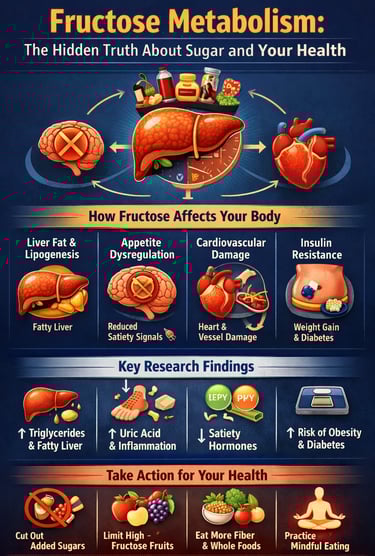
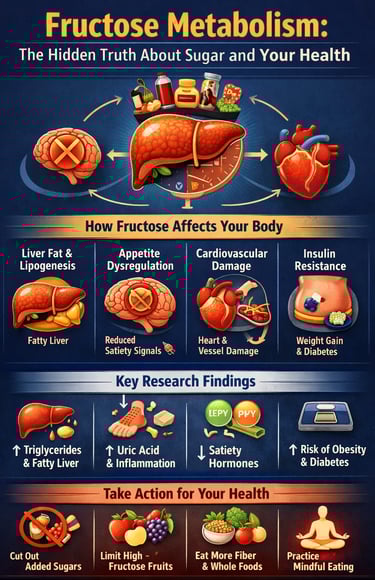
Many people believe overeating is simply a matter of poor willpower or lack of discipline. However, modern research in nutrition science and metabolic health suggests that certain sugars—especially fructose—can biologically disrupt the body’s natural hunger-control system (Nakagawa & Johnson, 2025). Unlike glucose, which is used by cells throughout the body and helps trigger normal fullness signals, fructose is processed mainly in the liver and bypasses several key appetite-regulating mechanisms (Agarwal et al., 2024).
One major problem is that fructose does not strongly stimulate insulin, leptin, or peptide YY—hormones that normally help the brain recognize satiety and reduce hunger (Flores Monar et al., 2025). In simple terms, the body receives calories, but the brain never gets a strong “I’m full” message. This helps explain why sugar-sweetened beverages, processed foods, desserts, and ultra-processed snacks can promote persistent hunger and overeating even after large calorie intake.
Research also shows that fructose may affect dopamine and reward pathways in the brain, reducing feelings of satisfaction after eating (Flores Monar et al., 2025). As a result, people may continue craving more food despite already consuming enough energy. This altered appetite regulation may contribute to obesity, food cravings, emotional eating, and metabolic syndrome.
At the same time, excess fructose intake rapidly increases liver fat production through a process called de novo lipogenesis and raises uric acid levels, which are linked to fatty liver disease, insulin resistance, inflammation, and cardiovascular risk (Agarwal et al., 2024; Baharuddin, 2025). Importantly, these metabolic effects can occur even in people who are not overweight, meaning that “thin” individuals may still develop hidden metabolic dysfunction and fatty liver disease (Tappia et al., 2026).
Together, these findings challenge the old idea that overeating is only about self-control. Modern dietary sugars—particularly added fructose from soft drinks, processed foods, and high-fructose corn syrup—can directly interfere with the brain’s hunger signals, reward circuits, and metabolism. Understanding how fructose affects appetite, weight gain, liver health, and cardiometabolic disease may help explain why modern diets are so strongly linked to chronic obesity, diabetes, and metabolic disorders.
Common Hidden Sources of Excess Fructose
Soft drinks
Fruit juice
Flavored yogurt
Granola bars
Breakfast cereals
Sports drinks
Sweetened coffee beverages
Packaged sauces
The Metabolic Difference Between Glucose and Fructose
Most people use the words “sugar” and “glucose” interchangeably, but metabolically they are profoundly different molecules.
Glucose is the body’s preferred fuel source. Nearly every cell can metabolize it. Its entry into cells is tightly controlled by insulin and cellular energy demand. When glucose is consumed, insulin rises, leptin signaling increases, ghrelin falls, and the brain receives a coordinated message that energy has been delivered.
Fructose behaves differently.
Instead of being widely distributed throughout the body, fructose is absorbed primarily through GLUT5 transporters and directed almost immediately to the liver. There, it bypasses phosphofructokinase—the major regulatory checkpoint that normally controls carbohydrate metabolism.
This bypass is metabolically significant because it allows fructose metabolism to proceed rapidly and relatively unchecked.
The liver essentially receives a sudden biochemical flood.
Rather than carefully regulating the influx of energy, hepatocytes rapidly phosphorylate fructose using ATP. This creates a transient intracellular energy depletion state, increases AMP degradation, and drives uric acid production. Simultaneously, excess carbon substrates are redirected toward de novo lipogenesis—the creation of new fat molecules.
In simple terms, fructose is uniquely efficient at turning sugar into fat. This process is particularly problematic in modern diets where fructose exposure is chronic rather than occasional. Evolutionarily, fructose likely functioned as a survival signal. Seasonal fruit availability may have promoted temporary fat storage before periods of scarcity. In today’s environment of continuous caloric abundance, however, this once-adaptive pathway becomes harmful.
Instead of brief seasonal activation, the body experiences persistent metabolic “winter preparation mode.”
The Energy Depletion Paradox
One of the most fascinating discoveries in fructose research is the concept of intracellular energy depletion.
Ordinarily, food increases cellular energy availability. Fructose paradoxically creates a temporary energy crisis inside liver cells during its metabolism.
This occurs because fructokinase rapidly phosphorylates fructose without the normal feedback inhibition present in glucose metabolism. ATP stores are consumed aggressively, AMP accumulates, and uric acid generation increases. ATP→AMP→Uric Acid This biochemical cascade produces oxidative stress, mitochondrial dysfunction, and inflammatory signaling.
Clinically, this matters because mitochondrial dysfunction reduces metabolic efficiency. Cells become less capable of generating energy effectively, promoting fatigue, insulin resistance, and abnormal fat accumulation. Uric acid appears central to this process. Traditionally associated mainly with gout, uric acid is increasingly recognized as a metabolic signaling molecule linked to hypertension, endothelial dysfunction, oxidative stress, and visceral adiposity.
Johnson and colleagues (2026) propose that uric acid may function as an evolutionary “survival switch,” encouraging fat storage and reducing energy expenditure during times of fructose exposure. In the modern world, chronic activation of this pathway contributes to persistent metabolic dysfunction.
This may explain why individuals consuming high-fructose diets frequently develop metabolic abnormalities even before significant weight gain occurs.
Why Fructose Fails to Trigger Fullness
One of fructose’s most concerning effects is its weak activation of satiety pathways.
When glucose is consumed, insulin rises and stimulates leptin secretion from adipose tissue. Leptin communicates with the hypothalamus to reduce appetite and increase satiety.
Fructose generates only a minimal insulin response. Consequently, leptin signaling remains blunted. At the same time, fructose inadequately suppresses ghrelin—the body’s primary hunger hormone. The result is a physiologic “satiety failure.” Calories are consumed, yet the hormonal cascade that normally signals fullness remains incomplete. This phenomenon helps explain why liquid sugars are particularly dangerous.
A sugar-sweetened beverage can contain enormous caloric loads without meaningfully reducing subsequent food intake. The brain does not fully register those calories as satisfying. From a clinical perspective, this is critically important.
Many individuals consuming highly processed diets are not overeating because they lack discipline. They are consuming foods specifically engineered—or metabolically structured—to bypass natural appetite regulation systems.
Flores Monar and colleagues (2025) further demonstrated that fructose alters reward signaling pathways involving dopamine. Normally, food consumption generates a balanced reward response that promotes satisfaction. Fructose appears to create a mismatch between caloric intake and perceived reward, encouraging continued seeking behavior despite adequate energy intake.
In practical terms, people may continue eating not because they remain energetically deficient, but because their neurochemical reward circuitry remains incompletely satisfied.
The Liver Fat Factory
The liver is uniquely vulnerable to fructose overload.
Because fructose metabolism occurs predominantly in hepatocytes, excessive intake drives rapid de novo lipogenesis (DNL)—the synthesis of triglycerides from carbohydrate substrates. Fructose→Acetyl-CoA→Triglycerides This process activates key transcription factors, including ChREBP and SREBP-1c, molecular regulators that stimulate fat synthesis genes. The consequence is hepatic fat accumulation.
Non-alcoholic fatty liver disease (NAFLD), now affecting roughly one-quarter of the global population, is strongly associated with excessive fructose intake. Importantly, this can occur independent of obesity. Many individuals with normal body weight develop “lean NAFLD,” sometimes referred to as the “skinny fat” phenotype. Externally, they may appear healthy, yet metabolically they exhibit visceral adiposity, hepatic steatosis, dyslipidemia, and insulin resistance.
This distinction matters because weight alone is a poor marker of metabolic health.
A person can maintain a relatively normal BMI while harboring significant metabolic dysfunction driven by fructose-mediated lipogenesis.
The liver, in essence, becomes a biochemical fat-production organ.
Fructose and Cardiovascular Disease
The metabolic damage caused by fructose extends far beyond body weight.
Recent cardiovascular research demonstrates that excessive fructose intake contributes directly to vascular dysfunction and cardiac injury.
Tappia and colleagues (2026) showed that high-fructose diets induce endothelial dysfunction, arterial stiffness, hypertension, and impaired cardiac performance.
One mechanism involves uric acid–mediated suppression of endothelial nitric oxide synthase (eNOS).
Nitric oxide is essential for vascular flexibility and vasodilation. Reduced nitric oxide availability promotes vasoconstriction, elevated blood pressure, and impaired blood flow. NO↓⇒Vasoconstriction↑
Fructose also increases circulating triglycerides and promotes lipid deposition within vascular tissue. Over time, this contributes to arterial inflammation, plaque formation, and cardiovascular risk.
Perhaps most concerning is the observation that these abnormalities occur even in lean individuals. This challenges the traditional assumption that metabolic risk can be reliably assessed by body size alone. A metabolically unhealthy normal-weight individual may still experience significant cardiovascular injury from chronic fructose exposure.
Fructose, Inflammation, and the Brain
Metabolic disease is increasingly recognized as an inflammatory disorder.
High fructose intake promotes chronic low-grade inflammation through multiple pathways:
Oxidative stress
Uric acid generation
Mitochondrial dysfunction
Endotoxin translocation from impaired gut barriers
Excess visceral fat accumulation
Inflammation within the hypothalamus appears especially important.
The hypothalamus serves as the brain’s metabolic control center, regulating hunger, energy expenditure, and hormonal balance.
Inflammatory injury to hypothalamic neurons impairs appetite regulation and may contribute to persistent overeating.
This creates a vicious cycle:
Fructose impairs satiety signaling
Overeating increases metabolic stress
Inflammation worsens hypothalamic dysfunction
Appetite dysregulation intensifies further
Over time, the body’s normal energy-regulation systems become increasingly resistant to correction.
The Fiber Defense System
One of the most misunderstood issues in nutrition is whether fruit itself is harmful. The answer lies largely in the metabolic context and delivery rate.
Whole fruit contains fructose, but it also contains fiber, water, polyphenols, micronutrients, and intact cellular structures that dramatically slow absorption. Fiber functions as a biological “slow-release system.” Instead of overwhelming the liver with rapid fructose delivery, whole fruit allows gradual absorption that the body can manage more effectively.
Fruit juice removes this protective matrix. Without fiber, fructose reaches the liver rapidly, producing metabolic effects much closer to sugar-sweetened beverages. This distinction explains why eating an apple is metabolically different from drinking apple juice. The issue is not simply fructose quantity, but fructose flux—the speed and concentration at which fructose reaches the liver.
Nature packaged fructose within a protective lattice of fiber and phytonutrients. Modern food processing removed that protection.
The Modern Fructose Environment
Historically, humans consumed fructose seasonally and in relatively small amounts.
Today, fructose exposure is nearly continuous. High-fructose corn syrup, sucrose, sweetened yogurts, processed snacks, breakfast cereals, sports drinks, flavored coffees, sauces, and ultra-processed foods collectively create a dietary environment of chronic fructose overload. This matters because the body’s fructose pathways evolved for intermittent survival signaling—not permanent activation.
Johnson et al. (2026) describe fructose as a “metabolic signal of abundance.” In ancestral settings, this signal promoted energy storage during times of food availability. In modern society, where abundance never ends, the signal becomes maladaptive. The body remains trapped in perpetual fat storage
mode. The authors distinguish fructose’s unique biochemistry from glucose, highlight its role in both dietary sweeteners and internal production, and underscore how sustained signaling of “metabolic plenty” in an era of caloric surplus accelerates obesity and cardiometabolic disease. This perspective positions targeted fructose reduction as a high-leverage strategy for prevention and treatment. A landmark synthesis that elevates fructose from simple sugar to key regulatory driver in modern metabolic pathology.
The Evidence From Population Studies
Mechanistic science is compelling, but population data strengthen the argument further.
Large cohort studies consistently demonstrate that added fructose consumption is associated with:
Increased type 2 diabetes risk
Elevated triglycerides
Hypertension
Fatty liver disease
Cardiovascular disease
Visceral obesity
Metabolic syndrome
Trius-Soler et al.(2025), studying Danish populations, found that different sugars exert distinct metabolic effects. This is a crucial insight. Not all carbohydrates behave identically. Whole-food carbohydrate intake did not show the same harmful associations observed with added fructose consumption. This challenges simplistic nutritional frameworks that treat all carbohydrates or all calories as metabolically equivalent. Biochemistry matters.
Practical Clinical Implications
The implications of this research are profound.
1. Weight Alone Is Not Enough
Normal BMI does not guarantee metabolic health.
Patients with normal weight may still develop:
Fatty liver disease
Hypertriglyceridemia
Insulin resistance
Hypertension
Endothelial dysfunction
2. Liquid Sugars Are Especially Harmful
Sugar-sweetened beverages represent one of the most concentrated and rapidly absorbed sources of fructose exposure.
These beverages bypass satiety systems with remarkable efficiency.
3. Appetite Dysregulation Is Biological
Many patients struggling with overeating are experiencing disrupted neurohormonal signaling—not merely poor self-control.
Understanding this can improve both clinical treatment and public health messaging.
4. Fructose Reduction May Offer High-Leverage Benefits
Reducing added fructose intake may improve:
Triglycerides
Liver fat
Blood pressure
Appetite control
Insulin sensitivity
Inflammatory burden
often within weeks to months.
Clinical Pearls
The “Energy Crisis” Effect
Fructose rapidly depletes liver ATP and increases uric acid production, triggering oxidative stress and metabolic dysfunction.
The “Invisible Calories” Problem
Fructose weakly activates satiety hormones, allowing caloric intake without adequate fullness signaling.
The “Sugar-to-Fat” Conversion
Excess fructose strongly drives de novo lipogenesis and visceral fat accumulation.
The “Vascular Corrosion” Mechanism
Fructose-induced uric acid reduces nitric oxide availability, promoting arterial stiffness and hypertension.
The “Fiber Protection” Principle
Whole fruit delivers fructose slowly through a fibrous matrix, unlike juice or processed sweeteners.
Rethinking the Narrative Around Overeating
The modern obesity epidemic cannot be fully explained by laziness, lack of willpower, or simple caloric excess.
Human biology evolved in a nutritional environment profoundly different from today’s ultra-processed food landscape.
Fructose appears uniquely capable of disrupting the systems designed to protect us from overconsumption.
It weakens fullness signaling.
It alters reward pathways.
It accelerates fat production.
It impairs mitochondrial efficiency.
It promotes inflammation and vascular dysfunction.These effects occur not simply because fructose contains calories, but because it functions as a powerful metabolic signal.
This understanding shifts the conversation from blame to biology.
The question is no longer merely:
“Why do people overeat?”The more important question may be:
“What kinds of foods biologically impair the body’s ability to stop eating?”Increasingly, fructose appears central to that answer.
Conclusion
The scientific evidence surrounding fructose metabolism has evolved dramatically over the past decade.
What was once viewed as simply another dietary sugar is now recognized as a uniquely disruptive metabolic compound capable of altering appetite regulation, hepatic fat production, vascular function, mitochondrial efficiency, and inflammatory signaling.
Importantly, these effects are not restricted to obesity alone. Lean individuals may also develop significant cardiometabolic dysfunction from chronic high-fructose exposure. The evidence reviewed across mechanistic, clinical, and epidemiological research converges on a consistent message:
Excessive added fructose is not merely an issue of empty calories—it is a biologically active driver of metabolic disease. This does not mean all carbohydrates are harmful or that fruit should be feared. Rather, it highlights the importance of distinguishing between naturally structured whole foods and rapidly absorbed industrial sweeteners that overwhelm normal metabolic control systems. Nutrition science continues to evolve, but one conclusion is becoming increasingly difficult to ignore: Modern diets rich in added fructose may fundamentally impair the body’s ability to regulate hunger, energy balance, and long-term metabolic health.
Understanding this biology may be essential not only for treating obesity and diabetes, but for preventing the broader epidemic of cardiometabolic disease shaping modern health
Aurhoes note
This article was written to clarify a topic that is often oversimplified, misunderstood, or distorted by nutrition marketing and popular media: fructose metabolism. While “sugar” is frequently discussed as a single entity, the scientific evidence clearly shows that different sugars behave very differently in the human body. Fructose, in particular, follows unique metabolic pathways that have profound implications for liver health, cardiometabolic risk, appetite regulation, and long-term metabolic disease.
The goal of this piece is not to promote fear of food or to demonize all carbohydrates, but to present the current state of scientific evidence as accurately and transparently as possible. The conclusions drawn here are based on mechanistic studies, population data, and clinical research, with careful attention to how fructose affects human physiology independent of body weight or total calorie intake.
Disclaimer: This article is for informational purposes only and does not constitute medical advice. Individual circumstances vary, and treatment decisions should always be made in consultation with qualified healthcare professionals.
Related Articles
Feed Your Gut, Fuel Your Health: Diet, Microbiota, and Systemic Health | DR T S DIDWAL
What’s New in the 2025 Blood Pressure Guidelines? A Complete Scientific Breakdown | DR T S DIDWAL
Low-Fat vs. Low-Carb: Which Diet is Best for Weight Loss? | DR T S DIDWAL
References
Johnson, R.J., Lanaspa, M.A., Tolan, D.R. et al. Fructose: metabolic signal and modern hazard. Nat Metab (2026). https://doi.org/10.1038/s42255-026-01506-y
Agarwal, V., Das, S., Kapoor, N., Prusty, B., & Das, B. (2024). Dietary fructose: A literature review of current evidence and implications on metabolic health. Cureus, 16(11), e74143. https://doi.org/10.7759/cureus.74143
Baharuddin, B. (2025). The metabolic and molecular mechanisms linking fructose consumption to lipogenesis and metabolic disorders. Clinical Nutrition ESPEN, 69, 63–68. https://doi.org/10.1016/j.clnesp.2025.06.042
Flores Monar, G. V., Sanchez Cruz, C., & Calderon Martinez, E. (2025). Mindful eating: A deep insight into fructose metabolism and its effects on appetite regulation and brain function. Journal of Nutrition and Metabolism, 2025, 5571686. https://doi.org/10.1155/jnme/5571686
Nakagawa, T., & Johnson, R. J. (2025). Do not overlook the role of fructose in obesity. Nature Metabolism, 7, 3. https://doi.org/10.1038/s42255-024-01198-2
Rahimi, K., & Ghazi Zadeh, S. (2025). The impact of high fructose consumption on metabolic syndrome: Dietary and treatment strategies for effective management. Clinical Reviews and Opinions, 11(1), 1–10. https://doi.org/10.5897/CRO2024.0128
Tappia, P., Garriock, E., Ramjiawan, B., & Moghadasian, M. (2026). High fructose consumption induces cardiac dysfunction and vascular abnormalities. Canadian Journal of Physiology and Pharmacology, 104, 1–10. https://doi.org/10.1139/cjpp-2025-0249
Trius-Soler, M., Bramming, M., Jensen, M. K., Tolstrup, J. S., & Guasch-Ferré, M. (2025). Types of dietary sugars and carbohydrates, cardiometabolic risk factors, and risk of diabetes: A cohort study from the general Danish population. Nutrition Journal, 24(1), 8. https://doi.org/10.1186/s12937-025-01071-2