The New Biology of Fat Burning: What Really Happens Inside Your Fat Cells
Discover the hidden biology of fat burning, from insulin and HSL enzymes to circadian rhythms and tirzepatide. Learn why fat loss is more than calories.
OBESITY
Dr. T.S. Didwal, M.D.(Internal Medicine)
5/16/202617 min read
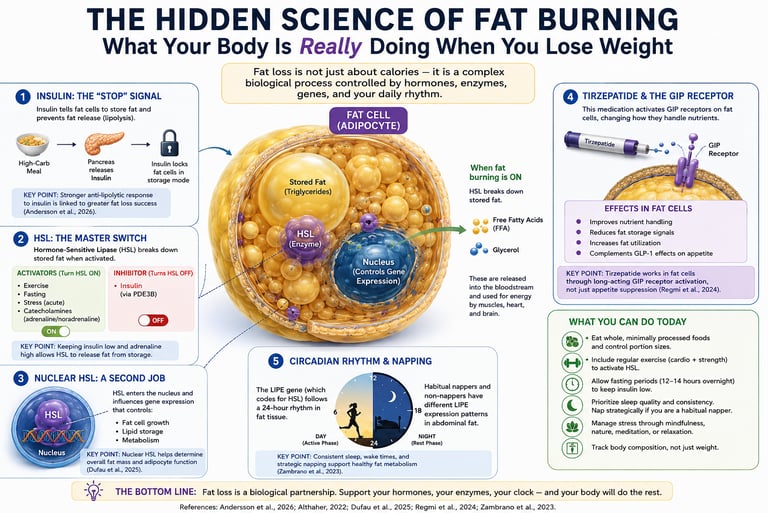
"Fat loss is not a simple matter of eating less and moving more — it is a finely tuned biological symphony, conducted by hormones, enzymes, and even your afternoon nap."
Key Takeaways
Insulin strongly influences fat burning
HSL is the body’s core fat-burning enzyme
Sleep and circadian rhythms affect adipose metabolism
Tirzepatide directly reprogrammes fat cells
Sustainable fat loss depends on metabolic health, not willpower alone
For decades, weight loss advice has sounded deceptively simple: eat less, move more, burn more calories than you consume. Yet millions of people discover a frustrating reality — the human body does not behave like a simple calculator. Two individuals can follow nearly identical diets and exercise plans, yet experience dramatically different results. Modern metabolic science is now revealing why. Fat loss is not governed by willpower alone; it is orchestrated by a complex biological network involving hormones, enzymes, circadian rhythms, brain signaling, and even the microscopic behavior of individual fat cells (Althaher, 2022; Andersson et al., 2026).
What researchers once considered “inactive body fat” is now recognized as a highly intelligent endocrine organ that constantly communicates with the brain, liver, muscles, pancreas, and immune system. Your fat tissue can sense insulin levels, respond to stress hormones, alter gene expression, and even follow its own internal biological clock (Zambrano et al., 2023). Deep inside these adipocytes, specialized enzymes such as hormone-sensitive lipase (HSL) determine whether stored fat is released for energy or locked away for future storage (Althaher, 2022). Scientists have even discovered that HSL performs a second, unexpected role inside the cell nucleus, influencing the genetic programming of fat tissue itself (Dufau et al., 2025).
At the same time, a new generation of metabolic medications — including tirzepatide — is transforming obesity treatment by directly reprogramming how fat cells handle nutrients, not merely suppressing appetite (Regmi et al., 2024). Combined with growing evidence linking sleep quality, circadian rhythms, insulin sensitivity, and abdominal fat metabolism, the science of fat loss is entering a completely new era.
The result is a powerful shift in understanding: successful fat loss is not simply about eating less. It is about creating the biological conditions that allow your body to safely and efficiently access stored energy.
1. The Insulin–Lipolysis Connection: Why Your Fat Cells Listen to Your Blood Sugar
Every time you eat a carbohydrate-containing meal, your pancreas releases insulin — a hormone whose primary job is to escort glucose into your cells. But insulin does something else that receives far less attention: it tells your fat cells to stop releasing fat.
This process — the suppression of fat breakdown, or lipolysis — is called the anti-lipolytic effect of insulin, and a landmark longitudinal study published in Obesity Facts (Andersson et al., 2026) has found that the strength of this effect is directly related to how much weight and fat mass you actually lose on a diet.
In other words, how sensitively your fat cells respond to insulin's "stop burning fat" signal may be a key predictor of your weight-loss success.
What the research tells us
In the Andersson et al. (2026) study, researchers followed participants through a structured dietary weight-loss intervention and measured insulin's anti-lipolytic potency in their adipose tissue. The finding was striking: individuals whose fat cells showed a stronger anti-lipolytic response to insulin achieved greater losses in both body weight and fat mass. This suggests that fat-cell insulin sensitivity is not merely a marker of metabolic health — it may be a driver of fat-loss outcomes.
What this means for you
If your fat cells are resistant to insulin's signals, two problems emerge simultaneously: blood glucose remains elevated (contributing to Type 2 diabetes risk), and fat release from adipose tissue becomes dysregulated. Strategies that improve insulin sensitivity — including low-glycaemic diets, resistance training, quality sleep, and stress reduction — may therefore improve not just blood sugar control, but the very cellular machinery that governs fat loss.
2. Hormone-Sensitive Lipase (HSL): The Master Switch Inside Your Fat Cells
Deep inside every fat cell sits an enzyme with a remarkable job: it physically breaks apart stored fat molecules so they can be released into the bloodstream as fuel. This enzyme is called Hormone-Sensitive Lipase (HSL), and it is, quite literally, the molecular switch that turns fat burning on or off.
A comprehensive review by Althaher (2022), published in The Scientific World Journal, provides an authoritative overview of HSL's structure, function, and regulation. HSL earns its name because it responds to a cascade of hormones — particularly catecholamines (adrenaline and noradrenaline), which activate fat burning, and insulin, which powerfully inhibits it.
How HSL works
When you exercise, fast, or experience stress, your adrenal glands release adrenaline. This hormone binds to receptors on the fat cell surface, triggering a chain reaction that activates HSL. The enzyme then cleaves triglycerides (the storage form of fat) into free fatty acids and glycerol — molecules small enough to escape the fat cell and travel through the bloodstream to fuel muscles, the heart, and the brain.
Insulin, conversely, suppresses HSL activity through a signalling molecule called phosphodiesterase 3B (PDE3B), which lowers levels of cyclic AMP (cAMP) — the "messenger" that keeps HSL in its active state. This is why eating — especially high-carbohydrate meals — essentially turns off fat burning at the cellular level.
Why this matters for weight management
Understanding HSL illuminates why strategies like intermittent fasting, low-carbohydrate diets, and aerobic exercise are effective: they all operate, at least in part, by keeping insulin low and catecholamines high, maintaining HSL in its active, fat-liberating state. Knowing the mechanism helps you make strategic, informed choices rather than following rules you don't understand.
3. Nuclear HSL: The Fat-Burning Enzyme Has a Second Job — And It Lives in the Cell Nucleus
A groundbreaking 2025 study published in Cell Press journal Cell Metabolism by Dominique Langin and colleagues has reshaped scientists’ understanding of how fat cells function. For years, hormone-sensitive lipase (HSL) was primarily known as the enzyme responsible for breaking down stored fat inside adipocytes, allowing fatty acids to be released and used as energy during exercise, fasting, or calorie restriction. However, this study revealed that HSL has a second and surprisingly important role inside the cell nucleus — the “control center” where genes are regulated.
Researchers discovered that a portion of HSL moves into the nucleus of fat cells and influences the activity of genes involved in fat storage, adipocyte growth, and overall metabolic regulation. Importantly, when this nuclear function was disrupted, adipose tissue behavior changed significantly even if the enzyme’s traditional fat-burning activity remained intact. This suggests that HSL is not merely a fat-burning enzyme, but also a regulator of how fat tissue develops and functions over time.
Key Takeaway
Fat loss is influenced not only by how much fat your body burns, but also by how fat-cell genes are regulated at the molecular level.
Clinical Implications
This discovery could lead to future obesity therapies that target fat-cell metabolism more precisely, potentially improving weight management, insulin sensitivity, and metabolic health beyond traditional calorie-focused approaches.e" equation.
4. Tirzepatide and the GIP Receptor: How a New Generation of Weight-Loss Medications Reprogrammes Fat Cells
Perhaps no class of medications has generated more excitement — and more questions — in recent years than the dual GLP-1/GIP receptor agonists, and tirzepatide leads the charge. Already approved for Type 2 diabetes and obesity management, tirzepatide is now being studied at the cellular level to understand exactly how it drives such significant fat loss.
A landmark study by Regmi et al. (2024), published in Cell Metabolism, reveals a crucial and previously underappreciated mechanism: tirzepatide modulates adipocyte nutrient metabolism primarily through long-acting activation of the GIP receptor — not just through GLP-1.
What the GIP receptor does in fat cells
The Glucose-Dependent Insulinotropic Polypeptide (GIP) receptor sits on the surface of adipocytes and plays a nuanced, context-dependent role in fat storage and fat release. When activated by tirzepatide, the GIP receptor in fat cells triggers a cascade that shifts how adipocytes handle incoming nutrients — essentially changing whether fat cells are in "storage mode" or "metabolic mode."
Regmi and colleagues found that tirzepatide's long-acting GIP receptor activation leads to altered lipid handling, changed patterns of fatty acid uptake, and modified energy substrate utilisation within fat cells. These effects are separate from the well-known appetite-suppressing actions mediated by GLP-1 receptor activation in the brain.
Why this is significant
Prior to this research, GIP receptor activation in fat tissue was considered controversial — some animal studies suggested it promoted fat storage. The Regmi et al. (2024) findings help resolve this paradox, showing that in the context of tirzepatide's long-acting pharmacology, GIP receptor activation in adipocytes actually supports favourable metabolic reprogramming that complements — rather than counteracts — fat loss.
For patients and clinicians alike, this means that tirzepatide's superior weight-loss efficacy compared to GLP-1-only medications is likely not just a matter of greater appetite suppression — it reflects a genuinely different and additive mechanism acting directly within fat cells.
5. Your Afternoon Nap and the Fat-Burning Clock: The Circadian Rhythm of HSL
Of all the research in this article, perhaps none is more surprising — or more immediately actionable — than findings from Zambrano et al. (2023), published in Frontiers in Endocrinology. Their research reveals that habitual nappers and non-nappers show fundamentally different circadian rhythms in the expression of the LIPE gene — the gene that encodes HSL — in abdominal adipose tissue.
In other words, whether or not you habitually take afternoon naps shapes the daily rhythmic pattern of your body's primary fat-burning enzyme in your belly fat.
The circadian biology of fat
Your body runs on a roughly 24-hour internal clock — the circadian rhythm — that governs not just sleep-wake cycles, but the metabolic activity of virtually every tissue, including adipose tissue. The LIPE gene, which codes for HSL, is expressed rhythmically throughout the day, with peaks and troughs that align with periods of metabolic activity and rest.
Zambrano and colleagues studied abdominal adipose tissue explants — small samples of belly fat tissue maintained in the lab — from habitual nappers and non-nappers. They found that these two groups showed distinctly different circadian patterns of LIPE expression, suggesting that the habit of afternoon napping restructures the molecular clock within fat cells themselves.
What this means practically
The implications are multi-layered. First, it confirms that adipose tissue has its own peripheral clock that can be shifted by behavioural patterns — including napping. Second, because HSL activity is gated by this circadian rhythm, the timing of when your fat cells are primed to burn fat may vary significantly depending on your napping habits. Third, this adds to a growing body of evidence that sleep quality and timing — not just duration — are important variables in body weight management.
For people trying to lose abdominal fat specifically, this research suggests that paying attention to circadian health — consistent sleep and wake times, strategic napping if you are a habitual napper, and avoiding erratic sleep patterns — may meaningfully influence fat metabolism outcomes.
Connecting the Dots: An Integrated Picture of Fat Loss
When these research discoveries are viewed together, they reveal that fat loss is a highly coordinated biological process involving hormones, enzymes, genes, medications, and circadian rhythms — not simply calorie restriction alone.
Key Scientific Insights
Insulin sensitivity in fat cells matters greatly.
Research suggests that adipocytes that respond efficiently to insulin are better able to regulate fat metabolism and achieve greater fat-mass reduction during dietary interventions (Andersson et al., 2026).Hormone-Sensitive Lipase (HSL) is the core fat-burning enzyme.
HSL is responsible for breaking down stored triglycerides into fatty acids that can be used for energy. Its activity is strongly influenced by hormones such as insulin and adrenaline (Althaher, 2022).HSL also regulates fat-cell genes.
Scientists now know that HSL is not limited to fat breakdown alone. Nuclear HSL can influence gene expression inside adipocytes, helping determine how fat tissue grows, stores energy, and functions metabolically (Dufau et al., 2025).Tirzepatide directly reprogrammes adipocyte metabolism.
Beyond appetite suppression, tirzepatide activates GIP receptors within fat cells, altering nutrient handling and improving metabolic efficiency at the cellular level (Regmi et al., 2024).Circadian rhythms influence fat burning.
The body’s internal clock regulates daily fluctuations in HSL-related gene activity, meaning that sleep timing, napping patterns, and circadian health can affect abdominal fat metabolism (Zambrano et al., 2023).
The Bigger Picture
Fat loss is not simply about “eating less.”
Hormones determine whether fat is stored or released.
Sleep and circadian biology influence metabolic timing.
Fat cells actively respond to lifestyle, medications, and stress.
Sustainable weight management depends on creating the right metabolic environment for adipocytes to release stored energy efficiently.
Energy balance still matters, but hormones determine how efficiently the body accesses and stores that energy
Practical Applications: What You Can Do Today
Science is only valuable when it becomes action. Here is how to apply these findings in your daily life:
1. Prioritise insulin sensitivity. Choose whole foods, reduce ultra-processed carbohydrates, eat protein-rich meals, and incorporate both aerobic and resistance training. These strategies keep insulin levels lower between meals, allowing HSL to remain active and lipolysis to proceed.
2. Time your meals strategically. Avoid constant grazing. The anti-lipolytic effect of insulin means that frequent eating keeps fat cells in "storage mode." Structured meal times with genuine fasting periods (even 12–14 hours overnight) allow insulin to fall and HSL to activate.
3. Respect your circadian rhythm. Go to bed and wake at consistent times. If you are a habitual napper, keep naps short (20–30 minutes) and scheduled consistently — erratic sleep patterns may disrupt the molecular clock in your adipose tissue, potentially impairing HSL rhythmicity.
4. Exercise — especially in the morning or before meals. Exercise powerfully activates HSL via catecholamine release. Doing so in a fasted state or before insulin rises from a meal may maximise fat release from adipocytes.
5. If you have obesity or Type 2 diabetes, talk to your doctor about emerging therapies. Medications like tirzepatide represent a new frontier in metabolic medicine. The science behind their adipocyte-level actions (Regmi et al., 2024) suggests that their benefits go well beyond suppressing appetite. A conversation with your physician could open doors to evidence-based pharmacological support.
6. Reduce chronic stress. Chronic stress elevates cortisol, which promotes visceral (abdominal) fat accumulation and can impair circadian rhythmicity. Practices like mindfulness, yoga, and nature exposure are not luxuries — they are metabolic tools.
7. Track body composition, not just weight. Given that research links insulin sensitivity to losses in both body weight and fat mass (Andersson et al., 2026), using tools like DEXA scans or bioelectrical impedance to track fat percentage gives you a more meaningful metric than scale weight alone.
Frequently Asked Questions (FAQs)
Q1: What is lipolysis, and why does it matter for weight loss? Lipolysis is the biological process by which stored fat — in the form of triglycerides — is broken down into free fatty acids and glycerol, releasing them from fat cells into the bloodstream to be used as energy. Without lipolysis, stored body fat simply stays in place. Hormones like adrenaline activate it; insulin suppresses it. Understanding lipolysis explains why the hormonal environment created by your diet and lifestyle matters as much as — or more than — the number of calories you consume.
Q2: If insulin suppresses fat burning, does that mean I should avoid carbohydrates entirely? Not necessarily. Carbohydrate quality, quantity, and timing all matter. Whole food sources — vegetables, legumes, fruits, whole grains — elicit a more moderate and sustained insulin response compared to refined sugars and processed foods. Rather than eliminating carbohydrates, the goal is to prevent chronically elevated insulin levels by choosing unrefined sources, controlling portions, and spacing meals. Blanket carbohydrate elimination is not supported by the current body of evidence as the single optimal strategy for all individuals.
Q3: What exactly is HSL and how can I support it naturally? Hormone-Sensitive Lipase (HSL) is an enzyme located in fat cells that physically catalyses the breakdown of stored fat. It is activated by adrenaline (released during exercise and fasting) and inhibited by insulin. You can naturally support HSL activity by: exercising regularly (especially high-intensity and aerobic training), maintaining fasting periods between meals, getting quality sleep, and keeping insulin levels moderate through diet. No single supplement has robust evidence for meaningfully boosting HSL activity in humans.
Q4: What is tirzepatide and is it right for me? Tirzepatide (brand name Mounjaro or Zepbound, depending on indication) is a dual GIP/GLP-1 receptor agonist approved for the management of Type 2 diabetes and obesity. It works through multiple mechanisms — including suppressing appetite via the brain and, as research by Regmi et al. (2024) demonstrates, directly reprogramming how fat cells handle nutrients through GIP receptor activation. Whether tirzepatide is appropriate for you depends on your individual health status, BMI, comorbidities, and medical history. Please consult a qualified healthcare provider before considering this or any prescription medication.
Q5: Does napping help or hurt fat loss? The relationship between napping and fat loss is nuanced. Research by Zambrano et al. (2023) shows that habitual nappers have different circadian patterns of LIPE (HSL gene) expression in abdominal fat compared to non-nappers — indicating that napping habits influence the molecular clock of fat tissue. Whether this is beneficial or detrimental depends on the individual, the timing and duration of naps, and overall sleep quality. Consistent, moderate naps of 20–30 minutes in people who habitually nap appear to be metabolically distinct from sporadic, lengthy naps. The overarching message is that circadian regularity — in all sleep behaviours — supports metabolic health.
Q6: Can stress cause fat to be stored more readily? Yes. Chronic psychological stress elevates cortisol, which promotes fat storage — particularly visceral (abdominal) fat. Cortisol also disrupts circadian rhythms, impairs sleep quality, and can increase appetite for calorie-dense foods. From a molecular standpoint, cortisol and the catecholamines released during acute stress have opposing effects on adipose tissue (acute stress can transiently activate lipolysis, but chronic stress is net pro-storage). Managing stress is therefore not just a mental health concern — it is a direct intervention in your metabolic biology.
Q7: How do I know if my adipocytes are insulin resistant? Adipocyte insulin resistance is not routinely tested in clinical practice. Proxy markers include: elevated fasting blood glucose, high fasting triglycerides, low HDL cholesterol, increased waist circumference, and elevated fasting insulin levels. A formal HOMA-IR (Homeostatic Model Assessment of Insulin Resistance) calculation, which requires a fasting blood glucose and insulin level, can provide a rough index. If you are concerned about insulin resistance, a conversation with your GP or an endocrinologist — along with a full metabolic panel — is the appropriate first step.
Clinical pearls.
1. Adipocyte Insulin Sensitivity as a Weight Loss Predictor
Scientific Perspective: The anti-lipolytic potency of insulin within adipose tissue is a critical physiological determinant of weight management. As demonstrated by Andersson et al. (2026), individuals exhibiting a more pronounced anti-lipolytic response to insulin inside their adipocytes experience significantly greater reductions in overall body weight and absolute fat mass during dietary interventions. Adipocyte insulin sensitivity is a dynamic driver of lipolytic efficiency, not merely a passive metabolic marker.
Think of your fat cells as having ears. When you eat, your body releases insulin, which tells your fat cells, "Stop burning fat and store this energy." Recent research shows that people whose fat cells are highly sensitive to this "stop" signal actually lose more weight and fat on a diet. Improving how well your fat cells listen to insulin—by eating whole foods and exercising—is a major secret to unlocking weight loss.
2. Dual Pathways of Hormone-Sensitive Lipase (HSL)
Scientific Perspective: Hormone-Sensitive Lipase (HSL) is a dual-functioning protein. While its cytoplasmic role in hydrolyzing triglycerides into free fatty acids and glycerol via a cAMP-mediated cascade is well-documented (Althaher, 2022), Dufau et al. (2025) established that HSL also translocates to the nucleus. In the nucleus, it acts as a transcriptional regulator, modulating gene expression related to adipocyte differentiation and lipid storage.
For a long time, scientists thought HSL was just a simple "on/off switch" that physically chopped up fat inside your cells so it could be burned for fuel. Now we know it has a second, hidden job: it actually travels into the command center (the nucleus) of your fat cells to turn genes on or off. This means HSL doesn't just burn fat; it actively rewrites the blueprint of how your fat tissue behaves.
3. Direct Adipocyte Reprogramming via GIP Agonism
Scientific Perspective: The superior therapeutic efficacy of tirzepatide over selective GLP-1 receptor agonists is not solely attributable to central nervous system-mediated appetite suppression. Regmi et al. (2024) demonstrated that tirzepatide utilizes long-acting GIP receptor activation to directly alter lipid handling, fatty acid uptake, and energy substrate utilization inside peripheral adipocytes, successfully shifting them out of a pathological storage profile.
Breakthrough weight-loss medications like tirzepatide do more than just trick your brain into feeling full. They travel straight to your fat cells and activate a specific docking station called the GIP receptor. This acts like a software update, completely reprogramming your fat cells so they shift out of "hoarding mode" and into "burning mode."
4. Behavioral Modulation of Peripheral Adipose Clocks
Scientific Perspective: Adipose tissue functions as a peripheral circadian organ governed by an autonomous molecular clock. Zambrano et al. (2023) demonstrated that behavioral sleep patterns, specifically habitual afternoon napping, significantly alter the 24-hour rhythmic expression profile of the LIPE gene (which encodes HSL) within abdominal adipocytes. Disruptions to this peripheral rhythm can desynchronize systemic lipolytic capacity.
Your belly fat keeps its own daily schedule. It has an internal molecular clock that decides when it is easiest to burn fat. New research reveals that your daily habits—like whether or not you regularly take an afternoon nap—actually change the schedule of your primary fat-burning enzyme. Keeping a consistent sleep and nap routine ensures your fat cells are primed to burn energy when they are supposed to.
5. Insulin Spacing Over Simple Caloric Restriction
Scientific Perspective: Because insulin suppresses lipolysis through phosphodiesterase 3B (PDE3B) activation and subsequent degradation of cyclic AMP, chronic hyperinsulinemia creates a persistent biochemical barrier to fat breakdown. To optimize HSL activation, clinical strategies must prioritize lengthening intermeal intervals or minimizing glycemic variability to allow basal insulin levels to drop, thereby relieving the inhibition on HSL.
If you graze on snacks all day long, you keep your insulin levels constantly elevated. Because insulin completely paralyzes your fat-burning enzymes, continuous eating keeps the "fat-burning door" locked, no matter how few calories you are eating. Spacing out your meals and avoiding constant snacking gives insulin time to drop, which finally allows your body to unlock and use stored fat for fuel.
6. The Limitations of Scale Weight vs. Metabolic Phenotyping
Scientific Perspective: Because fat loss outcomes are tightly bound to cellular insulin sensitivity, genomic HSL expression, and peripheral circadian alignment, tracking total body mass via a standard scale provides an inadequate clinical picture. Clinicians should utilize body composition tracking (e.g., DEXA, bioelectrical impedance) alongside metabolic markers (HOMA-IR, fasting lipids) to evaluate qualitative adipose tissue changes rather than relying on gravimetric weight loss.
Stepping on a standard bathroom scale only tells you your total weight, completely ignoring the complex biological symphony happening inside you. Because your hormones, stress levels, and fat-burning enzymes dictate how and where you lose fat, tracking your body fat percentage and blood markers (like fasting blood sugar) gives you a much truer picture of your health than a simple number on the scale.
Clinician’s Perspective
As a physician, one of the most important lessons I try to teach patients is that excess body fat is not simply a cosmetic issue or a reflection of poor self-control. Modern metabolic science clearly shows that adipose tissue is a biologically active organ deeply involved in hormonal regulation, inflammation, insulin sensitivity, cardiovascular risk, and long-term metabolic health. This is why weight management is often far more complex than “eat less and exercise more.”
In clinical practice, I frequently see patients who are frustrated because they are making genuine lifestyle changes yet experiencing slow or inconsistent progress. Research now helps explain why. Factors such as insulin resistance, sleep disruption, chronic stress, circadian rhythm disturbances, and even the molecular behavior of enzymes inside fat cells can significantly influence how efficiently the body stores or releases fat. Understanding these mechanisms allows us to move away from blame-based conversations and toward evidence-based, compassionate care.
What is especially encouraging is that the science is evolving rapidly. We now have stronger evidence supporting the role of resistance training, protein-rich diets, sleep optimization, stress reduction, and structured meal timing in improving metabolic flexibility and adipocyte function. At the same time, newer therapies such as GLP-1/GIP receptor agonists are transforming obesity treatment by targeting the biology of fat tissue itself rather than relying solely on appetite suppression.
Ultimately, sustainable fat loss is rarely achieved through extreme restriction or short-term motivation alone. It is built through consistent lifestyle habits that improve the body’s hormonal and metabolic environment over time. The goal is not perfection — it is metabolic resilience, long-term health, and improved quality of life.
Disclaimer: This article is for informational purposes only and does not constitute medical advice. Individual circumstances vary, and treatment decisions should always be made in consultation with qualified healthcare professionals.
Related Articles
Why Your Body Resists Weight Loss: Understanding the Science of Weight Regain | DR T S DIDWAL
The BMI Paradox: Why "Normal Weight" People Still Get High Blood Pressure | DR T S DIDWAL
Breakthrough Research: Leptin Reduction is Required for Sustained Weight Loss | DR T S DIDWAL
Obesity 2025: Revolutionary Research Advances in Treatment and Management | DR T S DIDWAL
References
Althaher, A. R. (2022). An overview of hormone-sensitive lipase (HSL). The Scientific World Journal, 2022, Article 1964684. https://doi.org/10.1155/2022/1964684
Andersson, D. P., Sørensen, T. I. A., & Arner, P. (2026). The anti-lipolytic effect of insulin in adipocytes associates with the magnitude of dietary induced loss in body weight and fat mass: A longitudinal study. Obesity Facts, 19(2), 109–117. https://doi.org/10.1159/000547949
Dufau, J., Regufe, E., & Langin, D. (2025). Nuclear hormone-sensitive lipase regulates adipose tissue mass and adipocyte metabolism. Cell Metabolism, 37(11), 2250–2263.e9. https://doi.org/10.1016/j.cmet.2025.09.014
Regmi, A., Aihara, E., Christe, M. E., Varga, G., Beyer, T. P., Ruan, X., Beebe, E. C., O'Farrell, L. S., Bellinger, M. A., Austin, A. K., Lin, Y., Hu, H., Konkol, D. L., Wojnicki, S., Holland, A. K., Friedrich, J. L., Brown, R. A., Estelle, A. S., Badger, H. S., Gaidosh, G. S., Kooijman, S., Rensen, P. C. N., Coskun, T., Thomas, M. K., & Roell, W. (2024). Tirzepatide modulates the regulation of adipocyte nutrient metabolism through long-acting activation of the GIP receptor. Cell Metabolism. https://doi.org/10.1016/j.cmet.2024.04.016
Zambrano, C., Kulyté, A., Luján, J., Rivero-Gutiérrez, B., Sánchez de Medina, F., Martínez-Augustin, O., Rydén, M., Scheer, F. A. J. L., & Garaulet, M. (2023). Habitual nappers and non-nappers differ in circadian rhythms of LIPE expression in abdominal adipose tissue explants. Frontiers in Endocrinology, 14, Article 1166961. https://doi.org/10.3389/fendo.2023.1166961