Muscle Weakness and Ageing: How Mitochondrial Health Influences Muscle Strength, Energy and Longevity
Discover why muscles become weaker with age, how mitochondrial dysfunction contributes to sarcopenia, and how exercise, protein and lifestyle changes can help preserve muscle strength, energy and independence.
SARCOPENIAAGING
Dr. T.S. Didwal, M.D.(Internal Medicine)
11/28/202620 min read
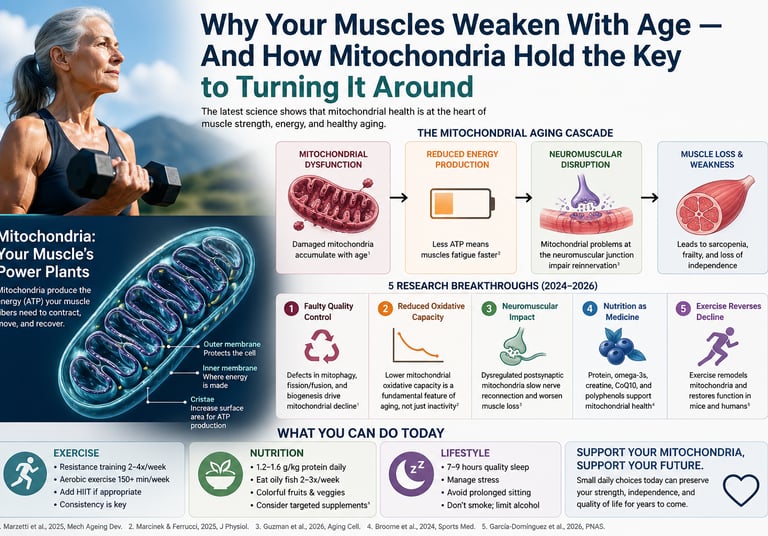
Is Muscle Weakness an Inevitable Part of Getting Older?
Have you noticed that activities that once felt effortless now require a little more effort? Perhaps climbing stairs leaves you more tired than before, carrying shopping bags feels harder, or getting up from a low chair takes longer than it used to. Many people dismiss these changes as a normal consequence of growing older. After all, we have been told for generations that muscles inevitably become weaker with age.
But modern science is beginning to tell a much more interesting story.
Age-related muscle weakness is not simply about losing muscle size. Something much more fundamental is happening inside our muscle cells. The tiny structures responsible for producing the energy that powers every movement – the mitochondria – gradually become less efficient. Their ability to generate energy, repair damage, remove defective components and support healthy muscle function may decline with advancing age.
This matters because your muscles need a continuous supply of energy not only to lift weights or climb stairs but also to maintain posture, walk comfortably, recover after physical activity and perform everyday tasks. When the cellular energy systems become less efficient, muscles may fatigue more easily, recover more slowly and gradually lose their functional capacity.
Researchers increasingly recognise that mitochondrial dysfunction is an important contributor to sarcopenia, the age-associated decline in skeletal muscle mass, strength and physical performance. Equally important, the deterioration is not entirely beyond our control. Exercise and appropriate nutrition can stimulate mitochondrial adaptations, support muscle maintenance and improve physical function, even in later life (Marzetti et al., 2025; Broome et al., 2024).
This is an encouraging development. It suggests that preserving muscle health as we age requires more than simply trying to maintain muscle size. We also need to protect the cellular machinery that keeps those muscles functioning.
The central message is simple: healthy ageing is not just about how much muscle you have, but how well that muscle works.
And that brings us to one of the most fascinating developments in the science of ageing: the relationship between mitochondria, muscle strength and longevity.
What Is Sarcopenia, and Why Should You Be Concerned?
Before exploring the role of mitochondria, it is worth understanding the condition they are increasingly associated with: sarcopenia.
Sarcopenia is a progressive skeletal muscle disorder characterised by declining muscle strength, muscle quantity and physical performance. Although it becomes more common with advancing age, it is not simply an unavoidable consequence of getting older. Physical inactivity, inadequate nutrition, chronic inflammation, hormonal changes, insulin resistance, illness and neurological changes can all contribute to its development.
The consequences extend well beyond the appearance of thinner arms or smaller legs. Muscle is one of the body's most metabolically active tissues. It plays a central role in glucose disposal, insulin sensitivity, energy expenditure, balance and physical independence. When muscle health deteriorates, the consequences can affect almost every aspect of daily life.
People with significant muscle weakness may experience:
Greater difficulty climbing stairs, getting up from a chair or walking longer distances.
Increased susceptibility to falls and fractures.
Reduced ability to perform everyday activities independently.
Deteriorating glucose regulation and metabolic health.
Slower recovery following illness, surgery or periods of inactivity.
Greater vulnerability to frailty and loss of quality of life.
One important clinical distinction deserves attention: muscle weakness can precede measurable muscle loss. A person may still have reasonably preserved muscle size but experience a substantial reduction in strength and physical performance. This is why assessing muscle function, rather than relying on body weight or appearance alone, is so important.
The emerging mitochondrial research helps explain why this happens.
Why Mitochondria Matter: Understanding the Cellular Energy Crisis
Think of your muscles as highly sophisticated engines. Every time you walk, lift something, climb stairs or even maintain an upright posture, muscle cells require energy to perform their work.
That energy is supplied primarily through adenosine triphosphate (ATP), the molecule that powers cellular activity. Mitochondria are central to producing ATP through oxidative phosphorylation, a process that uses oxygen to extract energy from nutrients.
A healthy muscle contains an extensive network of mitochondria that continually adapts to changing energy demands. These organelles are not static structures. They grow, divide, merge, communicate with other cellular systems and remove damaged components.
With ageing, however, this finely coordinated system can become less efficient.
Mitochondria may produce ATP less effectively, generate excessive reactive oxygen species under certain conditions, handle calcium less efficiently and lose some of their ability to respond to metabolic stress. The result is not simply reduced energy production. It is a broader disturbance in the cellular environment required to maintain healthy muscle tissue.
This distinction is important. Muscle ageing is not just a matter of having fewer mitochondria; it also involves changes in their quality, organisation, adaptability and ability to repair themselves.
A 2025 review by Marzetti and colleagues describes mitochondrial dysfunction as an important component of age-related skeletal muscle deterioration, highlighting the importance of mitochondrial quality control, oxidative stress and cellular repair mechanisms (Marzetti et al., 2025).
Let's look at five important developments that are changing our understanding of muscle ageing.
Five Important Research Developments That Explain Why Muscles Become Weaker With Age
1. Mitochondrial Quality Control Begins to Fail
One of the most interesting discoveries in the biology of ageing is that mitochondria need their own maintenance and repair system.
Imagine a large factory operating continuously. Machines gradually wear out, components become damaged and outdated equipment needs replacing. Unless the factory has an efficient maintenance department, defective machinery begins to accumulate and overall productivity declines.
Something similar happens inside muscle cells.
Mitochondrial quality control (MQC) is the collection of biological processes responsible for maintaining a healthy mitochondrial population. It ensures that damaged mitochondria are repaired, remodelled or removed and that new mitochondria are produced when needed.
Three processes are particularly important.
Mitophagy: Removing damaged mitochondria
Mitophagy is the selective removal of damaged or dysfunctional mitochondria through cellular recycling pathways. It prevents defective organelles from accumulating and interfering with normal cellular activity.
With ageing, mitophagy may become less efficient. Damaged mitochondria can then accumulate, potentially increasing oxidative stress and disturbing the cellular processes involved in muscle maintenance.
A useful way to understand this is to imagine a kitchen in which the rubbish is no longer collected regularly. Waste gradually accumulates, the environment becomes less efficient and eventually the entire kitchen begins to function poorly. Mitophagy is essentially the cellular waste-management system that helps prevent this from happening.
Mitochondrial fission and fusion: Maintaining a healthy network
Mitochondria are constantly changing their shape and organisation.
Through a process called fission, they divide into smaller units. Through fusion, they join together and exchange components. These processes allow mitochondria to adapt to changing energy requirements and help maintain their structural integrity.
Age-related disturbances in this balance can contribute to fragmented, dysfunctional mitochondrial networks.
Mitochondrial biogenesis: Building new energy-producing units
Mitochondrial biogenesis is the process through which cells generate new mitochondria and expand their energy-producing capacity.
This process is particularly important in skeletal muscle because physical activity increases the demand for energy. Exercise activates signalling pathways, including those involving PGC-1α, that help stimulate mitochondrial adaptation.
Unfortunately, the ability to maintain and remodel mitochondrial networks may become less efficient with advancing age.
Together, impaired mitophagy, disturbed mitochondrial dynamics and reduced mitochondrial biogenesis can create a cycle of cellular deterioration. This is one reason researchers increasingly view mitochondrial quality control as a promising target for preserving muscle health during ageing.
2. Reduced Mitochondrial Oxidative Capacity: Ageing Changes the Muscle's Energy System
There has been considerable debate among exercise physiologists about an important question: does mitochondrial function decline because older people become less physically active, or does ageing itself reduce the ability of mitochondria to generate energy?
The distinction matters because it determines whether mitochondrial decline is primarily a lifestyle problem or an intrinsic biological feature of ageing.
A 2025 publication by Marcinek and Ferrucci in The Journal of Physiology examined this question using data from large ageing cohorts. Their analysis found that skeletal muscle mitochondrial oxidative capacity declined with age even after accounting for physical activity and other relevant factors (Marcinek & Ferrucci, 2025).
This does not mean that inactivity is unimportant. In fact, physical activity remained a significant predictor of mitochondrial function. Rather, the findings suggest that ageing and inactivity contribute through partly independent pathways.
But what exactly is oxidative capacity?
It refers to the muscle's ability to use oxygen to generate ATP through mitochondrial oxidative phosphorylation. This energy system is essential for sustained activities such as walking, cycling, swimming, gardening and climbing stairs.
When oxidative capacity deteriorates, muscles may become less efficient at meeting prolonged energy demands. Fatigue may develop earlier, exercise tolerance may decline and recovery may become more difficult.
Think of your muscles as having two complementary engines. One provides rapid energy for short bursts of activity, while the other supports sustained movement. Mitochondria are central to the second system.
Ageing may gradually reduce the efficiency of this endurance engine, but physical inactivity can accelerate the deterioration.
The clinical implication is important: we should not wait until muscle weakness becomes obvious before taking steps to protect mitochondrial health. Regular physical activity throughout middle age and beyond provides an important stimulus for maintaining the muscle's aerobic energy-producing machinery.
3. The Nerve–Muscle Connection: An Overlooked Contributor to Age-Related Weakness
Muscle strength depends on more than healthy muscle fibres. It also depends on the nervous system's ability to communicate with them.
This communication occurs at a specialised structure called the neuromuscular junction (NMJ), where a motor nerve connects with a skeletal muscle fibre.
You can think of it as an electrical connection between a control centre and an engine. The brain and spinal cord send signals through motor nerves, and the neuromuscular junction transmits these signals to the muscle, allowing it to contract.
With advancing age, this connection can become less stable.
Motor neurons may gradually lose contact with some muscle fibres. The body attempts to repair these connections through a process known as reinnervation, in which surviving nerve branches reconnect with previously disconnected muscle fibres.
However, this repair process may become less efficient with age.
An important 2026 study by Guzman and colleagues, published in Aging Cell, examined the role of mitochondria located on the muscle side of the neuromuscular junction. The researchers found that older muscle tissue showed reduced postsynaptic mitochondrial abundance, increased denervation and delayed reinnervation following nerve injury. Their experimental work also linked disruption of specific mitochondrial proteins to impaired neuromuscular junction organisation and regeneration (Guzman et al., 2026).
This research offers an important new perspective on sarcopenia.
Muscle weakness may not always originate within the muscle fibre itself. Deterioration of the communication system between nerves and muscles can also contribute to declining strength and function.
For patients, the message is straightforward: maintaining muscle health means maintaining the entire neuromuscular system. Regular movement, resistance exercise and avoiding prolonged periods of inactivity are important components of this strategy.
4. Nutrition and Mitochondrial Health: Why What You Eat Matters
Exercise is a powerful stimulus for mitochondrial adaptation, but muscle cells also need the right nutritional environment to maintain and repair themselves.
This is particularly important as we age because older adults may experience anabolic resistance. In simple terms, ageing muscle may respond less effectively to the same nutritional stimulus that previously supported muscle protein synthesis.
Consequently, an older person may need to pay greater attention to both the quality and distribution of dietary protein.
A 2024 review by Broome and colleagues in Sports Medicine explored the relationship between nutrition, mitochondrial function and muscle health during ageing. It highlighted several nutritional factors that may support mitochondrial function and physical performance.
Protein and essential amino acids
Protein provides the building blocks required to repair and maintain muscle tissue. Leucine, an essential branched-chain amino acid, is particularly important because it helps activate the mTOR signalling pathway involved in muscle protein synthesis.
For many healthy older adults, an intake of approximately 1.2–1.6 g of protein per kilogram of body weight daily may be a reasonable target, particularly when combined with resistance training. However, individual requirements depend on nutritional status, physical activity, kidney function and existing medical conditions.
For example, a healthy 70 kg older adult aiming for 1.2–1.6 g/kg would require approximately 84–112 g of protein daily.
Rather than consuming most of this in a single meal, distributing protein across breakfast, lunch and dinner can help provide repeated opportunities to stimulate muscle protein synthesis.
Creatine: Supporting the muscle energy system
Creatine is one of the most extensively studied nutritional supplements in exercise science.
It helps regenerate ATP during short-duration, high-intensity muscular activity through the phosphocreatine energy system. This can improve the ability to perform repeated muscular efforts and support resistance-training adaptations.
In older adults, creatine supplementation combined with resistance exercise has evidence supporting improvements in muscle strength and lean mass. However, its direct effects on mitochondrial ageing in humans are less firmly established.
Omega-3 fatty acids: Supporting muscle and metabolic health
Omega-3 fatty acids, particularly EPA and DHA, are found in oily fish such as sardines, salmon and mackerel.
They have important roles in cell membrane biology and may help modulate inflammatory pathways. Some research suggests potential benefits for muscle function, although the evidence is not uniform and supplementation should not be considered a substitute for adequate protein or exercise.
Polyphenols and plant-based nutrients
Berries, colourful vegetables, green tea, nuts and other plant foods provide polyphenols and antioxidant compounds.
These nutrients interact with cellular signalling pathways involved in oxidative stress responses and mitochondrial regulation. However, it is important not to assume that consuming concentrated antioxidant supplements will automatically improve mitochondrial function. Human clinical evidence remains variable.
Coenzyme Q10 (CoQ10)
CoQ10 participates in the mitochondrial electron transport chain and plays an important role in cellular energy production.
Although its biological importance is well established, evidence that routine CoQ10 supplementation prevents age-related muscle weakness in otherwise healthy older adults remains insufficient.
The broader nutritional message is therefore not about finding a single mitochondrial supplement. It is about establishing a sustainable dietary pattern that supplies adequate protein, essential fats, vitamins, minerals and a wide range of plant-derived nutrients.
5. Can Exercise Actually Reverse Some Aspects of Mitochondrial Ageing?
Perhaps the most encouraging development in this field comes from research published in Proceedings of the National Academy of Sciences in 2026.
García-Domínguez and colleagues investigated how exercise influences mitochondrial structure and function in ageing skeletal muscle. Their research demonstrated that mitochondrial adaptations were essential for exercise-induced improvements in physical function and reduced frailty in older mice.
The investigators also examined human muscle samples from 30 donors aged 17–99 years. These observations supported an association between mitochondrial function, age and physical capacity.
The findings suggest that skeletal muscle mitochondria retain considerable adaptive potential even during later life (García-Domínguez et al., 2026).
This is an important advance, but one scientific distinction deserves emphasis: the exercise intervention and mechanistic evidence came primarily from animal experiments, while the human component was observational and cross-sectional. It would therefore be premature to claim that the study demonstrated reversal of mitochondrial ageing through an exercise intervention in older humans.
Nevertheless, the biological message is highly encouraging.
Exercise can stimulate several processes involved in mitochondrial maintenance:
Mitochondrial biogenesis: Encouraging the production of new mitochondria.
Mitophagy: Supporting the removal of damaged mitochondrial components.
Mitochondrial dynamics: Improving the balance between fission and fusion.
Oxidative capacity: Enhancing the muscle's ability to use oxygen for energy production.
Muscle function: Improving the physiological capacity to perform everyday activities.
In practical terms, this means that muscles retain the ability to adapt to physical activity even in later life.
The goal is not necessarily to make an older person's muscles biologically identical to those of a young adult. It is to improve the function, resilience and adaptability of the muscle tissue they have.
That is a far more realistic and clinically meaningful definition of reversing muscle ageing.
How to Protect Mitochondrial Health and Preserve Muscle Strength as You Age
Understanding the biology of muscle ageing is useful, but the real question most readers want answered is much simpler: what can I actually do to protect my muscles?
The encouraging answer is that the most effective strategies are not necessarily complicated or expensive. They involve combining regular physical activity, appropriate nutrition, adequate recovery and a few sustainable lifestyle habits.
The emphasis should be on consistency rather than extreme exercise routines.
1. Resistance Training: The Foundation of Healthy Ageing
If there is one intervention that deserves priority when discussing age-related muscle weakness, it is resistance training.
Muscles need regular mechanical stimulation to maintain their size, strength and functional capacity. When they are challenged against resistance, a series of cellular signals is activated that promotes muscle protein synthesis and helps preserve muscle tissue.
Resistance training also improves neuromuscular coordination, bone health, glucose regulation and the ability to perform everyday activities.
You do not necessarily need an expensive gym membership. Depending on your fitness level, resistance exercise can include:
Squats, chair stands and lunges.
Push-ups and wall push-ups.
Resistance-band exercises.
Dumbbell and weight-machine training.
Step-ups and controlled lifting exercises.
Farmer's carries and other functional strength movements.
For most adults, two to three well-planned resistance-training sessions each week provide a useful starting point. Some people can progress to three or four sessions, depending on recovery and training experience.
The important principle is progressive overload: gradually increasing the challenge as strength improves, without sacrificing technique.
For older adults, functional movements deserve particular attention. Being able to rise from a chair, climb stairs, carry groceries and maintain balance is just as important as improving performance in the gym.
2. Aerobic Exercise: Training the Muscle's Energy Factories
Resistance training helps preserve muscle strength and mass, but aerobic exercise plays a complementary role by improving mitochondrial oxidative capacity.
Activities such as brisk walking, cycling, swimming and dancing encourage muscles to use oxygen more efficiently and stimulate adaptations in the mitochondrial network.
For generally healthy adults, a useful public-health target is at least 150 minutes of moderate-intensity aerobic activity each week, or an equivalent amount of vigorous activity, adjusted to individual fitness and medical status.
Moderate-intensity exercise should make you breathe somewhat faster while still allowing you to hold a conversation.
The key is to make aerobic activity a regular part of your routine rather than something reserved for occasional bursts of enthusiasm.
Even relatively short sessions accumulated throughout the week can contribute meaningfully to physical fitness.
3. High-Intensity Interval Training: A Powerful but Not Universal Option
High-intensity interval training (HIIT) involves alternating relatively short periods of harder exercise with easier recovery periods.
For example, a person might alternate 30 seconds of faster walking with 90 seconds of comfortable walking, repeating the sequence several times.
When appropriately prescribed, interval training can provide a strong stimulus for improving cardiorespiratory fitness and mitochondrial adaptations.
However, more intense exercise is not automatically better.
Older adults who are sedentary, have cardiovascular disease, uncontrolled hypertension, significant joint problems or other medical conditions should not begin vigorous interval training without appropriate assessment.
A gradual progression from comfortable walking to brisk walking and then to more demanding exercise is often a safer and more sustainable approach.
4. Prioritise Protein at Every Meal
Exercise provides the stimulus for muscle adaptation, but nutrition supplies the materials required to support it.
As discussed earlier, older adults may experience anabolic resistance, meaning that smaller amounts of protein may produce a weaker muscle-building response than they did earlier in life.
A practical approach is to distribute high-quality protein across the main meals of the day.
Useful options include:
Eggs, milk, yoghurt and paneer.
Fish and chicken.
Lentils, chickpeas, kidney beans and other pulses.
Soybeans, tofu and other soy products.
Appropriate protein supplements when dietary intake is insufficient.
For healthy older adults, approximately 1.2–1.6 g/kg/day may be appropriate in many circumstances, particularly when undertaking regular exercise. However, people with chronic kidney disease or other conditions affecting protein requirements should seek individualised dietary advice.
There is little advantage in concentrating almost all daily protein into dinner while eating very little during breakfast and lunch.
A more balanced distribution is generally a better strategy.
5. Eat for Metabolic Health, Not Just Muscle Growth
Muscle health does not exist in isolation from the rest of the body.
Insulin resistance, chronic inflammation, excess visceral fat and poor dietary quality can all adversely affect muscle metabolism.
A balanced dietary pattern should therefore include:
Adequate protein from varied sources.
Vegetables and fruits of different colours.
Whole grains and fibre-rich foods.
Nuts and seeds.
Healthy unsaturated fats.
Fish or other sources of omega-3 fatty acids where appropriate.
For Indian readers, a well-planned diet can include dal, rajma, chana, curd, paneer, eggs, fish, seasonal vegetables and whole grains.
The aim is to provide sufficient protein and micronutrients while supporting good glucose regulation and cardiovascular health.
6. Do Not Underestimate Sleep and Recovery
Exercise stimulates adaptation, but recovery allows the body to respond to that stimulus.
Poor sleep, inadequate recovery and persistent psychological stress can interfere with training consistency, appetite regulation and metabolic health.
Most adults should aim for approximately seven to nine hours of sleep, although individual sleep requirements vary.
It is equally important to allow adequate recovery between demanding resistance-training sessions, particularly when beginning a new programme.
7. Break Up Prolonged Sitting
One of the simplest ways to support muscle health is to avoid remaining inactive for long periods.
Even people who exercise regularly may spend much of the remaining day sitting.
Breaking up prolonged sitting with short walks, standing, gentle mobility exercises or a few chair stands can increase daily movement and provide repeated muscular activity.
These brief movement breaks are not substitutes for structured resistance or aerobic exercise, but they are valuable additions to an otherwise sedentary day.
8. Are Supplements Necessary?
Supplements may have a role when dietary intake is inadequate or when a specific clinical indication exists. However, they should never be presented as replacements for exercise, adequate nutrition or appropriate medical care.
Some commonly discussed options include:
Creatine monohydrate: Has useful evidence for improving strength and lean mass when combined with resistance training.
Omega-3 fatty acids: May offer benefits in selected individuals, although evidence for preventing sarcopenia remains inconsistent.
CoQ10: Has a plausible biological role in mitochondrial energy production, but evidence for routine supplementation to prevent muscle ageing is limited.
Creatine and other supplements should be discussed with a healthcare professional when kidney disease, chronic illness or regular medication use is present.
The best strategy remains to build a strong foundation through food, physical activity and recovery before considering additional products.
Clinician's Perspective: What This Science Means for You
In clinical practice, one of the most common misconceptions about ageing is that declining strength is simply something people must accept.
The science of mitochondrial ageing challenges this assumption. Although biological ageing cannot be stopped, many of the factors contributing to declining muscle function can be influenced.
There are several important lessons worth taking away.
First, muscle weakness deserves attention before independence is affected. Difficulty rising from a chair, slower walking speed, reduced grip strength and increasing fatigue during ordinary activities should not automatically be attributed to age. They may be early indicators of declining muscle function.
Second, muscle strength matters more than body weight alone. A person can maintain a relatively stable weight while losing muscle and accumulating visceral fat. Assessing functional capacity provides a much clearer picture of muscle health than looking at the weighing scale.
Third, exercise should be viewed as an essential component of preventive healthcare. Resistance training helps preserve muscle strength and mass, while aerobic exercise supports mitochondrial function and cardiorespiratory fitness. Together, they provide a more comprehensive approach than either alone.
Fourth, nutrition is frequently overlooked. Many older adults do not consume enough protein, particularly at breakfast. Improving the distribution and quality of dietary protein can help support muscle maintenance.
Fifth, persistent fatigue should not automatically be blamed on mitochondrial ageing. Anaemia, thyroid disorders, diabetes, cardiovascular disease, medication effects, sleep disorders and nutritional deficiencies can also cause fatigue and weakness. A proper clinical assessment may be necessary.
Finally, it is never too late to begin. Even people in their seventies and eighties can improve strength, balance and physical function through appropriately supervised exercise.
The objective is not simply to live longer. It is to remain physically capable, independent and metabolically healthy for as many years as possible.
Frequently Asked Questions
1. At what age does mitochondrial function begin to decline?
Mitochondrial changes can occur gradually during adulthood, although the timing and rate of decline vary considerably between individuals. There is no single age at which mitochondrial function suddenly deteriorates. Physical activity, genetics, metabolic health, nutrition and chronic disease all influence the process.
2. Is muscle weakness an inevitable consequence of ageing?
No. Some biological changes are associated with ageing, but the extent of muscle weakness is highly variable. Inactivity, inadequate protein intake, chronic illness and metabolic disturbances can accelerate the decline. Regular resistance training, aerobic activity and appropriate nutrition can help preserve muscle strength and function.
3. Can exercise reverse mitochondrial ageing?
Exercise can improve mitochondrial function and stimulate mitochondrial remodelling, even in older individuals. The 2026 PNAS research provides particularly encouraging evidence of mitochondrial adaptability in ageing muscle. However, the exercise intervention was conducted in mice, while the human findings were observational. It is therefore more accurate to say that exercise can improve aspects of mitochondrial health and muscle function than to claim that it completely reverses biological ageing.
4. How much protein does an older adult need?
For many healthy older adults, approximately 1.2–1.6 g/kg/day may be a useful target, particularly when undertaking resistance exercise. Requirements should be individualised according to nutritional status, physical activity, kidney function and other medical considerations.
5. Which exercise is best for mitochondrial health?
Both aerobic and resistance exercise are important, but they serve complementary purposes. Aerobic exercise stimulates mitochondrial oxidative adaptations, while resistance training helps preserve muscle mass, strength and neuromuscular function. A combination is generally the most effective strategy for healthy ageing.
6. Are creatine and CoQ10 useful for preventing muscle weakness?
Creatine has good evidence for supporting strength and lean-mass gains when combined with resistance training. CoQ10 plays an important role in mitochondrial energy production, but evidence that supplementation prevents age-related muscle weakness is still limited. Neither should replace regular exercise and adequate nutrition.
7. Does the neuromuscular junction contribute to sarcopenia?
Yes. Age-related changes at the neuromuscular junction can contribute to muscle denervation, impaired nerve–muscle communication and reduced muscle function. The 2026 research by Guzman and colleagues provides further experimental evidence that postsynaptic mitochondrial integrity is important for maintaining this connection.
8. Can someone in their seventies or eighties still build muscle?
Absolutely. Older muscles retain the ability to adapt to resistance exercise. Improvements in strength, muscle function and balance are possible even at advanced ages. The programme should be tailored to the person's health, baseline fitness, mobility and recovery capacity.
Clinical Pearls: Six Important Lessons About Mitochondrial Health and Ageing Muscle
1. Mitophagy is the cellular housekeeping system.
Scientific perspective: Mitophagy removes damaged mitochondria and helps maintain mitochondrial quality. Impaired mitochondrial quality control may contribute to oxidative stress and muscle deterioration.
Patient perspective: Imagine your muscle cells as a busy kitchen. If damaged equipment and rubbish are never removed, the entire kitchen becomes less efficient. Mitophagy is the cleaning system that helps keep it functioning.
2. The neuromuscular junction is the communication bridge.
Scientific perspective: The neuromuscular junction enables motor neurons to communicate with skeletal muscle fibres. Age-related deterioration and impaired reinnervation can contribute to muscle fibre loss.
Patient perspective: Think of nerves as electrical wires and muscles as the machinery they control. If the connection becomes damaged, the machinery cannot work properly, even if the muscle itself is still present.
3. Mitochondrial oxidative capacity determines endurance.
Scientific perspective: Oxidative capacity reflects the ability of skeletal muscle mitochondria to generate ATP through oxygen-dependent metabolism. It may decline with age, independently of physical inactivity.
Patient perspective: Your muscles have an endurance engine that helps you walk, cycle and remain active for longer periods. Regular movement helps keep this engine working efficiently.
4. Exercise stimulates the formation of new mitochondria.
Scientific perspective: Exercise activates signalling pathways, including PGC-1α, which regulate mitochondrial biogenesis and other adaptations in skeletal muscle.
Patient perspective: Exercise does more than make muscles stronger. It sends signals to your cells to improve their energy-producing machinery.
5. Adequate protein helps overcome anabolic resistance.
Scientific perspective: Older muscle may require a stronger nutritional stimulus to achieve an effective muscle protein synthesis response. Adequate high-quality protein and essential amino acids help support this process.
Patient perspective: As we grow older, muscles may become less responsive to small amounts of protein. Providing sufficient protein throughout the day helps give them the materials needed for maintenance and repair.
6. Mitochondrial health is influenced by more than supplements.
Scientific perspective: Mitochondrial function depends on the interaction of exercise, nutritional status, metabolic health, mitochondrial quality control and cellular signalling.
Patient perspective: There is no magic pill that can compensate for inactivity and poor nutrition. The most reliable approach is to move regularly, eat well and allow your body to recover.
Author's Note
As a physician, I find the evolving science of mitochondrial ageing particularly important because it changes the way we think about muscle weakness and physical decline.
For many years, sarcopenia was discussed primarily in terms of declining muscle mass. We now understand that the picture is considerably more complex. Mitochondrial dysfunction, impaired cellular quality control, neuromuscular deterioration and metabolic disturbances all contribute to the ageing muscle.
This broader understanding also changes how we approach prevention. Preserving muscle health requires more than simply encouraging older adults to eat protein or lift weights. We need to appreciate the importance of maintaining the cellular energy systems that allow muscles to function efficiently.
The encouraging message is that skeletal muscle retains a remarkable capacity for adaptation. Even in later life, appropriately prescribed exercise and good nutrition can improve physical performance and help preserve independence.
Ultimately, the objective of healthy ageing should not be limited to adding years to life. It should be about maintaining the strength, energy and physical capability needed to enjoy those years.
Your muscles are not simply ageing. They are responding to the way you live, move, eat and recover. And many of those responses remain within your influence.
Medical Disclaimer
This article is intended for educational purposes and does not replace individual medical advice. People with cardiovascular disease, uncontrolled hypertension, significant joint problems or other chronic conditions should seek appropriate medical guidance before beginning vigorous exercise or HIIT. Exercise intensity and nutritional requirements should be tailored to individual health status.
Related Articles
Why Obesity Isn’t Just Fat: How Muscle Quality Controls Fat Loss and Metabolism
Neuromuscular Aging Explained: How Nerve–Muscle Breakdown Causes Weakness After 40
The mTOR Switch: Why Your Cells Stopped Listening to Insulin | DR T S DIDWAL
Can Resistance Training Reverse Diabetes? The Muscle–mTOR Link | DR T S DIDWAL
References
Broome, S. C., Whitfield, J., Karagounis, L. G., et al. (2024). Mitochondria as nutritional targets to maintain muscle health and physical function during ageing. Sports Medicine, 54, 2291–2309. https://doi.org/10.1007/s40279-024-02072-7
García-Domínguez, E., García-Domínguez, C., Cabrera-Alarcón, J. L., et al. (2026). Mitochondrial remodeling in skeletal muscle underlies exercise-induced reversal of age-associated functional decline in mice and humans. Proceedings of the National Academy of Sciences, 123(14), e2508286123. https://doi.org/10.1073/pnas.2508286123
Guzman, S. D., Fraczek, P. M., Itsani, K., et al. (2026). Age-associated dysregulation of postsynaptic mitochondria perturbs reinnervation kinetics. Aging Cell, 25(1), e70355. https://doi.org/10.1111/acel.70355
Marcinek, D. J., & Ferrucci, L. (2025). Reduced oxidative capacity of skeletal muscle mitochondria is a fundamental consequence of adult ageing. The Journal of Physiology, 603(1), 17–20. https://doi.org/10.1113/JP285040
Marzetti, E., Calvani, R., Coelho-Junior, H. J., Landi, F., & Picca, A. (2025). Defective mitochondrial quality control in the aging of skeletal muscle. Mechanisms of Ageing and Development, 228, 112112. https://doi.org/10.1016/j.mad.2025.112112