How Hard Should You Exercise for Heart Health? New Research Reveals the Answer
Walking helps, but new cardiovascular research suggests adding even a few minutes of vigorous activity may dramatically improve heart protection.
EXERCISEHEART
Dr. T.S. Didwal, M.D.(Internal Medicine)
6/25/202621 min read
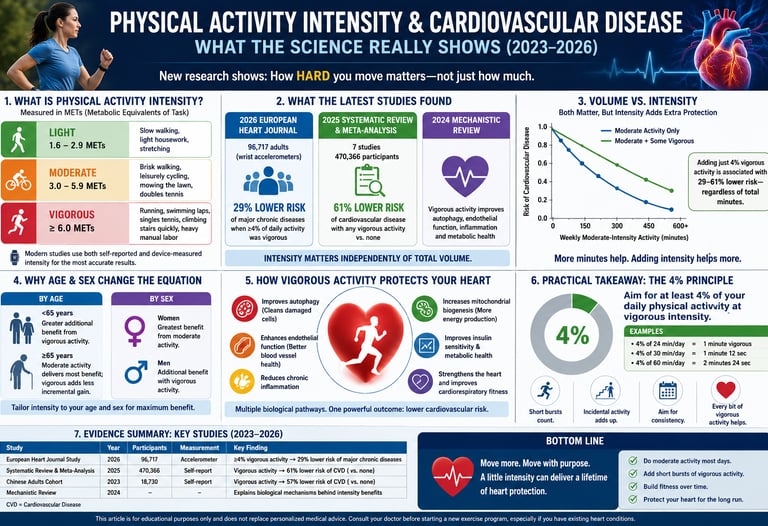
Research involving more than 470,000 adults shows that exercise intensity matters independently of exercise volume. People who performed at least 4% of their activity at vigorous intensity had 29–61% lower risk of major chronic diseases compared with those performing no vigorous activity. Moderate activity remains highly protective, particularly for women and older adults.
Key Takeaways: The Intensity Equation for Heart Health
1. Intensity Adds Protection Beyond Volume
Total minutes still matter, but research from 2026 shows that the proportion of your activity done at vigorous intensity predicts lower cardiovascular risk independently of total volume. Making just 4%+ of your activity vigorous was linked to 29–61% lower risk across 8 chronic diseases, even when total activity time was held constant European Heart Journal.
2. Men and Women Respond Differently
A 2023 study of 18,730 Chinese adults found vigorous activity was the only intensity tier significantly protective against CVD in men. For women, both moderate and vigorous activity showed strong protection. One-size-fits-all intensity advice ignores biology.
3. Brief Vigorous Bursts Deliver Outsized Benefit
Device-measured data reveals you don’t need long runs. If you’re active 60 min/day, just 2–3 minutes of breathless effort — fast stairs, uphill walks, short intervals — counts as the “4% vigorous” threshold linked to major risk reduction.
4. Moderate Isn’t Useless, Especially for Women and Adults 60+
For women aged 60–74, moderate activity was a standout protector. And for adults 60+, reducing total sedentary time correlated with risk more strongly than activity type. Intensity is a lever, not a mandate to abandon brisk walking.
5. Volume and Intensity Are Independent Levers
Think two-axis model: You can improve heart risk by adding minutes, or by making a slice of existing minutes harder. The newest data says layering intensity onto your current routine may be more time-efficient than adding volume alone.
6. Incidental Vigorous Activity Counts
The biggest studies used wrist accelerometers and found “vigorous” isn’t just gym time. Fast housework, carrying loads, brisk hill walks, and short active commutes all qualified — and contributed to the protective effect.
7. Mechanisms Favor Vigorous Vascular Adaptation
A 2026 mechanistic review confirms vigorous aerobic work drives larger gains in VO2 max, endothelial nitric oxide production, and arterial compliance per minute than moderate work. Strength training adds separate metabolic pathways. Combined training looks optimal.
8. Safety and Individualization Are Non-Negotiable
These are observational findings, not prescriptions. If you have heart disease, hypertension, or have been sedentary, get medical clearance before adding vigorous bursts. Relative risk numbers are powerful, but absolute risk and personal health status dictate what’s clinically smart.
Introduction
If you've ever wondered whether your daily walk is "enough" or whether you need to push into a sweatier, more breathless zone to protect your heart, you're asking exactly the right question — and the answer has shifted in the last two years.
For decades, public health advice treated physical activity like a bank account: every minute of movement was a deposit, and total volume was what mattered. Walk more, sit less, accumulate your 150 minutes a week, and you'd reduce your cardiovascular risk. That advice wasn't wrong. But it was incomplete.
A wave of large, methodologically rigorous studies published between 2023 and 2026 — including a 2026 European Heart Journal cohort study of more than 470,000 people and a 2025 systematic review and meta-analysis in the Journal of Health Science and Medical Research — has sharpened the picture considerably. The relationship between physical activity intensity and cardiovascular disease isn't just about how much you move. It's about how hard you move, how that interacts with your age and sex, and what that means for your actual risk of heart attack, stroke, and related conditions.
1. What Do We Mean by "Physical Activity Intensity"?
Before diving into the research on exercise intensity and heart disease risk, it helps to get precise about terminology, because "intensity" gets used loosely in everyday conversation but very specifically in research.
The MET System
Exercise scientists measure intensity using metabolic equivalents of task (METs) — a unit that compares how much energy an activity burns relative to sitting quietly (1 MET).
Light Intensity
MET Range: 1.6–2.9 METs
Examples: Slow walking, light housework, stretching
Moderate Physical Activity (MPA)
MET Range: 3.0–5.9 METs
Examples: Brisk walking, leisurely cycling, doubles tennis, mowing the lawn
Vigorous Physical Activity (VPA)
MET Range: ≥6.0 METs
Examples: Running, swimming laps, singles tennis, climbing stairs quickly, heavy manual labor
Research Application
This exact MET-based framework was utilized in a 2025 systematic review by Finnemore and colleagues.
The researchers used these specific thresholds (3–5.9 METs for moderate; ≥6 METs for vigorous) to pool and analyze data across multiple prospective cohort studies.
Subjective vs. Objective Intensity Measurement
Modern research increasingly distinguishes between two ways of measuring intensity:
Self-reported intensity — participants describe their activity as none, moderate, or vigorous (used in the 18,730-person Chinese adults study)
Device-measured intensity — wrist-worn accelerometers objectively capture movement intensity throughout the day, including activity people don't think to report, like fast-paced housework or stair climbing (used in the 2026 European Heart Journal study of over 96,000 accelerometer-wearers)
This distinction matters enormously. Device-based studies have revealed that a meaningful slice of vigorous activity in most people's days comes from incidental movement — not formal "exercise" — a finding that reshapes how we should think about intensity in daily life.
2. The Science: What the Latest Studies Actually Found
This is the core of what you came here for, so let's go through the most important recent findings in detail — not just headline conclusions, but what the data actually showed.
Study 1: 18,730 Chinese Adults — Intensity Effects Differ Sharply by Sex (2023)
Published in Scientific Reports, this study by Lin and colleagues analyzed 7,854 men and 10,876 women aged 15 and older using multistage random sampling, examining how activity type and intensity related to cardiovascular disease risk.
The standout finding was a striking sex difference:
In men, Moderate-intensity physical activity (MPA) showed no protective effect on CVD risk. Only vigorous-intensity physical activity (VPA) was significantly protective (odds ratio 0.615 — meaning roughly a 38% lower risk).
In women: Both moderate and vigorous activity were significantly protective (odds ratios of 0.593 and 0.537, respectively — roughly 41% and 46% lower risk).
In other words, for the men in this cohort, "going for an easy walk" wasn't statistically linked to lower cardiovascular risk — they needed to push into a vigorous zone to see a measurable benefit. Women, by contrast, benefited from both moderate and vigorous activity.
The researchers also found that vigorous activity remained protective against stroke and combined cardiovascular disease across all age groups in men, while in women aged 60–74, moderate-intensity activity specifically stood out as protective. For middle-aged and younger adults, activity accumulated through work, housework, and leisure all showed meaningful predictive value — but for adults over 60, sedentary time and sleep patterns became more strongly associated with risk than activity type itself.
Study 2: The 472,000-Person European Heart Journal Study — The Power of Even a Little Vigorous Activity (2026)
This is arguably the most important recent contribution to the field. Published in the European Heart Journal in early 2026, Wei and colleagues — including renowned physical activity epidemiologist Emmanuel Stamatakis — followed two huge groups:
96,408 participants with device-measured (wrist accelerometer) physical activity data, average age 61.9
375,730 participants with self-reported physical activity data, average age 56.2
The research question was direct: does the proportion of your total activity that's vigorous (rather than just your total activity volume) predict your risk of cardiovascular and other chronic diseases?
The results were striking. The study tracked eight major outcomes: major adverse cardiovascular events (MACE), atrial fibrillation, type 2 diabetes, immune-mediated inflammatory diseases, fatty liver disease (MASLD), chronic respiratory disease, chronic kidney disease, and dementia — plus all-cause mortality.
Key finding: In the device-measured group, the relationship between the percentage of vigorous activity (%VPA) and every single one of these outcomes was non-linear and inverse, meaning more vigorous activity, as a share of total movement, was associated with progressively lower risk, even after statistically controlling for total activity volume.
Most strikingly: people who got more than 4% of their total physical activity at a vigorous intensity had 29% to 61% lower risk across these chronic disease outcomes, compared to people with 0% vigorous activity — regardless of how much total activity they accumulated.
To put 4% VPA in perspective: if you're moderately active for about an hour a day, 4% works out to roughly 2–3 minutes of vigorous effort. This supports the idea that brief bursts of higher intensity, layered onto whatever volume of activity you're already doing, may offer outsized protective value.
Study 3: Mechanistic Review — Aerobic, Strength, and Combined Training (2026)
Rounding out the recent literature, a 2026 review published in Medicine Plus by Zhou and colleagues took a different angle: rather than asking "how much risk reduction," it asked "by what biological mechanisms" different types of physical activity protect the cardiovascular system.
This review systematically catalogued current guideline recommendations and synthesized evidence across three categories — aerobic activity, muscle-strengthening activity, and combined aerobic-plus-strength training — examining their effects on cardiovascular disease and major risk factors, along with the physiological pathways involved. We'll unpack those mechanisms in detail in Section 5.
3. Why Age and Sex Change the Equation
One of the most clinically important and underappreciated insights from this research is that a single blanket recommendation doesn't fit everyone equally well.
The Sex Difference
Across the studies reviewed here, a consistent pattern emerges: men appear to need higher intensity to see significant cardiovascular benefit, while women often show protection from both moderate and vigorous activity.
This doesn't mean moderate activity is "useless" for men in some general sense — the men in the 18,730-person Chinese cohort still likely benefited metabolically, for weight management, and for other outcomes not measured by this specific CVD analysis. But for the specific outcome of cardiovascular disease risk in that population, moderate intensity alone didn't reach statistical significance for men, while vigorous intensity did.
Possible biological explanations researchers have proposed include differences in baseline cardiorespiratory fitness, hormonal influences on vascular function, and differences in how men and women typically accumulate "moderate" activity in daily life (for example, through different occupational or household activity patterns). These are areas of active research rather than settled science.
The Age Difference
Age changes the picture too:
Younger and middle-aged adults: Activity accumulated through work, housework, and leisure time all showed strong associations with lower cardiovascular risk, suggesting the source of the activity matters less than getting it.
Older adults (60+): The picture shifts. Sedentary time and sleep patterns became more strongly associated with risk than the type of activity itself — highlighting that for older adults, reducing prolonged sitting may be just as important a target as adding structured exercise.
Women aged 60–74 specifically: Moderate-intensity activity stood out as a particularly strong protective factor — good news, since vigorous activity can become harder to sustain or safely perform with age-related joint or cardiovascular changes.
What This Means Practically
If you're a man without diagnosed heart disease, this research suggests there's real clinical value in incorporating some genuinely vigorous effort into your week — not just steady, easy movement — assuming you don't have contraindications.
If you're a woman, particularly in midlife or beyond, the data is more reassuring that consistent moderate activity carries strong protective value on its own, while added vigorous activity provides further benefit.
If you're over 60 of any sex, minimizing total sedentary time may deserve equal billing with your formal exercise plan.
4. Volume vs. Intensity: Which Matters More?
This is the question at the heart of the European Heart Journal study's title, and it deserves its own section because the answer has real-world implications for how you spend your limited exercise time.
The Old Model: Volume Is King
The traditional public health framing (still reflected in many official guidelines) emphasizes total weekly volume — accumulate 150–300 minutes of moderate activity, or 75–150 minutes of vigorous activity, or an equivalent combination, per week.
This model isn't wrong. Total volume of activity has a well-established inverse, dose-response relationship with cardiovascular risk: more activity, generally, means lower risk, with diminishing returns at higher volumes.
The Newer Model: Intensity Adds an Independent Layer
What the 2026 European Heart Journal analysis demonstrated is that intensity provides protective value independent of volume. When researchers statistically adjusted for total activity volume, the proportion of that volume occurring at vigorous intensity still predicted risk on its own.
This is a meaningfully different claim than "exercise harder for the same effect." It's closer to: "Of the activity you're already doing, shifting even a small slice of it to vigorous intensity adds protection beyond what the extra volume alone would explain."
Practical Translation
Here is the information rewritten into clear, scannable points based on the training approaches and the core clinical takeaway:
Training Approaches
Volume-Only Focus
What It Looks Like: Walking 45 minutes daily at a steady, comfortable pace.
Takeaway: Provides a solid, well-established benefit that successfully meets minimum health guideline requirements.
Volume + Intensity Layering
What It Looks Like: The same 45-minute walk, but with 3 to 5 short bursts of brisk/fast walking or light jogging mixed in.
Takeaway: Potentially yields a greater protective benefit—per the 2026 European Heart Journal (EHJ) findings—without needing to add any extra time to the workout.
Vigorous-Only, Low Volume
What It Looks Like: Two or three short, hard 15 to 20-minute workouts per week.
Takeaway: Delivers meaningful intensity-related benefits, though combining this approach with more total volume is likely optimal.
Core Clinical Takeaway
Efficiency Over Duration: You do not necessarily need to add more time to your weekly routine to improve your cardiovascular protection. Instead, you can simply make a portion of your existing activity harder.
5. How Vigorous Activity Protects Your Heart: The Mechanisms
Numbers and odds ratios are persuasive, but understanding why intensity matters helps this information stick — and helps you trust the recommendation enough to actually act on it.
Drawing on the mechanistic review by Zhou and colleagues (2026) and the broader exercise physiology literature, here's what's happening inside your cardiovascular system:
Aerobic (Vigorous) Activity Mechanisms
Improved cardiorespiratory fitness (VO2 max): Higher-intensity effort places greater demand on your heart and lungs, driving stronger adaptations in stroke volume (how much blood your heart pumps per beat) and oxygen extraction by working muscles.
Endothelial function: Vigorous activity appears to more strongly stimulate the cells lining your blood vessels (the endothelium) to produce nitric oxide, which helps blood vessels relax and resist the early stages of atherosclerosis (artery hardening).
Favorable lipid and blood pressure shifts: Both moderate and vigorous activity improve cholesterol profiles and blood pressure, but vigorous activity tends to produce larger improvements per minute spent exercising.
Reduced arterial stiffness: Regular vigorous aerobic effort is associated with more compliant (flexible) arteries, which reduces strain on the heart over time.
Muscle-Strengthening Activity Mechanisms
The 2026 mechanistic review also highlighted that resistance/strength training contributes to cardiovascular health through different but complementary pathways:
Improved insulin sensitivity and glucose handling, which reduces metabolic strain on the cardiovascular system
Increased lean muscle mass, which supports healthier resting metabolic rate and body composition
Modest blood pressure benefits, particularly when combined with aerobic training
Why Combined Training May Be Optimal
The same review found that combining aerobic and muscle-strengthening activity tends to produce benefits that aerobic or strength training alone don't fully replicate — each modality appears to address a partially distinct set of cardiovascular risk pathways, which is the physiological basis for guideline recommendations to do both.
6. Why Cardiorespiratory Fitness (VO₂max) Matters too
An important concept often overlooked in discussions about physical activity is cardiorespiratory fitness (VO₂max)—the maximum amount of oxygen your body can use during intense exercise. Many researchers now consider VO₂max one of the strongest predictors of cardiovascular health and longevity, sometimes even more predictive than self-reported exercise habits.
Higher exercise intensity is one of the most effective ways to improve VO₂max because it places greater demands on the heart, lungs, and muscles, stimulating adaptations that enhance oxygen delivery and utilization. This may help explain why vigorous activity often provides cardiovascular benefits beyond those achieved through exercise volume alone.
Clinical takeaway: While moving more remains essential, improving fitness through appropriately prescribed moderate-to-vigorous activity may be one of the most powerful strategies for reducing long-term cardiovascular risk.
For clinicians and patients alike, the practical clinical translation is:
Total activity volume remains foundational — don't abandon volume-based guidelines.
Where feasible and medically appropriate, incorporating a vigorous-intensity component appears to provide measurable additional protective value, even in small amounts.
This guidance should be individualized based on age, sex, baseline fitness, and existing cardiovascular risk factors or disease — which is why a conversation with your physician matters before significantly changing intensity, especially if you're starting from a sedentary baseline or have known heart disease.
7. Practical Application: Building Your Own Intensity-Smart Routine
Here's how to translate this research into an actual weekly plan — without needing a lab, a coach, or hours of extra time.
Step 1: Establish Your Baseline Volume
Before worrying about intensity, make sure you're hitting foundational volume targets, consistent with WHO and American Heart Association guidelines:
At least 150–300 minutes/week of moderate-intensity activity, or
At least 75–150 minutes/week of vigorous-intensity activity, or
An equivalent combination of both
Plus muscle-strengthening activity on 2+ days per week
Step 2: Add a "Vigorous Layer" Using the 4% Principle
Based on the 2026 EHJ findings, aim to make roughly 4% or more of your total activity time vigorous intensity. Practically:
If you're active (walking, chores, etc.) for about 60 minutes a day, that's just 2–3 minutes of vigorous effort layered in.
This could be: a brisk uphill push during a walk, a fast flight of stairs, 30-second intervals of faster pace during a bike ride, or a few minutes of higher-effort intervals at the end of a workout.
Step 3: Use the "Talk Test" to Self-Assess Intensity
You don't need a heart rate monitor to estimate intensity:
Light: You can sing while doing it.
Moderate: You can talk in full sentences, but not sing.
Vigorous: You can only speak a few words at a time before needing a breath.
Step 4: Tailor by Age and Sex (Using the Research as a Guide)
Men without cardiovascular disease: Prioritize getting some vigorous activity weekly — the data suggests moderate alone may not move the needle as much for this specific outcome.
Women, especially in midlife and beyond: Continue prioritizing consistent moderate activity, and layer in vigorous effort as an added bonus, not a requirement.
Adults 60+: Focus equally on reducing total sedentary time (standing, walking breaks every 30–60 minutes) alongside whatever structured exercise you do.
A Simple Pre-Workout Checklist
[ ] Have I cleared higher-intensity exercise with my doctor if I have any cardiovascular risk factors or have been sedentary for an extended period?
[ ] Have I warmed up for at least 5 minutes before any vigorous bursts?
[ ] Am I building intensity gradually over weeks, not jumping straight to maximal effort?
[ ] Do I know the warning signs that mean I should stop (covered in Section 10)?
8. Evidence Summary Table: Comparing the Key Studies
Lin et al. (2023, Scientific Reports)
Population: 18,730 Chinese adults (7,854 men, 10,876 women).
Design: Cross-sectional, utilizing self-reported physical activity (PA).
Key Finding: Vigorous activity is highly protective in men (OR 0.615); both moderate and vigorous activities are protective in women (OR 0.593 and 0.537, respectively).
Wei et al. (2026, European Heart Journal)
Population: 96,408 adults (tracked via accelerometer) + 375,730 adults (self-reported data).
Design: Prospective cohort.
Key Finding: Ensuring that more than 4% of total activity volume is vigorous is associated with a 29–61% lower risk across 8 distinct chronic disease outcomes—completely independent of total activity volume.
Finnemore et al. (2025, J Health Sci Med Res)
Population: Pooled prospective cohorts spanning from 1990 to 2024.
Design: Systematic review and meta-analysis.
Key Finding: Strongly confirms the differential, independent protective effects of vigorous versus moderate intensity across pooled global cohort evidence.
Zhou et al. (2026, Medicine Plus)
Population: Comprehensive review of aerobic, strength, and combined training mechanisms.
Design: Narrative and mechanistic review.
Key Finding: Aerobic and strength training protect the heart via distinct, complementary biological pathways, suggesting that combined training may be optimal.
Core Insight: How to Read the Evidence
The Consensus: Despite these different approaches, the data reach the same conclusion: exercise intensity matters independently of total volume, and its protective effects vary predictably by age and sex.
9. Common Myths and Mistakes
Myth #1: "If I'm not sweating and breathless, I'm not getting cardiovascular benefit."
Reality: Moderate-intensity activity has well-established, independent cardiovascular benefits, particularly for women and older adults. The research discussed here adds vigorous activity as an additional lever, not a replacement for moderate activity.
Myth #2: "More intensity is always better, with no upper limit."
Reality: The dose-response relationship between vigorous activity and cardiovascular benefit shows diminishing returns at very high volumes, and excessive high-intensity training without adequate recovery can increase injury risk and, in rare cases involving underlying undiagnosed heart conditions, trigger adverse cardiac events. More isn't infinitely better.
Myth #3: "This research means men should ignore moderate activity."
Reality: The Chinese cohort study examined one specific outcome (CVD) in one specific population. Moderate activity still carries broad benefits for weight management, mental health, blood sugar control, and other outcomes in men. The finding is about this specific endpoint, not a blanket dismissal of moderate activity's value for men generally.
Myth #4: "I need a gym and special equipment to get vigorous activity."
Reality: Brisk uphill walking, fast stair climbing, vigorous housework, fast cycling, or recreational sports like tennis and basketball all qualify as vigorous intensity. The 2026 EHJ study's device-measured data specifically captured this kind of "incidental" vigorous activity, not just formal gym workouts.
Myth #5: "Self-reported fitness app data is just as good as a clinical study."
Reality: Be cautious about extrapolating wellness app benchmarks to clinical conclusions. The strongest recent evidence comes from device-measured accelerometer data in formal research cohorts, analyzed with rigorous statistical adjustment — not casual app-based step or "activity score" tracking.
Mistake to Avoid: Going From Zero to High-Intensity Overnight
If you've been largely sedentary, jumping straight into vigorous exercise without a gradual ramp-up and medical clearance (if you have risk factors) is genuinely risky. Build a moderate-intensity base first, then layer in brief vigorous bouts gradually over several weeks.
10. Safety Considerations and When to See a Doctor
Talk to your doctor before increasing exercise intensity if you:
Have diagnosed heart disease, including prior heart attack, heart failure, or arrhythmia
Have uncontrolled high blood pressure
Have diabetes with cardiovascular complications
Are over 40 (men) or 50 (women) and have been largely sedentary
Have a family history of sudden cardiac events at a young age
Experience chest pain, unusual shortness of breath, dizziness, or palpitations during activity
Stop activity immediately and seek medical attention if you experience:
Chest pain, pressure, or tightness
Pain radiating to the jaw, neck, or arm
Severe shortness of breath disproportionate to your effort
Lightheadedness, fainting, or loss of coordination
Irregular or rapid heartbeat that doesn't settle with rest
This article provides general, evidence-based educational information and is not a substitute for individualized medical evaluation. If you're managing existing cardiovascular risk factors, a cardiac stress test or supervised exercise assessment can help your doctor determine a safe intensity ceiling for you specifically.
11. Frequently Asked Questions
Does walking count as enough exercise to protect my heart, or do I need to run?
Walking at a brisk pace (moderate intensity) provides well-established cardiovascular benefits on its own, especially for women and older adults. However, recent 2026 research suggests adding even small amounts of vigorous effort — like brief faster-paced intervals during your walk — may provide additional, independent protective benefit beyond what volume alone delivers.
What counts as "vigorous" intensity exercise?
Vigorous intensity generally means activity at 6 METs or higher — anything where you can only speak a few words at a time without catching your breath. Examples include running, fast swimming, singles tennis, fast cycling, climbing stairs briskly, or high-intensity interval training.
Is vigorous exercise more important than moderate exercise for heart health?
Not exactly "more important" — the evidence suggests they provide complementary, partly independent benefits. Moderate activity has strong, well-established protective effects, particularly in women. Vigorous activity adds further protection on top of that, and appears especially important for men based on recent cohort data.
How much vigorous activity do I actually need?
The 2026 European Heart Journal study found that having more than 4% of your total physical activity volume at vigorous intensity was associated with substantially lower risk across multiple chronic disease outcomes. For someone active about an hour daily, that's roughly 2–3 minutes of vigorous effort.
Why does the research show different results for men and women?
A 2023 study of over 18,700 Chinese adults found that moderate activity didn't show a statistically significant protective effect against cardiovascular disease in men, while vigorous activity did. In women, both intensities showed protective effects. Researchers believe this may relate to differences in baseline fitness, hormonal factors, and how activity is typically accumulated by sex, though more research is needed to fully explain the mechanism.
Is it safe for someone with high blood pressure to do vigorous exercise?
It can be, but it requires individualized medical guidance first. Uncontrolled hypertension increases risk during high-intensity effort, so blood pressure should generally be reasonably controlled before introducing vigorous activity, and any increase in intensity should be gradual and ideally discussed with your physician.
Does strength training help my heart, or is that only for muscles?
Strength training contributes to cardiovascular health through mechanisms distinct from aerobic exercise — including improved insulin sensitivity, better body composition, and blood pressure benefits. A 2026 mechanistic review found that combining aerobic and strength training appears to offer more comprehensive cardiovascular protection than either alone.
What's the difference between physical activity volume and intensity?
Volume refers to the total amount of activity you do (typically measured in minutes per week). Intensity refers to how hard that activity is (light, moderate, or vigorous). Recent research shows these are partially independent contributors to cardiovascular risk reduction — high volume with low intensity and lower volume with higher intensity both offer benefits, but combining adequate volume with some vigorous intensity appears to offer the most protection.
Are older adults able to safely do vigorous exercise?
Many older adults can, particularly with gradual progression and medical clearance. However, research suggests that for adults over 60, reducing total sedentary time may be just as clinically important as the specific intensity of structured exercise, since extended sitting and disrupted sleep patterns become more strongly associated with cardiovascular risk in this age group.
Can too much vigorous exercise be harmful to the heart?
Extremely high volumes of vigorous exercise without adequate recovery can increase injury risk, and in rare cases, can be a trigger for cardiac events in people with undiagnosed underlying heart conditions. This is why a gradual, individualized approach — and medical clearance for those with risk factors — matters more than simply maximizing intensity.
How is "physical activity intensity" actually measured in research studies?
Researchers typically use METs (metabolic equivalents of task), either through self-report questionnaires (where participants describe their activity types and effort levels) or through device-measured data from wrist-worn accelerometers, which objectively capture movement intensity throughout the day, including activity that isn't formally "exercise."
Should I trust a single study, or look at multiple studies together?
Single studies — even large ones — carry inherent limitations and potential biases specific to their population and design. Systematic reviews and meta-analyses, like the 2025 study by Finnemore and colleagues that pooled multiple prospective cohorts, provide more reliable evidence because they test whether a pattern holds consistently across many independent populations.
12. Conclusion and Action Steps
The science on physical activity intensity and cardiovascular disease has moved past a simple "move more" message into something more precise and, frankly, more actionable: total volume matters, but the intensity of even a small fraction of your activity carries independent protective value — and that value isn't distributed identically across age and sex groups.
Here's what to actually do with this information:
Keep your foundation solid. Maintain at least 150 minutes of moderate activity (or 75 minutes vigorous, or an equivalent mix) weekly, plus strength training twice a week.
Layer in a vigorous component. Aim for roughly 4% or more of your total activity time at vigorous intensity — often just a few minutes a day of genuinely breathless effort.
Tailor to your profile. If you're a man without cardiovascular disease, prioritize getting some vigorous effort weekly. If you're a woman, especially in midlife or older, know that consistent moderate activity already provides strong protection, with vigorous activity as a valuable bonus.
If you're over 60, fight sedentary time as hard as you fight for "exercise." Standing breaks and reduced total sitting time matter as much as your workout itself.
Get medical clearance if you have risk factors, and progress intensity gradually rather than abruptly.
Your heart responds to both how much and how hard you move — and now you know how to use both levers wisely.
This article is for informational purposes only and is not a substitute for professional medical advice, diagnosis, or treatment. Always consult your physician before beginning or significantly modifying an exercise program, particularly if you have known cardiovascular disease or risk factors.
Related Articles
How Much Exercise Do You Really Need for Heart Health? New Research Reveals the Answer
Is Your Heart at Risk? How the TG/HDL Ratio Can Warn You Early | DR T S DIDWAL
What’s New in the 2025 Blood Pressure Guidelines? A Complete Scientific Breakdown | DR T S DIDWAL
13. Sources and References
Lin, B., Zhang, Z., Zhang, W., Zhang, C., Xue, L., An, B., & Wang, K. (2023). Associations of physical activity types and intensity with cardiovascular diseases by age and gender among 18,730 Chinese adults. Scientific Reports, 13(1), 14623. https://doi.org/10.1038/s41598-023-41768-0
Wei, J., Shen, M., Li, S., Xiao, Y., Luo, D., Ferrari, G., Lee, D. H., Rezende, L. F. M., Gill, J. M. R., Ahmadi, M. N., Stamatakis, E., & Chen, X. (2026). Volume vs intensity of physical activity and risk of cardiovascular and non-cardiovascular chronic diseases. European Heart Journal, ehag168. https://doi.org/10.1093/eurheartj/ehag168
Finnemore, A., Lidoriki, I., Criado Madrid, Á., López-Gil, J. F., Georgakopoulos, S., Kales, S. N., & Fernandez-Montero, A. (2025). Intensity of Physical Activity and Cardiovascular Events in Adults: A Systematic Review and Meta-Analysis. Journal of Health Science and Medical Research. https://doi.org/10.31584/jhsmr.20251286
Zhou, T., Su, S., Yuan, C., Jiang, D., Qiu, Y., Xiao, J., Lu, X., Gu, D., & Liu, F. (2026). Cardiovascular health benefits of physical activity: Aerobic, muscle-strengthening, and combined exercise modalities. Medicine Plus. https://doi.org/10.1016/j.medp.2026.100137
World Health Organization. (2020). WHO guidelines on physical activity and sedentary behaviour. who.int
American Heart Association. Recommendations for Physical Activity in Adults and Kids. heart.org
Ahmadi, M., Clare, P., Katzmarzyk, P., Del Pozo-Cruz, B., Lee, I-M., & Stamatakis, E. (2022). Vigorous physical activity, incident heart disease, and cancer: how little is enough? European Heart Journal, 43(46), 4801–4814. https://doi.org/10.1093/eurheartj/ehac572
Del Pozo Cruz, B., Ahmadi, M. N., Lee, I-M., & Stamatakis, E. (2022). Prospective associations of daily step counts and intensity with cancer and cardiovascular disease incidence and mortality and all-cause mortality. JAMA Internal Medicine, 182(11), 1139–1148. https://doi.org/10.1001/jamainternmed.2022.4000
Mu, X., Liu, S., Fu, M., Luo, M., Ding, D., Chen, L., & Yu, K. (2022). Associations of physical activity intensity with incident cardiovascular diseases and mortality among 366,566 UK adults. International Journal of Behavioral Nutrition and Physical Activity. https://doi.org/10.1186/s12966-022-01393-y
Lear, S. A., et al. (2017). Association of Physical Activity With Risk of Major Cardiovascular Diseases in Chinese Men and Women. JAMA Cardiology.
Cillekens, B., Huysmans, M. A., Holtermann, A., van Mechelen, W., Straker, L., Krause, N., van der Beek, A. J., & Coenen, P. (2023). Physical activity at work may not be health enhancing: A systematic review with meta-analysis on the association between occupational physical activity and cardiovascular disease mortality. Scandinavian Journal of Work, Environment & Health. https://doi.org/10.5271/sjweh.4090
Wang, D., Wu, L., Yan, L., Yang, H., Huang, X., Wang, Z., & Guan, Y. (2025). Associations of the volume and proportion of vigorous-intensity physical activity with all-cause, cardiovascular, and cancer mortality: a systematic review and meta-analysis. PeerJ. https://doi.org/10.7717/peerj.19538
Herrmann, S. D., Willis, E. A., Ainsworth, B. E., et al. (2024). 2024 Adult compendium of physical activities: a third update of the energy costs of human activities. Journal of Sport and Health Science, 13, 6–12. https://doi.org/10.1016/j.jshs.2023.10.010
Choi, Y., Lee, D., Han, Y., Sung, H., Yoon, J., & Kim, Y. S. (2024). Combined association of aerobic and muscle strengthening activity with mortality in individuals with hypertension. Hypertension Research. https://doi.org/10.1038/s41440-024-01788-3
Centers for Disease Control and Prevention. How much physical activity do adults need? cdc.gov