How Exercise Rewires Your Metabolism: Best Workouts for Blood Sugar, Fat Loss & Heart Health
Discover which exercise—aerobic, resistance, or HIIT—best improves blood sugar, fat loss, and heart health based on the latest 2025–2026 research.
EXERCISEMETABOLISM
Dr. T.S. Didwal, M.D.(Internal Medicine)
5/3/202616 min read
Which Exercise Is Best for Metabolic Health?
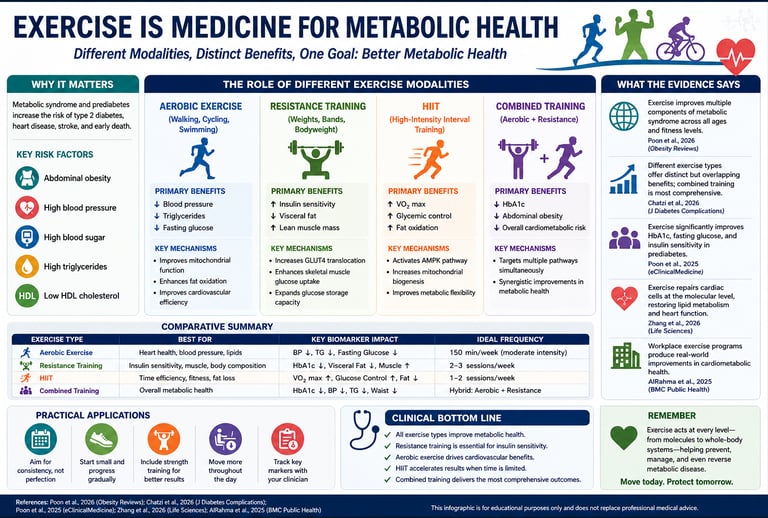
No single exercise is “best.” Different modalities target different metabolic pathways, and combined training provides the most comprehensive benefit.
Head-to-Head Evidence from 2026 Umbrella Reviews by Chatzi et al. (2026) graded the evidence strength and found strong evidence for aerobic exercise in reducing waist circumference and blood pressure. Resistance training showed suggestive evidence for insulin sensitivity and visceral fat reduction but weaker evidence for blood pressure. HIIT performed well on glycemic control, but had fewer high-quality studies for long-term adherence. The clearest signal across both major umbrella reviews (Chatzi and Poon) is that combined aerobic + resistance training produced the most consistent improvements across the largest number of risk factors.
Exercise Modalities: What Each Type Does Best
Aerobic Exercise (Walking, Cycling, Swimming)
Strongest for:
Blood pressure reduction
Triglyceride lowering
VO₂ max improvement
Moderate / weaker for:
Muscle mass gain
Insulin sensitivity (less than resistance training)
Best suited for:
Cardiovascular efficiency
Heart health and endurance
Resistance Training (Weights, Bands, Bodyweight)
Strongest for:
Insulin sensitivity
Visceral fat reduction
Lean muscle mass increase
Moderate / weaker for:
Pure blood pressure reduction
Best suited for:
Long-term blood sugar control
Metabolic resilience
High-Intensity Interval Training (HIIT)
Strongest for:
Time efficiency
VO₂ max improvement
Fat oxidation
Moderate / weaker for:
Long-term sustainability in beginners
Best suited for:
Busy individuals
Rapid cardiometabolic gains
Combined Training (Aerobic + Resistance)
Strongest for:
Overall cardiometabolic profile improvement
Moderate / weaker for:
— (no major limitations identified in current evidence)
Best suited for:
Most individuals with metabolic syndrome
Comprehensive metabolic health
Clinical Bottom Line
All exercise types improve metabolic health
Resistance training is important for insulin sensitivity
Aerobic exercise often produces larger effects on blood pressure and triglycerides
HIIT accelerates results when time is limited
Combined training shows the broadest overall benefits
Exercise is medicine — but the type, dose, and timing determine how powerfully it rewires your metabolism.
Metabolic syndrome and prediabetes are no longer silent conditions confined to clinics—they are now among the most pervasive global health threats, driven by insulin resistance, visceral adiposity, and chronic low-grade inflammation. Yet a convergence of high-quality evidence is reshaping how we approach prevention and treatment. Recent umbrella reviews—representing the highest tier of clinical evidence—demonstrate that structured exercise is not merely supportive care but a primary, disease-modifying intervention capable of improving glycemic control, lipid profiles, blood pressure, and body composition simultaneously (Chatzi C et al., 2026; Poon et al., 2026).
What makes this paradigm shift particularly compelling is that different exercise modalities—aerobic training, resistance exercise, and high-intensity interval training (HIIT)—target distinct yet overlapping biological pathways. From enhancing mitochondrial function and glucose uptake to restoring cellular lipid metabolism, exercise acts at multiple physiological levels, including the molecular machinery of the heart itself (Zhang et al., 2026). Importantly, these benefits are not restricted to athletes or highly motivated individuals; even moderate, consistent activity produces clinically meaningful improvements across diverse populations (Poon et al., 2025).
In this evolving landscape, the key question is no longer whether exercise works—but which type works best, for whom, and why.
What Is Metabolic Syndrome — and Why Should You Care?
Metabolic syndrome is not a single disease. It is a cluster of conditions that, when they appear together, dramatically increase your risk of type 2 diabetes, heart disease, stroke, and even early death. Doctors typically diagnose it when three or more of the following are present:
Elevated waist circumference (abdominal obesity)
High blood pressure (hypertension)
High fasting blood sugar (glucose dysregulation)
High triglycerides (a blood fat)
Low HDL ("good") cholesterol
The conditions feed each other in a vicious cycle driven by insulin resistance, chronic low-grade inflammation, and a dysfunctional fat-storage system. Left unaddressed, this cluster significantly accelerates the ageing of your heart, liver, kidneys, and brain.
Here is what makes the recent research so exciting: exercise appears to interrupt this cycle at multiple biological levels simultaneously — from your blood pressure to your cellular machinery.
The Big Picture: What Umbrella Reviews Are Telling Us
An umbrella review is the highest level of scientific evidence available. Instead of reviewing individual studies, it reviews all the existing systematic reviews and meta-analyses on a topic, making its conclusions extraordinarily robust.
1. Exercise-Based Interventions for Metabolic Syndrome: A Global Synthesis
A 2026 umbrella review with meta-analyses published in Obesity Reviews by Poon, Li, Wong, Sum, Little, and Sabag examined the overall efficacy of exercise-based interventions for people living with metabolic syndrome. This comprehensive analysis synthesised data from dozens of systematic reviews and meta-analyses and reached a powerful conclusion: exercise-based interventions reliably and significantly improve multiple components of metabolic syndrome simultaneously — not just one risk factor in isolation.
The study found that different types of exercise — aerobic training, resistance training, and combined approaches — each offered distinct and complementary benefits. Importantly, the review highlighted that the benefits were not limited to a single age group or fitness level. People across the spectrum, including previously sedentary adults and older individuals, demonstrated meaningful improvements when they engaged in structured exercise programmes (Poon et al., 2026).
This is critical for patients and clinicians alike. It means there is no single "perfect" exercise — and that finding a type of movement you can sustain consistently is far more important than chasing the theoretically optimal protocol.
2. Different Exercise Types, Different Metabolic Wins
A 2026 umbrella review published in the Journal of Diabetes and Its Complications by Chatzi and colleagues took an even deeper dive into how different types of exercise affect cardiometabolic risk factors. The review of systematic reviews and meta-analyses covered aerobic exercise, resistance training, high-intensity interval training (HIIT), and combined exercise programmes across thousands of patients.
The findings revealed a nuanced picture:
Aerobic exercise (walking, cycling, swimming) showed the strongest and most consistent improvements in blood pressure, triglycerides, and fasting blood glucose.
Resistance training (weightlifting, bodyweight exercise, resistance bands) had a particularly significant impact on insulin sensitivity, blood sugar control, and body composition — especially the reduction of visceral (belly) fat.
HIIT produced impressive improvements across nearly all cardiometabolic markers, often in a shorter time commitment than traditional aerobic training.
Combined training (doing both aerobic and resistance) emerged as the most comprehensively beneficial approach, improving the widest range of risk factors (Chatzi et al., 2026).
For patients, this evidence is empowering. It means that even if your joints prevent you from running, resistance training or swimming can still powerfully protect your heart and metabolism. There is genuinely something for everyone.
Prediabetes: The Critical Window for Lifestyle Intervention
Prediabetes — blood sugar that is higher than normal but not yet in the diabetic range — affects an estimated 720 million adults globally. It is arguably the most important metabolic fork in the road: turn left with lifestyle changes, and you can often prevent or indefinitely delay type 2 diabetes. Turn right by doing nothing, and the majority of people will develop full diabetes within a decade.
3. Exercise Interventions for Prediabetes: An Evidence-Based Road Map
A landmark 2025 umbrella review published in eClinicalMedicine by Poon, Wong, Kong, and Ali examined exercise-based interventions specifically for people with prediabetes, synthesising data from multiple meta-analyses of randomised controlled trials (RCTs) — the gold standard of clinical evidence.
The results were striking. Exercise interventions significantly reduced HbA1c (a key marker of average blood sugar over three months), fasting blood glucose, and body weight in people with prediabetes. Structured exercise also improved insulin sensitivity — meaning the body became more efficient at using the insulin it produces, rather than becoming increasingly resistant to it.
Perhaps most importantly, the review found that the type of exercise mattered less than the consistency and duration of the programme. This should reassure anyone who feels intimidated by high-intensity gym workouts: a brisk daily walk, sustained over months, can meaningfully move the needle on prediabetes markers (Poon et al., 2025).
This study sends a clear and urgent message: if you or someone you love has been told they are "borderline" or "pre-diabetic," structured exercise is not optional — it is one of the most evidence-based interventions available, and in many cases outperforms pharmaceutical approaches for preventing progression to full diabetes.
Inside the Cell: How Exercise Heals Your Heart at the Molecular Level
Most people understand exercise as something that burns calories or builds muscle. But a fascinating 2026 study published in Life Sciences reveals that exercise does something far more profound — it rewires the very molecular machinery inside your heart cells.
4. Exercise and Cardiac Lipid Metabolism: A Molecular Breakthrough
Researchers Zhang, Ding, Ding, Peng, Ping, Gu, Yu, Zhang, Yi, Pan, and Zheng (2026) used the fruit fly (Drosophila) — a powerful and well-validated model organism for studying cardiovascular biology — to investigate what happens inside heart cells when a high-sugar diet causes cardiac dysfunction.
Their discovery centres on a molecule called PECT (phosphoethanolamine cytidylyltransferase), which plays a key role in synthesising phosphatidylethanolamine — a critical phospholipid (fat molecule) that makes up cell membranes, especially in heart tissue. High-sugar diets suppressed PECT expression, disrupted the synthesis of this membrane lipid, and led to measurable cardiac dysfunction.
Here is the remarkable part: exercise restored PECT expression, normalised phosphatidylethanolamine synthesis, and reversed the diet-induced cardiac dysfunction — even while the high-sugar diet continued.
This finding is significant beyond the laboratory. It demonstrates that exercise is not merely "burning off" the damage caused by poor diet — it is actively repairing it at the cellular and molecular level. It tells us that even in the context of an imperfect diet, regular exercise is doing protective work we cannot see from the outside (Zhang et al., 2026).
For patients who feel they must achieve a perfect diet before exercise can help them, this research offers a liberating message: start moving first. Your cells will begin healing immediately.
From the Lab to the Workplace: Real-World Evidence
One of the most common barriers to exercise is time, and for many adults, most waking hours are spent at or travelling to work. A major 2025 randomised controlled trial examined whether workplace exercise programmes could produce meaningful cardiometabolic benefits in a real-world setting.
5. Workplace Exercise Intervention: A Randomised Controlled Trial
AlRahma, Habib, Masuadi, and colleagues published their findings in BMC Public Health (2025), reporting on a randomised controlled trial (RCT) — the most rigorous type of experimental study — testing a structured workplace exercise intervention on cardiometabolic health outcomes.
The intervention group participated in structured exercise sessions delivered in the workplace setting over the study period, while the control group maintained their usual routines. The results demonstrated significant improvements in cardiometabolic markers for those in the exercise group — including improvements in blood pressure, lipid profiles, and body composition metrics — compared to control participants.
This study matters enormously from a public health perspective. It shows that you do not need a fancy gym membership or perfectly organised personal time to achieve real cardiometabolic benefits from exercise. When exercise is integrated into the environment where people already spend their time, uptake improves and measurable health outcomes follow (AlRahma et al., 2025).
For employers, this research is equally compelling. A workplace exercise programme is not just a wellness perk — it is an evidence-based health intervention that can reduce the long-term disease burden among your workforce.
Connecting the Dots: What This Research Landscape Tells Us
Taken together, these six studies — spanning umbrella reviews of global evidence, molecular biology, and real-world trials — paint a remarkably coherent picture:
Exercise works for metabolic syndrome. Not vaguely, not marginally, but powerfully and across multiple biological systems simultaneously.
Different types of exercise offer overlapping and complementary benefits. Aerobic exercise, resistance training, HIIT, and combined programmes all have meaningful roles to play. The best exercise is the one you will actually do.
Prediabetes is a critical intervention window. Exercise in the prediabetic stage can dramatically reduce or eliminate the progression to type 2 diabetes — and the evidence supporting this is now at the level of umbrella reviews of RCTs.
Exercise heals at the cellular level. The molecular biology research confirms that exercise is not just symptomatic treatment — it restores fundamental cellular function in cardiac tissue, including lipid metabolism pathways disrupted by a poor diet. Exercise can restore key molecular pathways in cardiac cells
Environment and delivery matter. Workplace exercise interventions prove that context and accessibility are not trivial details — they are central to whether interventions actually reach the people who need them most.
Practical Applications: Turning Research Into Daily Life
Science is only useful when it changes behaviour. Here is how to translate these findings into a realistic, sustainable exercise plan:
Building Your Evidence-Based Exercise Week
Step 1: Anchor with aerobic activity (150 minutes per week) This aligns with global guidelines and is strongly supported by the reviewed evidence. Split this into five 30-minute sessions, or three 50-minute sessions — whichever fits your schedule. Walking, cycling, swimming, dancing, and using an elliptical all count.
Step 2: Add resistance training (2–3 sessions per week) You do not need a gym. Bodyweight exercises — squats, lunges, push-ups, resistance band rows — deliver genuine improvements in insulin sensitivity and body composition. Start with two sessions and build from there.
Step 3: Consider one HIIT session per week For those medically cleared for higher-intensity work, a single weekly HIIT session (e.g., 20 minutes of alternating 40-second efforts with 20-second rest periods) can accelerate improvements across cardiometabolic markers.
Step 4: Move throughout the day Beyond formal exercise sessions, reducing prolonged sitting is independently beneficial. Set a reminder to stand and walk for two minutes every 45–60 minutes during sedentary work periods.
Step 5: Track the right markers. Work with your doctor to monitor HbA1c, fasting blood glucose, blood pressure, HDL cholesterol, and triglycerides at regular intervals. These are the biomarkers most responsive to exercise intervention, and tracking them keeps you motivated.
Overcoming Common Barriers
"I don't have time." The workplace exercise trial showed that even exercise integrated into the workday produces measurable results. Could you walk during a lunch break? Do a 15-minute resistance routine before your morning shower? Time is often an organisational problem, not an actual shortage.
"I have joint pain or physical limitations." Water-based exercise (swimming, aqua jogging) and seated resistance training can deliver comparable metabolic benefits with minimal joint loading. Always work with a physiotherapist or exercise specialist if you have physical limitations.
"I don't know where to start." Start small, start safe, and start now. Even a daily 20-minute walk is enough to begin shifting your cardiometabolic risk profile. The research does not demand perfection — it demands consistency.
"I tried exercise before, and it didn't work." The umbrella reviews highlight that duration and programme structure matter significantly. Short, unsupported attempts often fail not because your body is unresponsive but because the programme lacked structure, progression, or professional guidance. Consider working with a certified exercise physiologist or personal trainer for at least the first 8–12 weeks.
Frequently Asked Questions (FAQs)
Q1: How long does it take for exercise to improve my metabolic markers?
Most clinical trials show meaningful improvements in blood sugar, blood pressure, and cholesterol within 8 to 12 weeks of regular, structured exercise. However, even within the first two to four weeks, improvements in insulin sensitivity — the body's efficiency in using blood sugar — can begin. Progress is not always visible on the outside, but it is happening at the cellular level from the very first session.
Q2: Is walking enough to make a difference for metabolic syndrome?
Yes — and this is one of the most important messages from the reviewed research. Brisk walking is a legitimate aerobic intervention that consistently improves blood pressure, triglycerides, fasting blood glucose, and body composition when performed regularly (at least 150 minutes per week at a moderate intensity). It is especially effective for people who are just beginning an exercise programme. Add resistance training over time to maximise the metabolic benefits.
Q3: Can exercise alone reverse prediabetes without medication?
The umbrella review published in eClinicalMedicine (Poon et al., 2025) provides strong evidence that exercise-based interventions alone can significantly reduce HbA1c and fasting blood glucose in people with prediabetes — and in direct comparisons, lifestyle interventions including exercise have outperformed metformin (the most commonly prescribed prediabetes drug) in major prevention trials. That said, individual responses vary, and it is important to work with your doctor to monitor your progress and determine whether medication is needed alongside lifestyle changes.
Q4: What type of exercise is best for reducing belly fat?
Both aerobic exercise and resistance training reduce visceral (belly) fat, but they do so through different mechanisms. Aerobic exercise tends to create a calorie deficit that draws on visceral fat stores. Resistance training builds metabolically active muscle tissue, which improves insulin sensitivity and reduces visceral fat accumulation over time. The research reviewed here consistently shows that combined training programmes produce the greatest reductions in abdominal obesity.
Q5: Is it safe to start exercising if I have high blood pressure or high blood sugar?
For most people, yes — and the evidence strongly supports exercise as a therapeutic tool for both conditions. However, always consult your GP or specialist before beginning a new exercise programme, especially if your blood pressure or blood sugar is poorly controlled, if you have known heart disease, or if you are on medications that affect your heart rate (such as beta-blockers). A supervised, graduated start is the safest approach for anyone with significant cardiometabolic conditions.
Q6: How does exercise protect the heart at a molecular level?
The 2026 research by Zhang and colleagues provides a compelling answer. Exercise restores the expression of PECT — a key enzyme in the synthesis of phosphatidylethanolamine, a critical component of heart cell membranes. When this molecular pathway is disrupted (as it is by high-sugar diets), the heart muscle becomes dysfunctional. Exercise repairs this dysfunction from the inside out, restoring normal cellular lipid metabolism. In simpler terms: every time you exercise, your heart cells are actively being repaired and protected at a level no medication currently replicates.
Q7: My workplace doesn't have a gym. Can I still benefit from workplace-based exercise?
Absolutely. The BMC Public Health RCT (AlRahma et al., 2025) demonstrates that structured workplace exercise interventions — which may be as simple as organised walking groups, standing desk programmes, or lunchtime resistance sessions — produce genuine cardiometabolic improvements. You do not need equipment or a dedicated gym space. Even advocating for a walking meeting culture or a brief lunchtime movement break can contribute to measurable health outcomes over time. Speak to your HR department, occupational health team, or wellness coordinator about piloting a workplace movement programme.
Clinical pearls
1. The "Synergy of Combined Training"
Scientific Perspective: Combined aerobic and resistance training (CART) offers superior metabolic outcomes by targeting different physiological pathways simultaneously. Aerobic exercise improves mitochondrial density and cardiovascular efficiency, while resistance training enhances glucose disposal via increased muscle mass and GLUT4 translocation.
You don’t have to choose between cardio and weights—doing both is the "gold standard." Mixing them in your weekly routine covers more bases, helping your heart, your muscles, and your blood sugar more effectively than either one alone.
2. Resistance Training as a "Metabolic Sink"
Scientific Perspective: Skeletal muscle is the primary site for insulin-stimulated glucose uptake. Resistance exercise creates a "metabolic sink" by
increasing lean body mass and improving insulin sensitivity, which is particularly effective for reducing visceral adiposity and improving long-term glycemic control (HbA1c).
Think of your muscles as a sponge for blood sugar. Lifting weights or using resistance bands builds "more sponge," making it much easier for your body to soak up excess sugar from your bloodstream, even when you aren't moving.
3. HIIT: Maximum Efficiency in Minimal Time
Scientific Perspective: High-Intensity Interval Training (HIIT) induces rapid improvements in $VO_{2}max$ and cardiometabolic markers by pushing the metabolic system to its upper limits. It has been shown to produce comparable (and sometimes superior) metabolic adaptations to traditional moderate-intensity continuous training (MICT) with significantly lower time commitment.
If you are "time-poor," intensity can be a substitute for duration. Short bursts of higher-effort exercise (like a fast uphill walk or cycling sprint) can provide massive health hits in half the time of a slow, steady workout.
4. The "Molecular Repair" of Cardiac Tissue
Scientific Perspective: Recent 2026 data indicates that exercise acts as a molecular "reset" for lipid metabolism in the heart. By restoring PECT expression and phosphatidylethanolamine synthesis, exercise directly reverses the cellular damage caused by high-sugar diets, providing a cardioprotective effect that is independent of weight loss.
Exercise isn't just about "burning off" a bad meal; it’s about "repairing" the damage. Even if your diet isn't perfect yet, moving your body sends a repair crew to your heart cells to fix the internal machinery that sugar breaks down.
5. Consistency Over Complexity in Prediabetes
Scientific Perspective: Umbrella reviews of RCTs demonstrate that for prediabetic populations, the volume and consistency of an exercise intervention are better predictors of success than the specific "type" of movement. Chronic adherence is the primary driver for preventing the progression to Type 2 Diabetes.
When you are in the "prediabetes" stage, the best exercise is the one you actually do. You don't need a complicated gym plan to save your health; a consistent, brisk daily walk is often powerful enough to stop diabetes in its tracks, provided you keep it up long term
Call to Action: Your First Step Starts Today
Choose Your Starting Point Right Now:
Option A — Complete Beginner: Put on your shoes and walk for 20 minutes after your next meal. Do this every day this week. That's your week one goal — nothing more complicated than that.
Option B — Occasional Exerciser: Schedule three 30-minute walks and two resistance training sessions into your calendar for the next seven days as non-negotiable appointments. Treat them like medical appointments — because according to the latest evidence, they are.
Option C — Ready to Get Serious: Book an appointment with an exercise physiologist or certified personal trainer this week. Bring your most recent blood test results and ask them to help you design an evidence-based programme targeting your specific metabolic risk factors.
Author’s Note
As a clinician in internal medicine, I have witnessed a profound shift in how we understand and apply exercise in the management of metabolic disease. What was once considered supportive lifestyle advice is now firmly established as a powerful, evidence-based therapeutic intervention. High-quality data—including umbrella reviews such as those by Chatzi C et al. (2026)—consistently demonstrate that structured exercise can improve glycemic control, blood pressure, lipid profiles, and body composition, often in ways comparable to pharmacological therapy.
However, the real challenge lies not in the science, but in its translation to daily clinical practice. Patients do not struggle with understanding that exercise is beneficial—they struggle with starting, sustaining, and personalizing it within the realities of their lives. This is where clinicians must move beyond generic advice and adopt a more structured, individualized, and supportive approach.
This article is written with the intent to bridge that gap—integrating robust scientific evidence with practical, actionable guidance. The goal is not perfection, but progress. Even modest, consistent physical activity can initiate meaningful metabolic change.
Ultimately, exercise is one of the few interventions that acts across multiple organ systems simultaneously—making it not just a recommendation, but a cornerstone of modern preventive and therapeutic medicine.Join the Conversation
Share this article with someone who has recently been diagnosed with prediabetes, metabolic syndrome, or high blood pressure. The research reviewed here could genuinely change the trajectory of their health.
Leave a comment below and tell us: What is your biggest barrier to regular exercise? Our community and contributors actively respond — and your question might become the basis of a future evidence-based article.
Save this article to your reading list or send it to your GP or practice nurse. Sharing peer-reviewed evidence with your healthcare team helps create a collaborative conversation about the role of exercise in your personalised care plan.
This article is intended for educational and informational purposes only and does not constitute medical advice. Always consult a qualified healthcare professional before beginning a new exercise programme, particularly if you have existing health conditions or are currently taking medication.
.Related Articles
Just 2 Strength Workouts a Week Can Transform Your Metabolism—Here’s How
The Science of Healthy Brain Aging: Microglia, Metabolism & Cognitive Fitness | DR T S DIDWAL
The Aging Muscle Paradox: How Senescent Cells Cause Insulin Resistance and The Strategies to Reverse It | DR T S DIDWAL
VO2 Max & Longevity: The Ultimate Guide to Living Longer | DR T S DIDWAL
References
AlRahma, A. M., Habib, M. A., Masuadi, E., et al. (2025). Effects of a workplace exercise intervention on cardiometabolic health: A randomized controlled trial. BMC Public Health, 25, Article 3493. https://doi.org/10.1186/s12889-025-24815-5
Chatzi, C., Markozannes, G., Ntzani, E. E., Rizzo, M., Basios, A., Kalampoki, A., Tsilidis, K., Makrilakis, K., Milionis, H., Rapti, I., & Rizos, E. C. (2026). Effect of different types of exercise interventions on cardiometabolic risk factors: An umbrella review of systematic reviews and meta-analyses. Journal of Diabetes and Its Complications, 40(5), Article 109305. https://doi.org/10.1016/j.jdiacomp.2026.109305
Poon, E. T.-C., Li, H.-Y., Wong, P.-S., Sum, W. M.-K., Little, J. P., & Sabag, A. (2026). Efficacy of exercise-based interventions for metabolic syndrome: An umbrella review with meta-analyses. Obesity Reviews, e70144. https://doi.org/10.1111/obr.70144
Poon, E. T.-C., Wong, P.-S., Kong, A. P. S., & Ali, A. (2025). Efficacy of exercise-based interventions for prediabetes: An umbrella review of meta-analyses of randomised controlled trials. eClinicalMedicine, 90, Article 103606. https://doi.org/10.1016/j.eclinm.2025.103606
Zhang, Z., Ding, N., Ding, M., Peng, T., Ping, X., Gu, W., Yu, Z., Zhang, Z., Yi, Q., Pan, Z., & Zheng, L. (2026). Exercise enhances cardiac PECT expression to restore phosphatidylethanolamine synthesis and alleviate high-sugar diet–induced cardiac dysfunction in Drosophila. Life Sciences, 393, Article 124345. https://doi.org/10.1016/j.lfs.2026.124345