Can Omega-3 Boost Muscle Protein Synthesis? What the Latest Research Reveals
Does fish oil help build muscle? Explore the latest science on omega-3, mTOR signaling, and muscle growth.
NUTRITION
Dr. T.S. Didwal, M.D.(Internal Medicine)
5/13/202612 min read
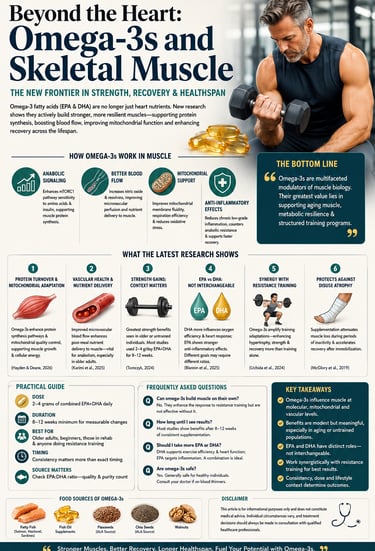
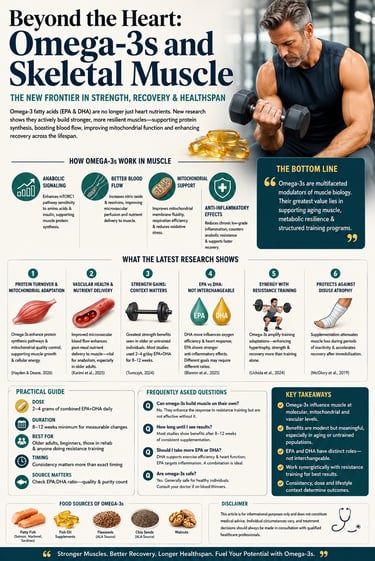
By age 50, many adults lose enough muscle each decade to fundamentally alter metabolism, mobility, and independence. Scientists now believe omega-3 fatty acids may influence this decline at the level of muscle cell signaling itself.
For decades, omega-3 fatty acids lived almost exclusively in the world of cardiology. They were discussed in relation to triglycerides, arrhythmias, endothelial function, and cardiovascular prevention. Fish oil became synonymous with “heart health,” while skeletal muscle remained largely absent from the conversation. That is now changing.
Between 2024 and 2026, a growing body of research in exercise physiology, metabolism, and healthy aging has repositioned omega-3 fatty acids — particularly eicosapentaenoic acid (EPA) and docosahexaenoic acid (DHA) — as biologically active regulators of skeletal muscle adaptation, mitochondrial efficiency, vascular function, and anabolic signaling (Hayden & Deane, 2026; Karimi et al., 2025).
This emerging field matters because skeletal muscle is far more than a movement tissue. It is a metabolic organ that regulates insulin sensitivity, glucose disposal, inflammatory balance, mitochondrial health, and physical resilience across the lifespan. Age-related muscle decline — known as sarcopenia — is strongly associated with frailty, metabolic dysfunction, falls, disability, and loss of independence.
After the age of 30, adults lose approximately 3–8% of muscle mass per decade, with the rate accelerating after midlife. But inactivity alone does not fully explain this decline. A major biological driver is anabolic resistance — the reduced ability of aging muscle to respond to protein intake, insulin, and exercise stimuli.
Emerging evidence suggests omega-3 fatty acids may partially restore this responsiveness by enhancing mTORC1 signaling, improving mitochondrial dynamics, increasing muscle perfusion, and reducing chronic low-grade inflammation (Karimi et al., 2025; Uchida et al., 2024). Omega-3s appear to work less like stimulants and more like membrane remodelers — gradually altering how muscle cells respond to protein, insulin, and exercise over time.
The result is a profound reframing of omega-3 science. The question is no longer simply whether fish oil is “good for the heart.” The modern question is far more precise:
Can omega-3 fatty acids meaningfully influence skeletal muscle biology, exercise adaptation, and healthy aging?
Skeletal Muscle: The Metabolic Organ We Underestimated
Modern exercise science increasingly recognizes skeletal muscle as one of the body’s most important endocrine and metabolic tissues.
Muscle is the primary site of postprandial glucose disposal. It influences insulin sensitivity, resting metabolic rate, inflammatory signaling, and mitochondrial function. Healthy muscle tissue supports metabolic flexibility — the body’s ability to efficiently switch between carbohydrates and fat as fuel. When muscle declines, metabolic health often deteriorates alongside it.
This is why sarcopenia is now viewed not merely as a consequence of aging, but as a central driver of aging-related disease.
Loss of muscle mass contributes to:
Insulin resistance
Reduced metabolic rate
Impaired mobility
Frailty
Increased fall risk
Loss of physical independence
Reduced recovery capacity
Chronic inflammation
Against this backdrop, nutritional interventions capable of improving muscle preservation or exercise responsiveness become clinically significant.
Omega-3 fatty acids have emerged as one of the most biologically intriguing candidates.
How Omega-3s Interact With Muscle Biology
EPA and DHA are incorporated directly into cell membrane phospholipids throughout the body, including skeletal muscle and mitochondria.
This incorporation changes membrane fluidity, receptor signaling, inflammatory dynamics, and intracellular communication.
The effects appear to occur across multiple interconnected systems:
1. Enhanced Anabolic Signaling
One of the most important proposed mechanisms involves mTORC1 — the master anabolic pathway regulating muscle protein synthesis.
Resistance exercise and amino acids activate mTORC1 signaling to stimulate muscle growth and repair. Aging, however, blunts this response.
Omega-3 fatty acids appear to enhance the sensitivity of muscle tissue to anabolic stimuli such as amino acids and insulin, effectively improving the “anabolic responsiveness” of skeletal muscle (Hayden & Deane, 2026).
In practical terms, omega-3s may help aging muscle “hear” anabolic signals more effectively.
2. Reduction of Chronic Inflammation
Low-grade systemic inflammation is strongly associated with anabolic resistance and muscle loss.
EPA and DHA serve as precursors to specialized pro-resolving mediators including resolvins, protectins, and maresins, which help regulate inflammatory resolution pathways rather than simply suppressing inflammation nonspecifically (Zhang et al., 2026).
This distinction is important because chronic unresolved inflammation interferes with muscle recovery, insulin signaling, and mitochondrial function.
3. Improved Mitochondrial Function
Mitochondria are central to muscle performance, endurance, and healthy aging.
Emerging research suggests omega-3s may improve mitochondrial membrane composition, respiratory efficiency, and redox balance while reducing oxidative stress within muscle tissue (Hayden & Deane, 2026).
Improved mitochondrial quality may partially explain why omega-3s appear particularly relevant for aging populations experiencing fatigue, reduced exercise tolerance, or metabolic dysfunction.
4. Enhanced Microvascular Blood Flow
Karimi and colleagues (2025) introduced one of the most compelling frameworks in modern omega-3 research: vascular-mediated anabolism.
Muscle growth and recovery depend not only on nutrients being consumed, but on nutrients reaching muscle tissue efficiently.
Omega-3s appear to improve nitric oxide signaling and microvascular perfusion, enhancing delivery of:
Amino acids
Glucose
Oxygen
Insulin
to skeletal muscle after meals and exercise. This mechanism may be especially important in older adults, where postprandial muscle blood flow is often impaired.
Omega-3s and Aging Muscle: Overcoming Anabolic Resistance
One of the most clinically relevant concepts in modern muscle physiology is anabolic resistance. In younger adults, protein intake and resistance exercise produce a robust increase in muscle protein synthesis. With aging, this response becomes blunted.
Older muscle tissue requires:
Larger protein doses
Greater exercise stimulus
Longer recovery periods
to achieve the same anabolic response seen in younger individuals. This is where omega-3s appear most promising. Multiple reviews suggest EPA and DHA may partially reverse anabolic resistance by:
Enhancing mTOR signaling
Improving insulin sensitivity
Reducing inflammatory interference
Increasing nutrient delivery
Improving mitochondrial responsiveness
Importantly, the benefits appear most consistent in:
Older adults
Sedentary individuals
Rehabilitation populations
Individuals with metabolic dysfunction
, rather than elite athletes or highly trained younger populations (Tomczyk, 2024). This population specificity is a recurring theme throughout the literature. A 65-year-old beginning resistance training with low baseline fish intake may experience greater improvements in recovery and anabolic sensitivity than a 25-year-old elite athlete already consuming a high-protein diet
The Strength Question: Do Omega-3s Actually Build Muscle?
The most practical question for clinicians, athletes, and health-conscious adults is straightforward:
Do omega-3 supplements improve muscle strength and hypertrophy?
According to Tomczyk’s 2024 review in Nutrients, the answer is nuanced. The literature shows modest but meaningful improvements in muscle strength — especially when omega-3 supplementation is combined with resistance training rather than used alone.
Positive findings are most consistently observed in:
Grip strength
Lower-body strength
Functional performance
Recovery capacity
Preservation of lean mass
However, the magnitude of benefit depends heavily on context.
The Best Responders
The strongest evidence exists for:
Older adults
Previously untrained individuals
Rehabilitation settings
Sarcopenic populations
Individuals recovering from injury or immobilization
Younger, highly trained athletes show smaller and less predictable responses. This likely reflects a ceiling effect: highly trained muscle is already operating near its adaptive capacity. Omega-3s appear to function primarily as an anabolic amplifier rather than a direct muscle-building agent. In other words, They enhance adaptation to exercise — they do not replace it.
EPA vs. DHA: The End of the “Fish Oil Is Fish Oil” Era
One of the most important developments in omega-3 research is the recognition that EPA and DHA are not metabolically interchangeable.
Historically, fish oil supplements were treated as a single category. Blannin et al.(2025) challenged that assumption by comparing EPA-rich and DHA-rich formulations in endurance-trained men. Their findings suggest distinct physiological effects:
DHA
DHA appeared more strongly associated with:
Improved oxygen efficiency
Reduced heart rate during submaximal exercise
Enhanced exercise economy
Cardiac efficiency
These findings may be particularly relevant for endurance athletes.
EPA
EPA demonstrated stronger anti-inflammatory effects and may play a greater role in recovery and inflammatory modulation. This distinction has important implications because commercial omega-3 supplements vary enormously in EPA: DHA ratio. Future precision nutrition strategies may increasingly tailor omega-3 formulations based on:
Athletic goals
Recovery demands
Cardiometabolic health
Inflammatory burden
Aging-related muscle loss
Omega-3s and Resistance Training: A Synergistic Relationship
Perhaps the most important conclusion from current evidence is that omega-3s work best when paired with structured exercise.
Uchida and colleagues (2024) reviewed the combined effects of omega-3 supplementation and resistance training on skeletal muscle adaptation. The findings support a synergistic interaction.
Potential mechanisms include:
Enhanced mTOR activation
Reduced exercise-induced inflammation
Improved satellite cell activity
Faster recovery
Improved muscle remodeling
Enhanced anabolic sensitivity
The implication is clear: Omega-3s are not passive wellness supplements. Their greatest physiological value emerges when combined with mechanical loading and exercise stimulus. This helps explain why sedentary supplementation studies often show inconsistent outcomes. Muscle adaptation remains fundamentally exercise-driven.
Omega-3s and Muscle Preservation During Inactivity
One of the most fascinating studies in this field comes from McGlory et al. (2019), who investigated omega-3 supplementation during short-term limb immobilization in healthy young women.
Participants receiving omega-3 supplementation experienced:
Less muscle volume loss
Better preservation of lean tissue
Faster recovery after immobilization
Higher myofibrillar protein synthesis rates
compared with controls. These findings are clinically important because disuse atrophy occurs rapidly during:
Hospitalization
Injury recovery
Orthopedic immobilization
Sedentary periods
Illness-related inactivity
Omega-3s may therefore have significant rehabilitation applications beyond athletic performance.
The Bone-Muscle Axis and Healthy Aging
Zhang et al. (2026) expanded the omega-3 discussion beyond muscle alone to include the integrated musculoskeletal system.
Their review highlights omega-3 effects on:
Osteoblast activity
Bone remodeling
Joint inflammation
Mechanosensitivity
Recovery biology
Osteoarthritis pathways
This integrated perspective matters because muscle and bone function as a coordinated biological unit. Loss of muscle accelerates bone fragility. Bone loss reduces mobility and exercise capacity. Omega-3s may influence both sides of this relationship simultaneously. This makes them particularly interesting within the broader framework of healthy aging, longevity science, and functional preservation.
Why Results Remain Inconsistent
Despite promising mechanisms, omega-3 research still produces variable findings.
Several factors likely explain this inconsistency.
Baseline Omega-3 Status
Individuals with already high dietary omega-3 intake may derive less additional benefit from supplementation.
Age Differences
Older adults appear substantially more responsive than younger populations.
Training Status
Untrained individuals generally improve more than elite athletes.
Dose Variability
Positive studies often use:
2–4 g/day combined EPA+DHA
sustained for at least 8–12 weeks
Lower doses frequently show weaker effects.
Duration Matters
Omega-3s are incorporated gradually into cell membranes.
Unlike caffeine or creatine, they do not produce rapid performance effects.
Physiological adaptation takes time.
Study Design Limitations
Many studies suffer from:
Small sample sizes
Short durations
Heterogeneous populations
Variable EPA: DHA ratios
Different exercise protocols
Hayden and Deane (2026) emphasize the need for larger, better-controlled trials using advanced metabolic tracing and precision nutrition approaches.
Practical Applications: What Should Clinicians and Active Adults Do?
The current evidence does not support viewing omega-3s as miracle supplements. However, it also does not support dismissing them as nutritionally trivial. The most evidence-based interpretation is that omega-3s are context-dependent metabolic tools.
Individuals Most Likely to Benefit
Current evidence is strongest for:
Older adults
Sarcopenia prevention
Rehabilitation settings
Individuals beginning resistance training
Metabolically unhealthy populations
Those with low dietary omega-3 intake
Suggested Intake Range
Most studies showing meaningful muscle-related outcomes used:
2–4 g/day combined EPA+DHA
consistently for ≥8–12 weeks
Timing
Total daily consistency appears more important than precise timing.
Omega-3s function through membrane incorporation rather than acute stimulation.
Food Sources
Rich omega-3 sources include:
Salmon
Sardines
Mackerel
Herring
Anchovies
Algae-derived DHA supplements may offer an alternative for plant-based diets.
Exercise Remains Essential
Perhaps the most important clinical point is this: Omega-3s enhance adaptation to exercise — they do not substitute for exercise.
Resistance training remains the primary driver of muscle preservation and healthy aging.
The Future of Precision Muscle Nutrition
The omega-3 field is moving rapidly toward individualized approaches.
Future research will likely explore:
Personalized EPA:DHA ratios
Baseline omega-3 testing
Genetic responsiveness
Sex-specific effects
Mitochondrial phenotyping
Integration with protein timing
Recovery-specific protocols
Rehabilitation applications
This reflects a broader shift in medicine and exercise science toward precision nutrition and functional longevity.
The future is unlikely to revolve around single “anti-aging supplements.”
Instead, it will focus on biologically targeted strategies that preserve metabolic resilience, mobility, and physical independence across the lifespan.
Omega-3 fatty acids may ultimately become one component of that larger framework.
Final Thoughts: Beyond the Fish Oil Hype
The modern omega-3 conversation is no longer primarily about cholesterol numbers or generic wellness marketing.
It is increasingly about skeletal muscle biology, metabolic resilience, mitochondrial health, and healthy aging.
The evidence suggests EPA and DHA are biologically active molecules capable of influencing anabolic signaling, inflammation resolution, vascular function, mitochondrial efficiency, and muscle adaptation — particularly in aging or metabolically vulnerable populations.
At the same time, science also provides an important reality check. Omega-3s are not anabolic steroids. They are not replacements for exercise, protein intake, sleep, or structured training. Their effects are subtle, cumulative, and context-dependent. But in the physiology of ageing — where small improvements in muscle preservation, recovery, and metabolic function can compound over decades — subtle effects may still matter enormously. The most scientifically defensible conclusion today is this: Omega-3 fatty acids are not magic bullets for muscle growth, but they may represent valuable adjuncts in the long-term preservation of strength, metabolic health, and functional independence across the lifespan. In the biology of aging, preserving muscle may ultimately matter more than chasing longevity itself — and omega-3s may help support that preservation, one cellular adaptation at a time
Frequently Asked Questions (FAQs)
1. How much omega-3 do I need to see benefits for muscle health? Based on the reviewed literature, most studies reporting meaningful muscle-related benefits used doses of 2–4 grams of combined EPA+DHA per day. Lower doses may still confer cardiovascular and anti-inflammatory benefits, but evidence for significant skeletal muscle effects tends to emerge more consistently at this higher range and after at least 8–12 weeks of continuous supplementation (Tomczyk, 2024).
2. Should I take EPA or DHA — or both? Current evidence suggests that EPA and DHA exert distinct physiological effects and should not be treated as interchangeable. DHA appears to have a greater influence on oxygen efficiency and cardiac responses during aerobic exercise, while EPA may produce stronger anti-inflammatory effects. For most individuals, a combined EPA+DHA supplement remains the standard recommendation, but endurance athletes may benefit from a DHA-rich formulation (Blannin et al., 2025).
3. Do omega-3s help build muscle, or just prevent muscle loss? Both. The research suggests omega-3s can contribute to muscle anabolism by sensitising the mTOR signalling pathway and enhancing protein synthesis — particularly when combined with resistance training (Uchida et al., 2024). They also protect against muscle loss by reducing inflammatory-driven catabolism, which is especially important in older adults, individuals with chronic illness, or those in caloric deficit.
4. Can omega-3 supplements improve my workout performance? Possibly — particularly at submaximal intensities. Blannin et al. (2025) found that six weeks of EPA-rich or DHA-rich supplementation altered submaximal exercise physiology in trained male endurance athletes. However, the effects on peak performance, VO₂ max, or maximal strength in already well-trained individuals are less convincing from the current evidence base.
5. Are omega-3 benefits greater for older adults? Yes. The reviewed literature consistently suggests that older adults respond more favourably to omega-3 supplementation in terms of muscle-related outcomes. This is likely because aging is associated with anabolic resistance — a blunted response to normal anabolic stimuli such as amino acids and insulin — which omega-3s may partially reverse. Vascular mechanisms also appear highly relevant in this population (Karimi et al., 2025).
6. How long does it take for omega-3 supplementation to affect muscle health? Studies reporting meaningful changes in protein synthesis markers, vascular function, and muscle strength typically ran for 8–12 weeks or longer. This timeline aligns with the biological process of omega-3 incorporation into cell membrane phospholipids, which stabilises over several weeks of consistent intake. Short-term supplementation of a few days or weeks is unlikely to produce clinically meaningful muscle adaptations (Hayden & Deane, 2026).
7. Is it better to take omega-3s before or after exercise? The evidence on timing is preliminary and not definitive. Some findings reviewed by Uchida et al. (2024) suggest that pre-exercise omega-3 ingestion may optimise the anabolic window by reducing post-exercise inflammatory interference. However, the total daily dose and consistency of supplementation appear to matter far more than precise timing. Until clearer evidence emerges, prioritising consistent daily intake is more important than optimising timing.
Author’s Note
The purpose of this article is not to promote supplementation, but to clarify evidence. Omega-3 fatty acids occupy a unique space in modern nutrition science — widely consumed, heavily marketed, yet biologically complex. As a physician trained in internal medicine and metabolic health, I am particularly interested in interventions that bridge molecular physiology and real-world function. Skeletal muscle sits at the center of that intersection. It determines metabolic resilience, physical independence, recovery capacity, and long-term healthspan.
The recent shift in omega-3 research toward muscle biology reflects a broader evolution in medicine: we are moving from disease management toward functional preservation. Muscle is not merely a locomotor tissue; it is an endocrine and metabolic organ that influences glucose regulation, inflammatory tone, mitochondrial health, and aging trajectories. Understanding how EPA and DHA interact with these systems requires careful interpretation of mechanistic studies, randomized trials, and population-specific data.
Disclaimer: This article is for informational purposes only and does not constitute medical advice. Individual circumstances vary, and treatment decisions should always be made in consultation with qualified healthcare professionals.
Related Articles
How SCFAs From Gut Bacteria Boost Metabolic Health | DR T S DIDWAL
What’s New in the 2025 Blood Pressure Guidelines? A Complete Scientific Breakdown | DR T S DIDWAL
Low-Fat vs. Low-Carb: Which Diet is Best for Weight Loss? | DR T S DIDWAL
Does Saturated Fat Cause Heart Disease? What the Latest Science Really Says | DR T S DIDWAL
References
Hayden, J. E., & Deane, C. S. (2026). Skeletal muscle protein turnover and mitochondrial responses to omega-3 fatty acid supplementation: an update. Current opinion in clinical nutrition and metabolic care, 29(2), 136–140. https://doi.org/10.1097/MCO.0000000000001196
Mcglory, C., Gorissen, S.H.M., Kamal, M., Bahniwal, R., Hector, A.J., Baker, S.K., Chabowski, A. and Phillips, S.M. (2019), Omega-3 fatty acid supplementation attenuates skeletal muscle disuse atrophy during two weeks of unilateral leg immobilization in healthy young women. Faseb, 33: 4586-4597. https://doi.org/10.1096/fj.201801857RRR
Zhang, H., Zhu, M., Qu, Y., Zhang, X., Wu, Z., & Wang, Z. (2026). Omega-3 PUFAs in musculoskeletal health and sports medicine: From molecular pathways to precision nutrition strategies. Frontiers in Nutrition, 13, Article 1789924. https://doi.org/10.3389/fnut.2026.1789924
Blannin, A. B., Boulton, G., & Thielecke, F. (2025). Six weeks of either EPA-rich or DHA-rich omega-3 supplementation alters submaximal exercise physiology in endurance trained male amateurs. Frontiers in Nutrition, 12, Article 1588421. https://doi.org/10.3389/fnut.2025.1588421
Karimi, E., Keske, M. A., Beba, M., & Kaur, G. (2025). Effects of omega-3 fatty acids on skeletal muscle vascular health and metabolism. Current Opinion in Clinical Nutrition and Metabolic Care, 28(6), 496–500. https://doi.org/10.1097/MCO.0000000000001155
Tomczyk, M. (2024). Omega-3 fatty acids and muscle strength: Current state of knowledge and future perspectives. Nutrients, 16(23), 4075. https://doi.org/10.3390/nu16234075
Uchida, Y., Tsuji, K., & Ochi, E. (2024). Effects of omega-3 fatty acids supplementation and resistance training on skeletal muscle. Clinical Nutrition ESPEN, 61, 189–196. https://doi.org/10.1016/j.clnesp.2024.03.019