High Blood Pressure? New Research Shows Strength Training May Be as Effective as Cardio
New research shows resistance training may significantly reduce blood pressure and improve cardiovascular health. Learn how strength training helps manage hypertension safely and effectively.
EXERCISEHEART
Dr. T.S. Didwal, M.D.(Internal Medicine)
5/12/202612 min read
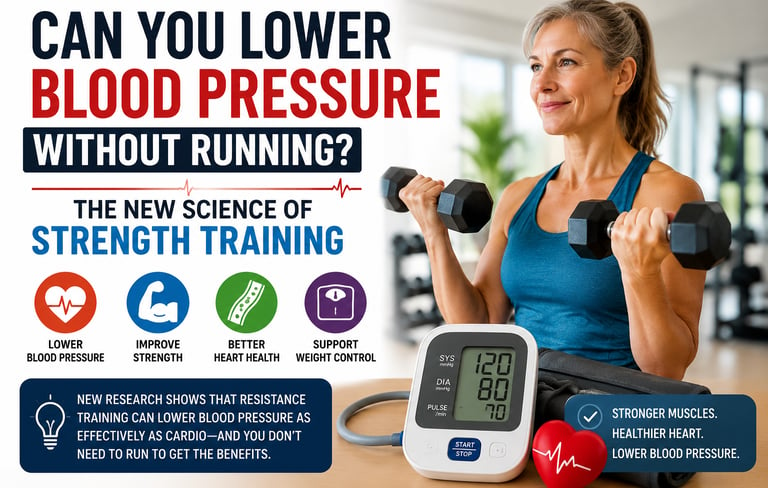
For decades, cardiologists told their hypertensive patients to walk, swim, and cycle. But a growing body of rigorous evidence is rewriting that script — and the weight room may be just as powerful as the treadmill. Meta-analyses suggest resistance training can reduce systolic blood pressure by approximately 4–8 mmHg and diastolic pressure by 2–4 mmHg.
Introduction: The Exercise Prescription for Hypertension Is Changing
Hypertension — commonly known as high blood pressure — affects more than 1.28 billion adults globally and remains one of the most important modifiable risk factors for cardiovascular disease, stroke, chronic kidney disease, heart failure, and premature mortality (World Health Organization, 2025). Persistent elevations in systolic and diastolic blood pressure contribute to endothelial dysfunction, arterial stiffness, vascular inflammation, and progressive damage to the heart, brain, and kidneys. For decades, clinical guidelines have consistently emphasized aerobic exercise — including walking, jogging, cycling, and swimming — as the cornerstone of non-pharmacological blood pressure management because of its well-established ability to improve vascular health and cardiorespiratory fitness (Alves et al., 2023).
However, the science of exercise physiology is evolving rapidly. Emerging evidence now suggests that resistance training — including weightlifting, resistance band exercises, and bodyweight strength training — may lower blood pressure as effectively as traditional aerobic exercise in many individuals (Kobayashi, 2025; Tanaka & Ferrari, 2026). More importantly, combined aerobic and resistance training appears to produce additive benefits for vascular function, insulin sensitivity, autonomic balance, muscular strength, and overall cardiometabolic health (Wang et al., 2025).
Recent systematic reviews and meta-analyses indicate that structured strength training can significantly reduce both systolic and diastolic blood pressure while simultaneously improving body composition, metabolic health, skeletal muscle function, and exercise adherence (de Oude et al., 2025). This growing body of evidence is reshaping modern hypertension management and expanding the role of exercise medicine in preventive cardiology
Understanding Hypertension: A Quick Refresher
Before exploring exercise science, it helps to understand what we are actually trying to change. Blood pressure is measured in two numbers: systolic (the pressure when your heart beats) and diastolic (the pressure between beats). Normal blood pressure sits below 120/80 mmHg. Hypertension is generally diagnosed at readings of 130/80 mmHg or higher, according to current American Heart Association guidelines.
Even modest reductions in blood pressure carry significant clinical weight. Lowering systolic blood pressure by just 5 mmHg can reduce the risk of a major cardiovascular event by approximately 10%. This is precisely why lifestyle interventions — including structured exercise — are considered frontline strategies, often recommended before or alongside medication.
Aerobic Exercise: The Long-Standing Standard
The evidence base for aerobic exercise and blood pressure reduction is robust and decades-old. Regular aerobic activity — sustained rhythmic exercise using large muscle groups — improves cardiovascular efficiency, reduces arterial stiffness, and promotes healthier endothelial function. The result is a measurable, clinically meaningful drop in both systolic and diastolic blood pressure.
Alves et al. (2023) offered an updated framework for understanding how exercise interventions should be designed for people with hypertension. Their work emphasized that both the type and the dose of exercise matter enormously — that blanket prescriptions are being replaced by individualized, evidence-based strategies that account for blood pressure severity, patient fitness levels, and concurrent medication use. This paradigm shift opened the door wider for resistance training to take its rightful place alongside aerobic modalities.
Resistance Training Steps Into the Spotlight
The Comparable Benefits Debate
For years, resistance training was viewed with some caution in hypertensive patients, primarily because of acute spikes in blood pressure that occur during heavy lifting. However, the chronic effects of regular resistance training tell a very different story.
Kobayashi (2025) raised a pointed and timely question in Hypertension Research: do the long-term blood pressure benefits of resistance exercise compare favourably to those seen with aerobic training? Reviewing the emerging evidence, Kobayashi concluded that resistance exercise exerts genuine antihypertensive effects through mechanisms including improved autonomic nervous system balance, reduced peripheral vascular resistance, and beneficial changes in arterial compliance. These are precisely the same pathways through which aerobic exercise operates — suggesting that the two modalities may achieve similar endpoints through partially overlapping biological routes.
This view was reinforced and substantially expanded by Tanaka and Ferrari (2026) in Current Hypertension Reports. Their comprehensive analysis asked the same core question: Does resistance training provide benefits comparable to aerobic exercise in hypertension? — and arrived at a nuanced affirmative. They found that resistance training produces clinically meaningful reductions in both systolic and diastolic blood pressure, comparable in magnitude to many aerobic protocols, particularly when resistance training is performed regularly and progressively. Crucially, Tanaka and Ferrari underlined that the combination of both modalities — concurrent training — may yield additive benefits that neither can achieve alone.
What the Meta-Analyses Tell Us
Individual studies are valuable, but systematic reviews and meta-analyses — which pool data across multiple high-quality trials — give us the clearest picture of what exercise actually does to blood pressure at a population level.
Wang et al. (2025): A Systematic Review and Meta-Analysis
Wang and colleagues (2025) published a rigorous systematic review and meta-analysis in Advances in Interventional Cardiology specifically examining the efficacy of resistance training for hypertension management. Their analysis synthesised data from multiple randomised controlled trials and drew several important conclusions.
Resistance training was associated with statistically and clinically significant reductions in both systolic and diastolic blood pressure across diverse populations. The reductions were consistent across age groups and were observed in both pre-hypertensive and overtly hypertensive individuals. The authors noted that while aerobic exercise remains a well-supported intervention, resistance training should no longer be treated as secondary or supplementary — it is a primary blood pressure-lowering tool in its own right.
The review also highlighted that patient adherence to resistance training programmes tends to be comparable to, and in some contexts better than, adherence to aerobic protocols — a finding with enormous practical significance for long-term management.
De Oude et al. (2025): Does Intensity Matter?
One of the most clinically useful questions in exercise prescription is not just what type of exercise to do, but how hard to push. De Oude et al. (2025) addressed this directly in their systematic review and meta-analysis published in the European Heart Journal Open, examining how different resistance training intensities affect cardiovascular risk factors in people with elevated cardiovascular risk.
Their findings were illuminating. Both moderate-intensity and higher-intensity resistance training produced meaningful improvements in blood pressure, as well as beneficial changes in other cardiovascular risk factors including blood lipid profiles and insulin sensitivity. Importantly, the analysis did not find a compelling advantage for very high-intensity protocols over moderate-intensity ones when the primary outcome was blood pressure reduction — a reassuring finding for patients who may be deterred by the idea of lifting very heavy weights. Supervised, progressive, moderate-intensity resistance training emerged as a practical and safe starting point for most individuals with hypertension.
Upper Extremity Training: A Closer Look
Most research on resistance training and blood pressure has focused on lower body or whole-body protocols. A notable study by Shahwani et al. (2026), published in the Journal of Health and Rehabilitation Research, directly compared upper extremity aerobic training versus upper extremity resistance training in hypertensive patients — a comparison that had received relatively limited attention in prior literature.
Their findings added an important dimension: upper limb resistance training produced blood pressure reductions that were comparable to upper limb aerobic exercise over the study period. This has meaningful implications for patients who may have limited mobility, lower limb injuries, or conditions that restrict participation in walking or cycling-based programmes. It reinforces the idea that resistance training — across various exercise formats and body regions — is a genuinely versatile antihypertensive tool.
How Does Resistance Training Lower Blood Pressure? The Mechanisms
Understanding why resistance training works is as important as knowing that it works. Several interconnected physiological mechanisms have been proposed:
1. Reduced Peripheral Vascular Resistance: Regular resistance training promotes structural adaptations in blood vessels, including improved arterial compliance and endothelial function. Over time, the systemic vasculature becomes better at dilating efficiently, reducing the resistance against which the heart must pump.
2. Autonomic Nervous System Rebalancing: Hypertension is frequently associated with overactivation of the sympathetic nervous system. Resistance training appears to improve sympathovagal balance — essentially dialling down the "fight-or-flight" chronic activation that drives blood pressure upward.
3. Improved Insulin Sensitivity and Metabolic Health: Resistance training builds and preserves skeletal muscle mass, which is the body's primary site of glucose uptake. Enhanced insulin sensitivity reduces hyperinsulinaemia — a state linked to sodium retention and blood pressure elevation.
4. Reductions in Resting Heart Rate: Like aerobic training, regular resistance exercise can lower resting heart rate over time, contributing to reduced cardiac output at rest and lower blood pressure.
5. Hormonal Adaptations: Resistance training favourably modulates hormones involved in blood pressure regulation, including reductions in plasma norepinephrine and favourable changes in the renin-angiotensin-aldosterone system.
Practical Applications: What This Means for You
The research is compelling, but what does it look like in practice? Here is a patient-friendly guide to incorporating resistance training safely and effectively for blood pressure management:
Getting Started Safely
Consult your healthcare provider first. Before beginning any new exercise programme — particularly if you are on antihypertensive medication — speak with your doctor. Blood pressure medications can affect your heart rate response to exercise, and your provider may want to adjust your prescription as your fitness improves.
Start with bodyweight or light resistance. You do not need a fully equipped gym to begin. Bodyweight squats, wall push-ups, seated leg raises, and resistance band exercises are effective starting points.
Monitor your blood pressure. Keep a log of your readings before and after exercise sessions, especially in the early weeks. Home blood pressure monitoring is inexpensive and highly informative.
Building an Effective Programme
Based on the evidence reviewed, an effective resistance training programme for blood pressure management should include:
Frequency: 2–3 sessions per week, with at least one day of rest between sessions to allow recovery.
Intensity: Moderate intensity — typically 50–70% of your one-repetition maximum (1RM), or a perceived effort where you can complete 10–15 repetitions while still maintaining good form.
Volume: 2–4 sets per exercise, covering 8–10 major muscle groups across the body.
Exercise Selection: Include both upper and lower body exercises. Examples include squats, lunges, leg press, chest press, rows, shoulder press, and core stabilisation exercises.
Progression: Gradually increase resistance, repetitions, or sets every 2–4 weeks as strength improves. Progressive overload is key to sustained cardiovascular benefit.
Breathing: Never hold your breath during resistance exercises. Exhale on exertion (the effort phase) and inhale on the return. Breath-holding (the Valsalva manoeuvre) causes acute spikes in blood pressure.
Combining Resistance and Aerobic Training
The evidence increasingly supports a combined approach. A practical weekly structure might look like this:
Day Activity Monday Resistance training (full body) Tuesday Moderate aerobic walk or cycle (30 minutes) Wednesday Rest or gentle yoga/stretching Thursday Resistance training (upper body focus) Friday Moderate aerobic activity Saturday Resistance training (lower body focus) Sunday Active rest — walking, swimming
This kind of concurrent training programme leverages the complementary mechanisms of both modalities, maximising blood pressure benefits while also improving overall cardiometabolic health.
Warning Signs to Watch For
Stop exercising and seek medical attention if you experience chest pain, severe shortness of breath, dizziness, unusual headache, or heart palpitations during or after resistance exercise.
Aerobic vs. Resistance: Is There Really a Winner?
After reviewing all the available evidence, the honest answer is: there is no single winner — because the competition itself may be a false framing.
The debate framed by Kobayashi (2025) and Tanaka and Ferrari (2026) is not truly about which modality is "better." It is about expanding our clinical toolkit. For decades, patients who could not tolerate aerobic exercise — due to joint pain, mobility limitations, severe deconditioning, or personal preference — were left without a well-evidenced exercise alternative. The emerging research firmly establishes that resistance training is not a consolation prize. It is a clinically powerful, evidence-based intervention in its own right.
For patients who can do both, the combination is likely superior. For patients who can only do one, the other is not a significantly lesser option. This is a genuinely liberating reframing — it means more patients can find an exercise approach that suits their lives, their bodies, and their circumstances.
Frequently Asked Questions (FAQs)
Q1. Is it safe for someone with high blood pressure to lift weights?
For most people with controlled or mildly elevated blood pressure, resistance training is safe and highly beneficial. Very heavy, maximal-effort lifting is generally not recommended for individuals with uncontrolled hypertension (readings above 180/110 mmHg). Moderate-intensity resistance training, performed with proper breathing technique, is considered safe for the majority of hypertensive patients. Always consult your doctor before starting.
Q2. How quickly will resistance training lower my blood pressure?
Most research demonstrates measurable reductions in blood pressure within 4–12 weeks of consistent resistance training. Some studies have observed improvements in as little as 4 weeks, though more robust and sustained changes typically emerge over 8–16 weeks of progressive training (Wang et al., 2025). Consistency and progression are the key drivers.
Q3. Do I need to go to a gym to benefit from resistance training?
Not at all. Effective resistance training can be performed at home using bodyweight exercises, resistance bands, and household items like water bottles or backpacks filled with books. The critical factors are progressive overload (gradually making the exercises more challenging), consistent frequency, and proper technique — not the location or equipment.
Q4. Can resistance training replace my blood pressure medication?
Resistance training is a powerful complement to medication, not necessarily a replacement. In some individuals with mildly elevated blood pressure, lifestyle interventions including structured exercise may reduce or eliminate the need for medication — but this should only happen under the direct supervision of a qualified healthcare provider. Never stop or reduce medication without medical guidance.
Q5. What if I have arthritis or joint pain — can I still do resistance training?
Resistance training can actually be very beneficial for people with arthritis, as stronger muscles better support and protect joints. Low-impact options — including seated exercises, water-based resistance training, resistance bands, and machines (rather than free weights) — are often well-tolerated. Working with a physiotherapist or accredited exercise physiologist is recommended to design a programme tailored to your joint health.
Q6. Is resistance training for blood pressure just for young people, or can older adults benefit too?
The benefits of resistance training for hypertension are well-documented across age groups, including older adults. In fact, because older adults are more susceptible to muscle loss (sarcopenia) and falls, resistance training offers an especially compelling value proposition for this population — simultaneously addressing blood pressure, muscle strength, balance, and bone density. De Oude et al. (2025) found beneficial cardiovascular effects across diverse populations, including older individuals.
Q7. Should I monitor my blood pressure specifically around exercise sessions?
Yes — this is excellent practice, especially when starting a new programme. Blood pressure normally rises acutely during resistance exercise (this is normal and expected), then falls below resting levels in the hours after exercise — a phenomenon called post-exercise hypotension. Over weeks and months, resting blood pressure should decline with consistent training. Tracking readings at the same time each day (ideally morning before exercise) gives you the clearest picture of your trend.
A Note on Personalisation
One of the most important themes running through recent research — including the framework proposed by Alves et al. (2023) — is that exercise for hypertension is not a one-size-fits-all prescription. The optimal type, intensity, duration, and frequency of exercise vary depending on your age, baseline fitness, blood pressure severity, concurrent medications, and personal preferences. Working with a qualified exercise professional — such as a certified clinical exercise physiologist or cardiac rehabilitation specialist — can help you design a programme that is both safe and maximally effective for your specific situation.
Conclusion: Rethinking the Exercise Prescription for Hypertension
The body of evidence reviewed here — spanning systematic reviews, meta-analyses, randomised controlled trials, and expert commentary from some of the world's leading cardiovascular scientists — supports a clear and empowering conclusion: resistance training is a legitimate, effective, and often underutilised tool in the management of hypertension.
Whether you prefer the weight room to the running track, whether mobility issues make aerobic exercise difficult, or whether you simply want to build strength alongside a healthier blood pressure — the evidence says you have options. Real, evidence-based, medically supported options.
The most important step is the first one. Talk to your healthcare provider, start where you are, progress gradually, and stay consistent. Your heart will thank you for it.
References
Alves, A. J., Wu, Y., & Costa, S. (2023). Exercise for hypertension: New recommendation strategies for blood pressure control. Journal of Clinical Exercise Physiology, 12(4), 120–128. https://doi.org/10.31189/2165-6193-12.4.120
de Oude, K. I., Elbers, R. G., Gerger, H., Maes-Festen, D. A. M., & Oppewal, A. (2025). The effect of different resistance exercise training intensities on cardiovascular risk factors: A systematic review and meta-analysis. European Heart Journal Open, 5(5), Article oeaf093. https://doi.org/10.1093/ehjopen/oeaf093
Kobayashi, H. (2025). Resistance exercise and hypertension: Comparable benefits to aerobic exercise? Hypertension Research, 48, 1236–1238. https://doi.org/10.1038/s41440-024-02076-w
Shahwani, N., Murtaza, E., Owais, M. R., & Iqbal, H. (2026). Upper extremity aerobic versus resistance training in hypertensive patients. Journal of Health and Rehabilitation Research, 6(2), 1–8. https://doi.org/10.61919/jhrr.v6i2.1972
Tanaka, H., & Ferrari, R. (2026). Does resistance training provide benefits that are comparable to aerobic exercise in hypertension? Current Hypertension Reports, 28(1), Article 22. https://doi.org/10.1007/s11906-026-01369-4
Wang, X., Wang, Q., Zhao, W., Wang, J., Chen, L., & Wang, L. (2025). The efficacy of resistance training for the management of hypertension: A systematic review and meta-analysis. Postępy w Kardiologii Interwencyjnej [Advances in Interventional Cardiology], 21, 163–170. Alves, A. J., Wu, Y., & Costa, S. (2023). Exercise for hypertension: New recommendation strategies for blood pressure control. Journal of Clinical Exercise Physiology, 12(4), 120–128. https://doi.org/10.31189/2165-6193-12.4.120
de Oude, K. I., Elbers, R. G., Gerger, H., Maes-Festen, D. A. M., & Oppewal, A. (2025). The effect of different resistance exercise training intensities on cardiovascular risk factors: A systematic review and meta-analysis. European Heart Journal Open, 5(5), Article oeaf093. https://doi.org/10.1093/ehjopen/oeaf093
Kobayashi, H. (2025). Resistance exercise and hypertension: Comparable benefits to aerobic exercise? Hypertension Research, 48, 1236–1238. https://doi.org/10.1038/s41440-024-02076-w
Shahwani, N., Murtaza, E., Owais, M. R., & Iqbal, H. (2026). Upper extremity aerobic versus resistance training in hypertensive patients. Journal of Health and Rehabilitation Research, 6(2), 1–8. https://doi.org/10.61919/jhrr.v6i2.1972
Tanaka, H., & Ferrari, R. (2026). Does resistance training provide benefits that are comparable to aerobic exercise in hypertension? Current Hypertension Reports, 28(1), Article 22. https://doi.org/10.1007/s11906-026-01369-4
Wang, X., Wang, Q., Zhao, W., Wang, J., Chen, L., & Wang, L. (2025). The efficacy of resistance training for the management of hypertension: A systematic review and meta-analysis. Postępy w Kardiologii Interwencyjnej [Advances in Interventional Cardiology], 21, 163–170. https://doi.org/10.5114/aic.2025.148321